
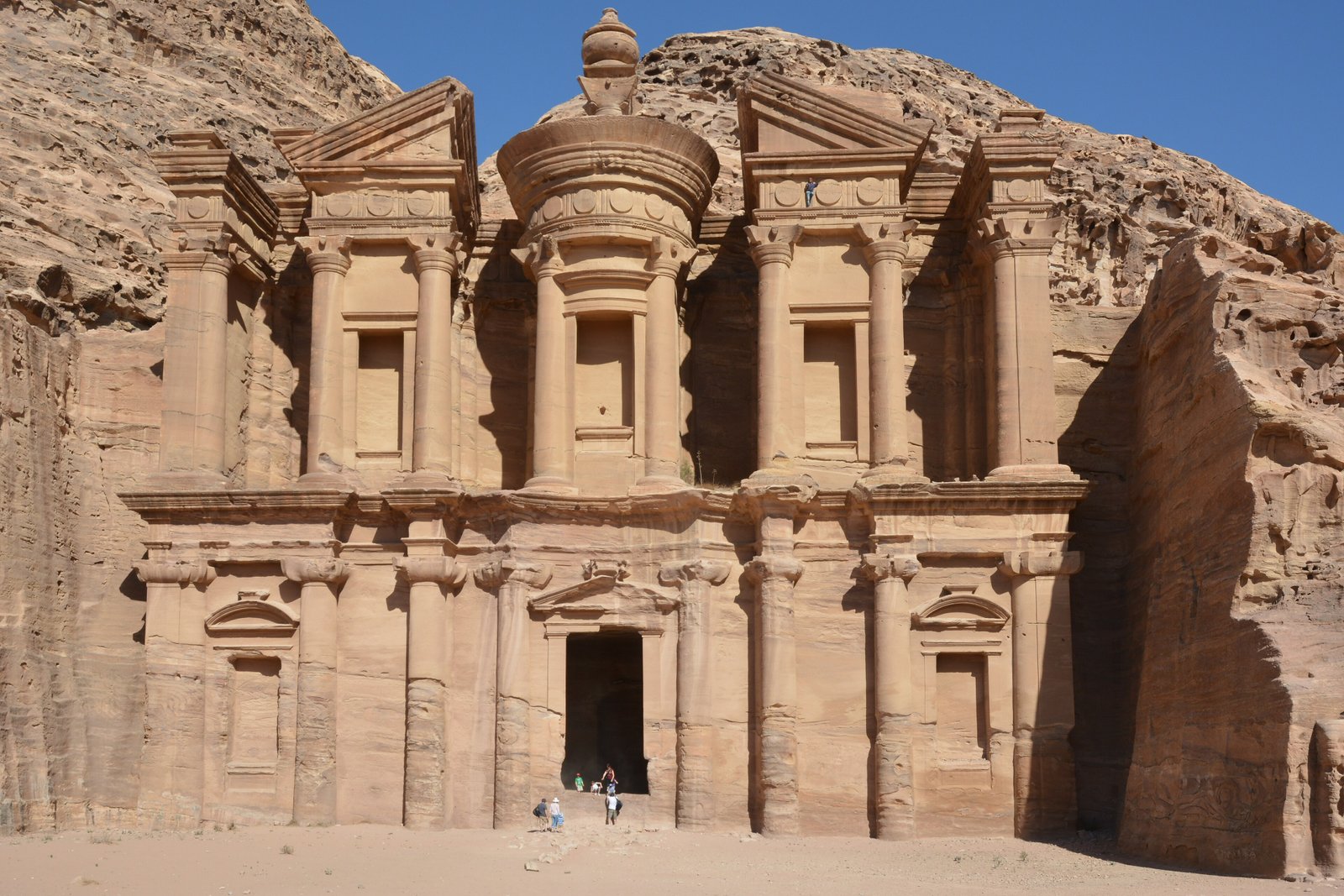
Petra
Carved directly into rose-red sandstone cliffs by the Nabataean Arab kingdom, Petra was a city of 20,000 that controlled the ancient incense trade routes between Arabia, Egypt, and Rome — and whose greatest monument served as the Holy Grail’s hiding place in a 1989 film seen by hundreds of millions.
At a glance
Petra, known to its Nabataean founders as Raqmu, occupies a sandstone plateau in southern Jordan ringed by mountains and accessible through a 1.2-kilometre slot canyon called the Siq. At its height in the 1st century BC, the city housed more than 20,000 people and managed the most lucrative long-distance trade network of the ancient Near East — frankincense and myrrh from Arabia, silk from China, spices from India, and copper from Sinai all passed through its markets. The Nabataeans were also hydraulic engineers of the first rank: a system of dams, cisterns, and ceramic pipes allowed them to harvest flash-flood water and sustain a city in an otherwise waterless desert. More than 800 individual monuments survive, including tombs, temples, colonnaded streets, a Roman-era theatre cut for 8,500 spectators, and the iconic Al-Khazneh (The Treasury), whose 40-metre facade was carved in a single piece of sandstone in the 1st century BC.
Key facts
- Founded: c. 4th century BC (Nabataean Arab kingdom)
- UNESCO inscription: 1985
- New Seven Wonders: 2007 (popular vote)
- Scale: 264 sq km protected area; over 800 individual monuments
- Al-Khazneh: 40 m high, 28 m wide; carved c. 1st century BC–1st century AD
- Film appearances: Indiana Jones and the Last Crusade (1989, dir. Steven Spielberg) — Al-Khazneh as the “Canyon of the Crescent Moon / Temple of the Holy Grail”; Transformers: Revenge of the Fallen (2009); The Mummy Returns (2001); Mortal Kombat: Annihilation (1997); Syriana (2005)
- Access: Petra Archaeological Park, daily 06:00–18:00 (summer); admission JOD 50 (1 day), JOD 55 (2 days), JOD 60 (3 days)
History
The Nabataeans were a nomadic Arab people who settled the Petra basin by the 6th century BC, gradually transforming it from a fortress refuge into a major caravan city. By the 1st century BC, under kings such as Aretas III (r. 87–62 BC) — who styled himself on Hellenistic coins as “Philhellene” — and Aretas IV (r. 9 BC–40 AD), Petra had become the capital of a kingdom stretching from the Sinai to the Hejaz. The Nabataean script, an Aramaic-based writing system used at Petra, is the direct ancestor of modern Arabic script. Their religion centred on male and female deities carved as simple rectangular blocks — the visual austerity of which contrasts sharply with the theatrical complexity of their carved facades.
The Romans annexed the Nabataean kingdom in 106 AD under Emperor Trajan, renaming it the province of Arabia Petraea with its capital at Bosra in present-day Syria. Petra continued to function as an important city under Roman rule — a colonnaded main street, the Cardo Maximus, was laid over the earlier Nabataean market quarter, and a large Byzantine church with floor mosaics was added in the 5th century. A sequence of major earthquakes in 363 and 551 AD severely damaged Petra’s water infrastructure, and the city shrank progressively as trade routes shifted northward. The Crusaders under Baldwin I briefly occupied it in 1100–1116, building a small fortress on a ridge above the ruins. By the 8th century the city had effectively been abandoned, known only to the Bdoul Bedouin who lived among and within its rock-cut chambers.
Swiss-born explorer Johann Ludwig Burckhardt reached Petra on 22 August 1812 by disguising himself as an Arab pilgrim intending to make a sacrifice at Aaron’s tomb above the city. He was thus the first European traveller since the Crusades to record the site. His brief account, published posthumously in 1822, sparked intense scholarly and popular interest in the West. Systematic archaeological study began with the Palestine Exploration Fund expeditions of the 1890s and has continued without interruption, with major excavation campaigns by Brown University, the Jordanian Department of Antiquities, and the American Center of Oriental Research revealing new structures as recently as 2016, when a large monumental platform was identified via satellite imagery south of the main colonnaded street.
What you see
The canonical approach to Petra passes through the Siq — a fault-line canyon whose walls narrow to as little as 3 metres and rise to 80 metres overhead. The sandstone walls record visible strata of pink, ochre, and purple, and the Nabataeans cut niches and small relief carvings into the rock at intervals along the route. After approximately 1.2 kilometres, the Siq opens abruptly onto Al-Khazneh: the sudden transition from narrow gorge to open plaza in front of a 40-metre Hellenistic façade is one of the most formally choreographed spatial experiences in the ancient world, arguably designed by the Nabataeans themselves as a processional revelation. Al-Khazneh (Arabic for “treasury,” named from a Bedouin legend that a pharaoh had hidden wealth in the stone urn at the top of its second storey) is believed by most archaeologists to be the tomb of Aretas IV. The urn shows pockmarks from rifle fire — Bedouin attempts to release the imagined treasure.
In Indiana Jones and the Last Crusade (1989), the Siq approach and the Al-Khazneh façade served as the “Canyon of the Crescent Moon,” the location of the Holy Grail. Spielberg’s production designer, Elliot Scott, used the actual Khazneh exterior for the approach sequence; the interior chamber where the Grail knight waits was a set built at Elstree Studios. The lower chamber seen in the film does not exist in reality — the monument’s interior consists only of a small undecorated room, no deeper than 10 metres. The film used selective camera placement to compress the scale of the approach, making the Siq appear to open directly onto the Khazneh, whereas in reality a small plaza and bazaar area intervene.
Practical information
- Opening hours: Daily 06:00–18:00 (winter); 06:00–20:00 (summer); Petra by Night (Mon/Wed/Thu, 20:30–22:30, JOD 17 additional)
- Best time to visit: March–May and September–November; avoid July–August (heat, 35–40°C); winter evenings are cold
- Duration: Minimum 1 full day for main circuit (Al-Khazneh + Royal Tombs + Colonnade + Qasr al-Bint); 2 days to include Al-Deir monastery and the High Place of Sacrifice
- Tip: Al-Deir (the Monastery), reached by a 45-minute climb of 800 steps, is larger than Al-Khazneh and sees far fewer visitors; the climb is worthwhile for both the monument and the plateau view over Wadi Araba toward Israel.
Getting there
Queen Alia International Airport (AMM), Amman, is the main entry point for Jordan; the drive south to Petra takes approximately 3 hours on the Desert Highway or 4 hours via the scenic Kings Highway. Aqaba Airport (AQJ), near the Red Sea coast, is 1.5 hours south of Petra and serves some budget and charter routes. The nearest town, Wadi Musa, has hotels at all price points; the visitor centre and main gate are at its southern end. JETT buses run daily from Amman’s Abdali Bus Station to Wadi Musa (approximately 3.5 hours). No direct rail service exists to the Petra region.
Nearby
- Little Petra (Siq al-Barid) (8 km north) — a smaller Nabataean suburb with carved facades, a painted dining room, and none of the crowds
- Wadi Rum (60 km south) — vast protected desert landscape of sandstone pillars and dunes; featured in Lawrence of Arabia (1962) and The Martian (2015)
- Aqaba (135 km south) — Jordan’s only Red Sea port, with diving on coral reefs and easy crossings to Egypt’s Sinai
- Dana Biosphere Reserve (50 km north) — Jordan’s largest nature reserve, with hiking trails through four climatic zones from highland plateau to desert
Sources
- Wikipedia, “Petra” — en.wikipedia.org/wiki/Petra
- UNESCO World Heritage Centre, “Petra” — whc.unesco.org/en/list/326
- Petra Archaeological Park official site — visitpetra.jo
- Schmid, S.G. & Nehmé, L. (2010). The Nabataeans and the Graeco-Roman World. In: Nabataean Studies.
Find it on the map
See this place and what’s around it →Historical events at this place (1)
📷 Diventa un fotografo di Cultural Heritage Online
Condividi le tue foto dei luoghi: restano pubblicate con la tua firma come autore. Più vengono viste, più ti fai conoscere — e presto un concorso premierà le foto più apprezzate.
Accedi o registrati gratis per aggiungere una foto