
Lalibela
In the highlands of northern Ethiopia, King Lalibela directed stonemasons to carve eleven churches not from stone blocks but downward through the living rock itself — creating monolithic sanctuaries that emerged from the earth as if poured in rather than built up, and still receive barefoot pilgrims walking the same sunken trenches the original craftsmen dug eight centuries ago.
At a glance
Lalibela is a small town in the Amhara region of northern Ethiopia, sitting at approximately 2,500 metres above sea level in the Lasta highlands. Its eleven rock-hewn churches are not constructed from cut and stacked stone blocks: they are excavated downward from solid volcanic tuff, leaving free-standing monolithic structures surrounded by deep trenches and connected by underground tunnels. The churches are arranged in two main groups, northern and southeastern, with Bete Giyorgis standing alone to the southwest. All eleven are still active Ethiopian Orthodox churches, their priests robed in white, their precincts circulated by pilgrims during the major feasts. UNESCO inscribed Lalibela as a World Heritage Site in 1978.
King Lalibela and the New Jerusalem
The churches are traditionally attributed in their entirety to the reign of King Gebre Meskel Lalibela of the Zagwe dynasty, who ruled approximately 1181–1221 AD. Ethiopian tradition holds that the king was guided in the project by an angel, and that the construction proceeded not only by human hands but by celestial workers who continued the carving at night while human masons slept. Art historians and archaeologists place the construction more broadly across the 7th to 13th centuries, with the most intensive phase likely in the late 12th century under Lalibela’s rule; some scholars argue that a few churches pre-date his reign.
The most significant interpretive key is the “New Jerusalem” theory. In 1187, Saladin’s forces captured Jerusalem, cutting off Ethiopian Christian pilgrimage to the holy sites. Tradition holds that King Lalibela responded by creating a symbolic Jerusalem in the Ethiopian highlands — the churches and their arrangement echo the holy topography: the Yordanos River flowing through the complex represents the Jordan; Golgotha church and its adjacent Selassie chapel occupy the position of the Church of the Holy Sepulchre; Bete Medhane Alem’s massive scale echoes the Cathedral of Hagia Sofia. Whether this symbolic program was original or was retrospectively layered onto an earlier construction is actively debated, but the spatial analogy is widely accepted as deliberate.
What the chisels made: the 11 churches
The northern group contains the largest churches. Bete Medhane Alem (House of the Saviour of the World) is the largest rock-hewn church in the world: 33.5 metres long, 23.5 metres wide, and 11.5 metres high, with a colonnaded exterior that mimics a carved version of a Classical temple. Its 72 columns recall the 72 columns of the Dwarkadhish Temple and, more immediately, the 72 disciples of Christ. Bete Maryam (House of Mary) is the most elaborately decorated, its ceilings and walls covered with painted geometric and figural patterns, including a cross inside a cross inside a Star of David. Bete Golgota contains life-size carved reliefs of saints and a tomb that tradition identifies as King Lalibela’s own.
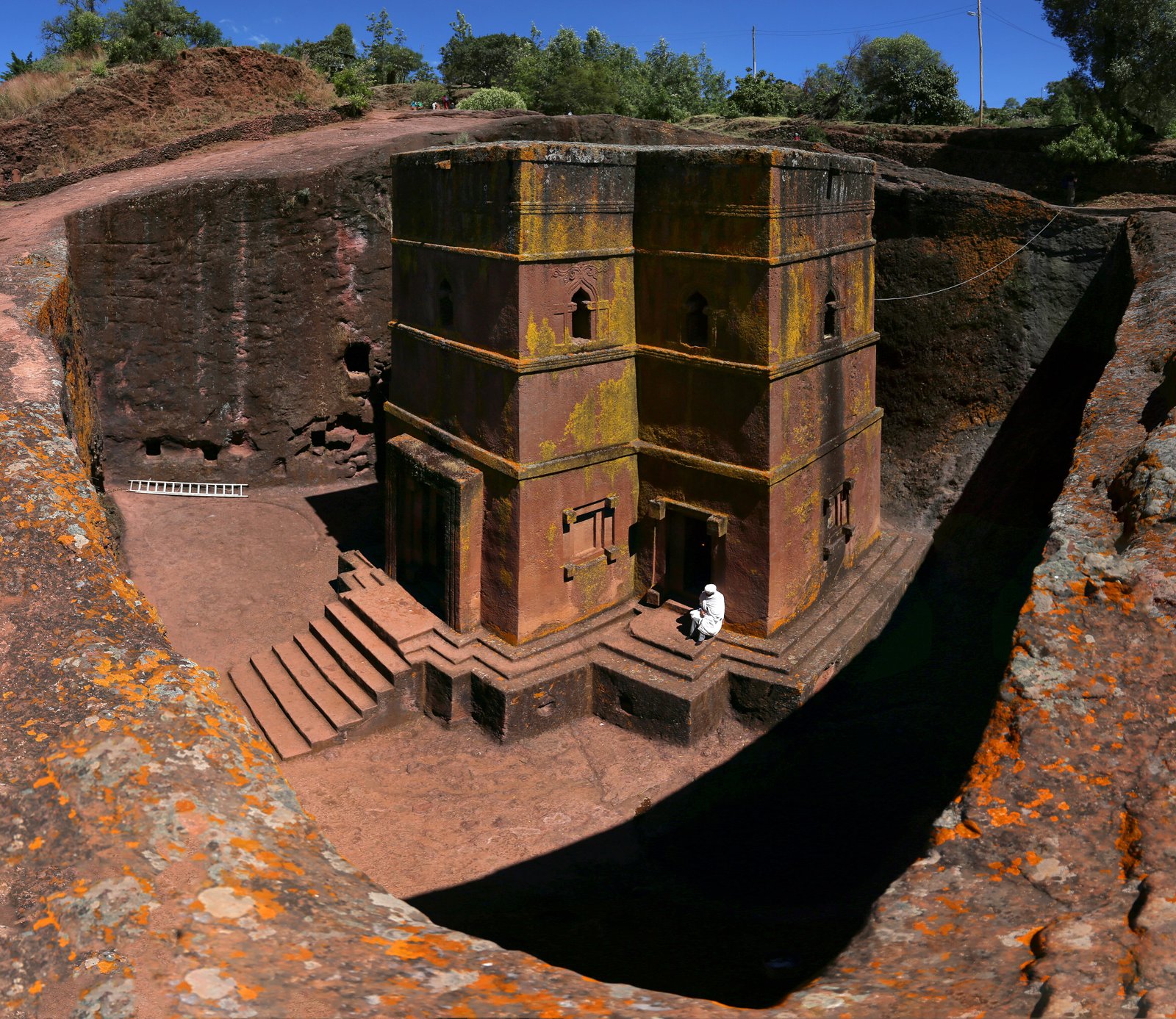
Bete Giyorgis (House of St. George), standing alone to the southwest and connected to the other churches by a tunnel, is the most photographed and technically astonishing. It is a perfect cube, approximately 12 metres on each side and 12 metres deep, cut cleanly from the surrounding tuff until only a single cruciform structure remained, its top flush with the earth surface. The roof is decorated with three interlocking Greek crosses in raised relief: from the air, what appears to be a sunken square reveals itself as a sealed letter, its address cut into the stone. The church was the last built in the complex, commissioned by King Lalibela after seeing the others and deciding that St. George — patron saint of Ethiopia — had been inadequately honoured.
Living faith: pilgrimage at Lalibela
Lalibela is not a museum. The eleven churches hold daily services; the sunken trenches are walked each morning by priests in embroidered vestments carrying gold crosses and illuminated manuscripts bound in wood. During the major Ethiopian Orthodox feasts, Lalibela draws pilgrims from across the country who camp on the hillsides around the complex for days. The most important are Genna (Ethiopian Christmas, January 7 by the Gregorian calendar), when pilgrims in white cotton robes circle the churches chanting through the night, and Timkat (Epiphany, January 19), when the tabot — the replica of the Ark of the Covenant that each church keeps in its sanctum — is carried in procession. For Timkat, tens of thousands of pilgrims converge on Lalibela. The noise of the ritual drums and the smell of frankincense fill the trenches from the night before.
Research and controversy
Systematic archaeological study of Lalibela is relatively recent. The Italian archaeologist and Ethiopianist Carlo Conti Rossini conducted early studies in the 1920s; the French archaeologist Francis Anfray led the first rigorous documentation campaigns in the 1960s and 1970s, contributing to the UNESCO inscription. The hypothesis that some churches significantly pre-date King Lalibela was argued most forcefully by the art historian David Phillipson (Cambridge University), whose 2009 monograph Ancient Ethiopia examined the structural and stylistic evidence for a multi-century construction history. Ethiopian Orthodox tradition maintains that all eleven were built within Lalibela’s reign; this remains the official position of the Ethiopian Orthodox Tewahedo Church.
The UNESCO reinforcement project of 2008, which installed metal-roofed shelter structures over several of the churches to protect them from rain erosion, has generated controversy among architects and conservationists. The shelters are visually intrusive and alter the experience of the sunken trenches; critics argue that less obtrusive methods of water management should have been prioritised. The shelters remain in place.
Practical information
- Best time to visit: October to March (dry season); avoid June–September (heavy rains). January brings major festivals (Genna Jan. 7, Timkat Jan. 19) — extraordinary to witness but extremely crowded
- Getting there: Lalibela Airport has direct flights from Addis Ababa (Ethiopian Airlines, approx. 1 hour). The town is also accessible by road from Dessie (c. 5 hours) or Axum (c. 7 hours)
- Admission: Entry to the church complex requires a ticket purchased at the main gate; the ticket covers all eleven churches and is valid for multiple days. Shorts and bare shoulders are not permitted inside; visitors must remove shoes in all churches
- Guides: Local licensed guides are strongly recommended; they carry oil lamps into the unlit interiors and know which priests can show the illuminated manuscripts and ceremonial objects stored inside
- Altitude: At 2,500m, altitude sickness is possible in visitors arriving from sea level; plan an acclimatisation day if flying from Addis Ababa (2,355m) directly to Lalibela
Key facts
- Location: Lalibela, Amhara Region, Ethiopia; 12.0320 N, 39.0470 E; altitude ~2,500m
- Construction: 7th–13th century; attributed to King Gebre Meskel Lalibela (r. c. 1181–1221 AD), Zagwe dynasty
- Method: 11 churches carved downward into solid volcanic tuff — monolithic, not assembled from blocks
- Largest church: Bete Medhane Alem: 33.5m × 23.5m × 11.5m; largest rock-hewn church in the world
- Most iconic: Bete Giyorgis: 12m cube, 12m below ground, roof decorated with three interlocking Greek crosses
- Status: UNESCO World Heritage Site (1978); active Ethiopian Orthodox churches
- Key scholar: David Phillipson (Cambridge); Francis Anfray (French Archaeological Mission)
Find it on the map
See this place and what’s around it →📷 Diventa un fotografo di Cultural Heritage Online
Condividi le tue foto dei luoghi: restano pubblicate con la tua firma come autore. Più vengono viste, più ti fai conoscere — e presto un concorso premierà le foto più apprezzate.
Accedi o registrati gratis per aggiungere una foto