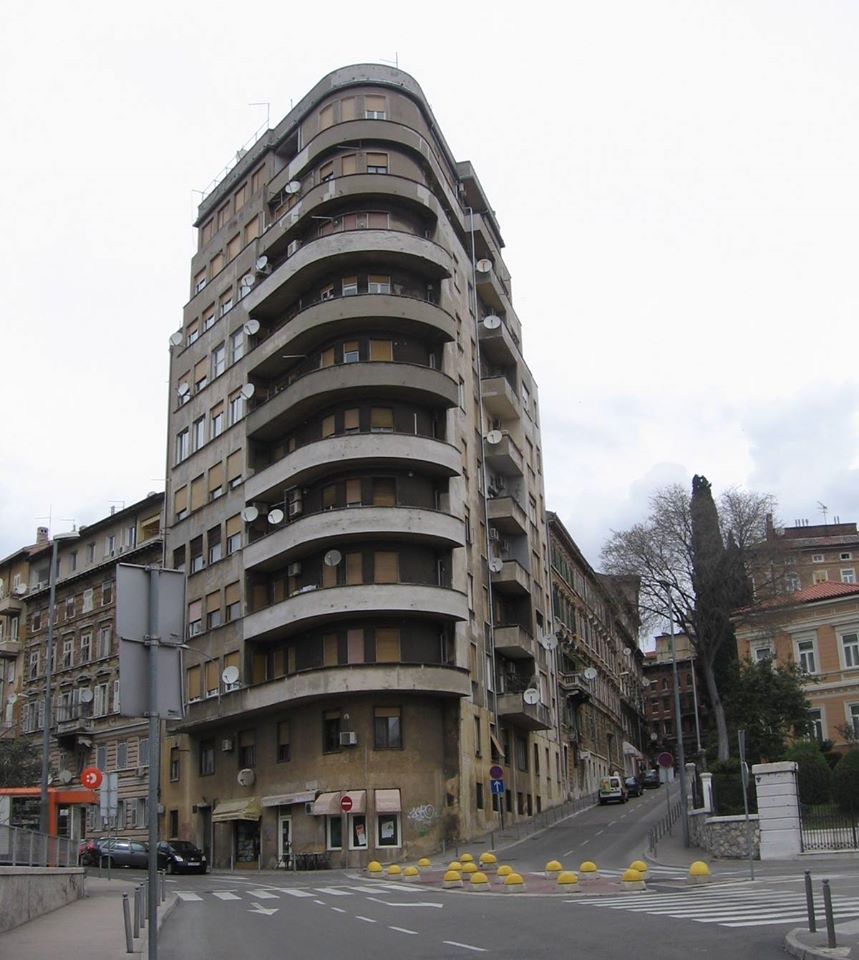
The Grattacielo Piccolo in Fiume was designed by Italian engineer Raoul Puhali and completed in 1940. Located at via Carducci 20, the building represents a significant architectural undertaking for its era and period.
Constructed during Italy’s interwar modernization, the structure incorporated functional innovations, including a small shelter-bunker in its basement. The building survived the extensive Allied bombing campaigns that caused considerable damage to Fiume during World War II, making it a rare architectural survivor of the conflict in the city.
About Raoul Puhali
Raoul Puhali (1904–1980) was an architect and engineer trained at the University of Vienna, where he earned his degree in 1928. Born in Pola, he spent his formative years in Fiume and established his professional practice there during the 1930s. The Grattacielo Piccolo represented the culmination of his early career. Following 1945, Puhali was among the 350,000 Istrian, Fiumian, and Dalmatian exiles who left the region and relocated to Trieste, where he contributed to numerous civic buildings including cinemas and residential structures.
Details
- Designed by engineer Raoul Puhali
- Completed 1940
- Location: via Carducci 20, Fiume, Croatia
- Features basement shelter-bunker
- Survived Allied bombing in World War II
Frequently asked questions
Who designed the Grattacielo Piccolo?
The building was designed by Raoul Puhali, an Italian architect and engineer trained in Vienna who established his professional practice in Fiume during the 1930s.
What makes this building historically significant?
The structure was a notable architectural achievement for Fiume in 1940 and was one of the few major buildings to survive the extensive Allied bombing campaigns that devastated the city during World War II.
What happened to the architect after the war?
Puhali was among approximately 350,000 Istrian, Fiumian, and Dalmatian exiles forced to leave in 1945, after which he relocated to Trieste and continued his architectural career there.
Sources
- S1 — Ciucci, Giorgio. Gli architetti e il fascismo: architettura e città 1922-1944. Einaudi, 1989. ISBN 978-88-06-11656-9.
- S2 — Danesi, Silvia, and Luciano Patetta, eds. Il razionalismo e l'architettura in Italia durante il fascismo. Electa, 1976. ISBN 978-88-435-0394-0.
Spotted an error? Write to editorial@culturalheritageonline.com and we correct it the same day.