
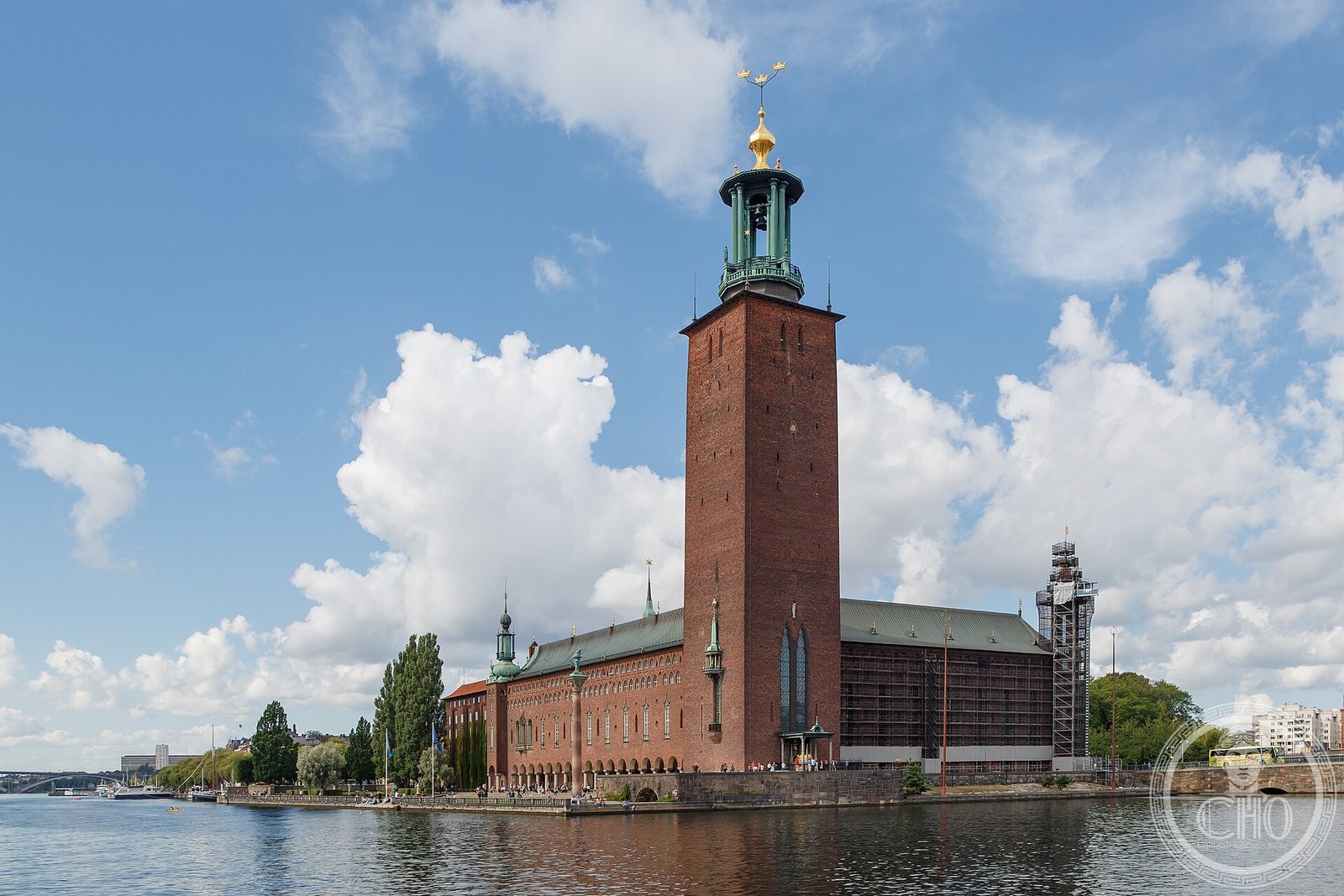
In thirty years Stockholm moved through three architectural ages: the brick romance of Östberg’s City Hall, the cool geometry of Asplund’s Nordic Classicism, and the glass-and-steel optimism of the 1930 exhibition that brought Functionalism to Sweden. The buildings are still here, and they still read as one continuous argument about how a modern city should look.
At a glance
Stockholm’s modern architecture is best read as a sequence. It opens with the Stockholm City Hall (Stadshuset), Ragnar Östberg’s National Romantic masterpiece on the Kungsholmen waterfront, built between 1911 and 1923. It continues with Gunnar Asplund, whose Stockholm Public Library of 1928 gave Nordic Classicism its single most quoted building and whose Woodland Cemetery, designed with Sigurd Lewerentz, is a UNESCO World Heritage Site. It culminates in the Stockholm Exhibition of 1930, the fair Asplund and Lewerentz designed to announce Functionalism — funkis — to a Swedish public. Three styles, three landmarks, one walkable city.
Key facts
- Country: Sweden (capital city)
- Key period: 1911–1940 (National Romanticism → Nordic Classicism → Functionalism)
- Key figures: Ragnar Östberg (City Hall) and Gunnar Asplund (1885–1940) — library, cemetery and the 1930 exhibition, often with Sigurd Lewerentz
- Essential sites: Stockholm City Hall (Stadshuset), Stockholm Public Library (Stadsbiblioteket), Woodland Cemetery (Skogskyrkogården, UNESCO)
- Turning point: the Stockholm Exhibition of 1930 (Stockholmsutställningen) launched Functionalism in Sweden
- Annual fixture: the Nobel Prize banquet is held in the City Hall’s Blue Hall
History
The Stockholm City Hall was the project that announced Sweden’s architectural ambition. Ragnar Östberg won the competition and built it between 1911 and 1923 in the National Romantic style, a movement that prized national symbolism, handmade brick and a free reading of older traditions over academic correctness. Its 106-metre tower, crowned with the Three Crowns of the Swedish national emblem, became an instant symbol of the city. The building was inaugurated on 23 June 1923 and remains one of Stockholm’s defining monuments.
The next chapter belonged to Gunnar Asplund, born in Stockholm in 1885. His Stockholm Public Library, constructed between 1924 and 1928, is the canonical work of Nordic Classicism: a stripped, geometric architecture whose great cylindrical reading room sits on a square base. The building’s clarity was admired across the Nordic countries and influenced the young Alvar Aalto in neighbouring Finland. In parallel, from 1914 onward, Asplund worked with Sigurd Lewerentz on the Woodland Cemetery, a landscape of pine, path and chapel that is now considered one of the masterpieces of modern architecture and a UNESCO World Heritage Site.
Then the language changed. For the Stockholm Exhibition of 1930, Asplund and Lewerentz built a temporary fair of glass-and-steel pavilions that broke decisively with classicism and put Functionalism on public display. The exhibition is remembered as the moment Swedish architecture turned modern; Asplund’s own career, like his Gothenburg City Hall extension completed in 1937, traces the same arc from neoclassical to functionalist. He died in Stockholm in 1940, aged 55.
What you see
The City Hall rewards a slow approach from the water: the long brick façades, the arcaded courtyard and the tower that can be climbed by lift or by a 365-step staircase. Inside, the Blue Hall — paradoxically left in bare brick, its name inherited from Östberg’s first sketch — hosts the Nobel banquet each December, and the Golden Hall above it is lined with mosaics of more than eighteen million tiles depicting Swedish history.
Asplund’s Public Library, north of the centre, is best understood from its rotunda: walk into the tall drum of the lending hall, ringed with books, and the logic of Nordic Classicism is immediately legible. The Woodland Cemetery, south of the city and reachable by metro, is a different experience again — an architecture made as much of landscape, grass and tree-line as of built form.
Practical information
- Stockholm City Hall: interiors visited by guided tour only; the tower opens seasonally — check current times before visiting
- Stockholm Public Library: a working public library; the rotunda is freely accessible during opening hours
- Woodland Cemetery (Skogskyrkogården): open as a public landscape; reached by the green metro line to Skogskyrkogården station
- Time needed: a full day to take in all three; half a day for the City Hall and Library together
Getting there
Stockholm Arlanda Airport (ARN) lies about 40 km north of the centre; the Arlanda Express train reaches Stockholm Central Station in roughly twenty minutes. From Central Station the City Hall is a short walk across to Kungsholmen, while the Public Library and the Woodland Cemetery are both on the city’s metro network. The compact centre makes a walking circuit of the City Hall and Library straightforward.
Related in CHO
- Helsinki — Alvar Aalto and Nordic Functionalism
- Ålesund — The Art Nouveau Town Reborn from Fire
- Berlin & Dessau — Gropius, the Bauhaus and German Modernism
- Vienna — Capital of the Vienna Secession
Sources
Find it on the map
See this place and what’s around it →📷 Become a Cultural Heritage Online photographer
Share your photos of places: they stay published under your name as the author. The more they're seen, the more you get noticed — and soon a contest will reward the most appreciated photos.
Log in or sign up free to add a photo