
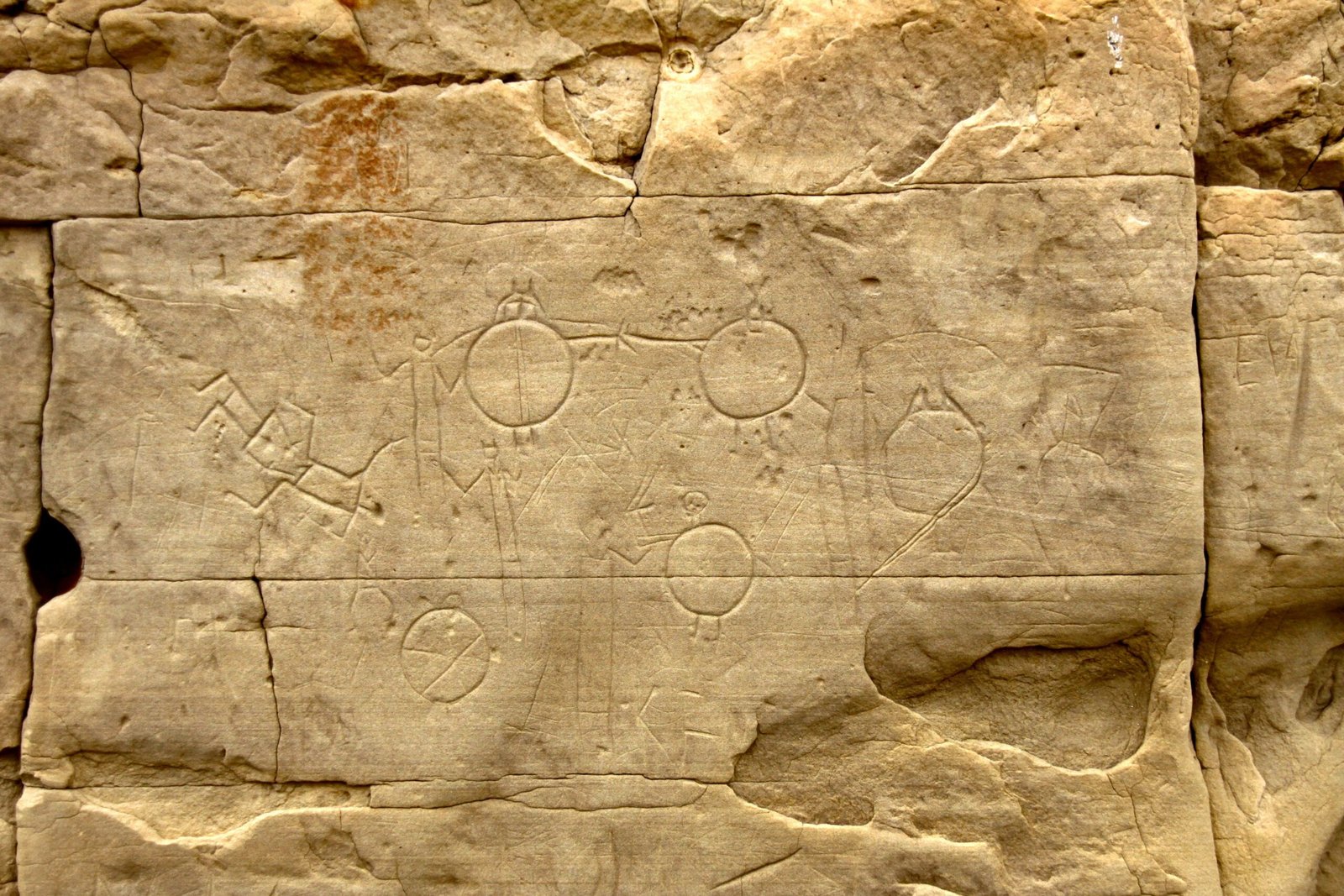
The largest concentration of rock art on the North American Great Plains — three thousand years of Blackfoot sacred imagery carved and painted into the sandstone hoodoos of a river valley that remains holy to this day.
At a glance
Writing-on-Stone / Áísínai’pi is a sacred cultural landscape on the Milk River in southern Alberta, Canada, containing the densest concentration of First Nations rock art (petroglyphs and pictographs) on the North American Great Plains. Over 50 individual rock art sites and thousands of images — carved and painted into the dramatically eroded sandstone hoodoos and canyon walls of the Milk River valley — document approximately 3,000 years of Blackfoot Confederacy cultural and spiritual life. The site was inscribed on the UNESCO World Heritage List in 2019 and is co-managed by Parks Canada and the Blackfoot Confederacy (comprising the Kainai, Siksika, and Piikani Nations). Áísínai’pi — meaning “it is written here” or “where it is written on the stone” in Blackfoot — remains an active place of ceremony and spiritual significance.
Key facts
- UNESCO inscription: 2019
- Location: Milk River valley, southern Alberta, Canada; near the town of Milk River, 100 km south of Lethbridge
- Blackfoot name: Áísínai’pi — “it is written here” / “where it is written on the stone”
- Period: c. 1000 BCE–1880s CE; most intensive use c. 1730 CE onward (post horse re-introduction)
- Rock art type: Both petroglyphs (incised/carved) and pictographs (painted); over 50 sites, thousands of individual images
- Subject matter: Horses, bison, human figures, shields, battle scenes, spiritual beings, ceremonial imagery
- Co-management: Parks Canada + Blackfoot Confederacy (Kainai, Siksika, Piikani Nations)
- Status: Actively sacred to Blackfoot peoples; some ceremonial areas restricted to Indigenous visitors
History
The Milk River valley has been a site of spiritual significance for the peoples of the northern Great Plains for at least 3,000 years. The dramatic landscape — sandstone cliffs and hoodoos (eroded pillars) carved by the river into fantastical forms, sheltering the valley from the open prairie — was understood by the Blackfoot as a place where the spirit world was accessible, where visions were sought and received, and where significant events were recorded in stone. The earliest images at the site are difficult to date precisely, but the tradition of incising and painting images into the sandstone continued into the historic period and is documented in oral traditions maintained by contemporary Blackfoot communities.
The most historically legible images were created after approximately 1730 CE, when the horse was reintroduced to the northern Plains by Indigenous trading networks extending from Spanish colonial New Mexico. The arrival of the horse transformed Plains warfare, hunting, and social organisation within a generation. At Writing-on-Stone, the post-horse images are extraordinary: detailed battle narratives carved into the cliff faces show mounted warriors in combat, with shields, guns (appearing in images after the 1730s–1780s), and horses rendered with striking observational accuracy. These images constitute the most detailed surviving visual record of inter-tribal Plains warfare on the Canadian prairies — a historical archive in stone created by the very peoples who fought the battles depicted.
The site was well known to European explorers and settlers from the early 19th century, who named it “Writing-on-Stone” in reference to the carvings. A North-West Mounted Police post was established near the site in 1887 to monitor the Canada–US border, and the area became a provincial park in 1957. The Blackfoot Confederacy’s sustained advocacy for formal recognition of Áísínai’pi’s sacred status and cultural significance culminated in the 2019 UNESCO inscription and the establishment of a collaborative management framework that gives the Blackfoot Nations formal authority over cultural protocols at the site.
What you see
The landscape of Áísínai’pi is extraordinary in itself: the Milk River has cut a valley 20–30 metres deep into the flat prairie, exposing layers of Cretaceous sandstone that have been eroded by wind and water into hoodoos — free-standing sandstone pillars and mushroom-shaped pedestals — and into overhanging cliff faces that shelter the rock art. The valley is a visually startling rupture in the surrounding shortgrass prairie, its ochre and cream sandstone contrasting with the blue sky and the cottonwood trees along the river.
The rock art itself is concentrated on the canyon walls and hoodoo faces. Petroglyphs are created by percussion and abrasion — the surface of the sandstone is pecked away to expose the lighter stone beneath, creating images that stand out against the weathered outer surface. Pictographs are painted in ochre (red and yellow iron oxide), charcoal, and white calcium-based pigments. The imagery ranges from abstract geometric forms through animal and human figures to complex narrative compositions. The most visited and extensively documented panels show post-1730 CE battle scenes: mounted warriors with muskets, shields decorated with personal medicine bundles, and enemies rendered in detail that allows scholars to identify tribal affiliations from shield designs and clothing. Parks Canada guides lead interpretive tours to accessible panels; some areas containing particularly sacred imagery are accessible only to Blackfoot peoples for ceremonial purposes.
Practical information
- Opening hours: Writing-on-Stone Provincial Park — year-round; visitor centre open May–September, daily 10:00–18:00
- Admission: Alberta provincial park day-use fee applies (approximately CAD 5 per vehicle); camping available in the park
- Guided tours: Strongly recommended; rock art hoodoo tours led by trained park interpreters (book in advance, especially July–August); some tours co-led by Blackfoot knowledge-keepers
- Access to rock art: Most rock art is within a protected archaeological preserve; independent access requires a guided tour
- Cultural protocols: Visitors are asked to treat the site with respect as an active sacred place; no touching of rock art; photography protocols vary by area — follow guide instructions
- Best season: May–September for full interpretive services; the valley is accessible and strikingly beautiful in autumn
Getting there
Writing-on-Stone Provincial Park is located approximately 100 km south of Lethbridge, Alberta, and 44 km east of Milk River town via Highway 501. From Lethbridge: take Highway 4 south to Milk River, then Highway 501 east for 44 km. From Calgary: approximately 2.5 hours south on Highway 2 to Lethbridge, then as above. There is no public transport to the park; a private vehicle is essential. The nearest commercial airport is Lethbridge County Airport (YQL). Note the park is very close to the Canada–US border; US visitors entering from Montana can cross at the Del Bonita or Coutts border crossings.
Nearby
- Head-Smashed-In Buffalo Jump — 130 km northwest; UNESCO World Heritage Site (1981), one of the world’s oldest and best-preserved buffalo jump sites, also related to Blackfoot cultural history
- Lethbridge — 100 km north; largest city in southern Alberta; Nikka Yuko Japanese Garden and Galt Museum
- Waterton Lakes National Park — 100 km northwest; UNESCO World Heritage Site (Waterton-Glacier International Peace Park); spectacular Rocky Mountain scenery on the Canada–US border
- Milk River Badlands — the immediate surrounding landscape offers hiking along the river valley and above the prairie rim
Sources
Find it on the map
See this place and what’s around it →📷 Become a Cultural Heritage Online photographer
Share your photos of places: they stay published under your name as the author. The more they're seen, the more you get noticed — and soon a contest will reward the most appreciated photos.
Log in or sign up free to add a photo