
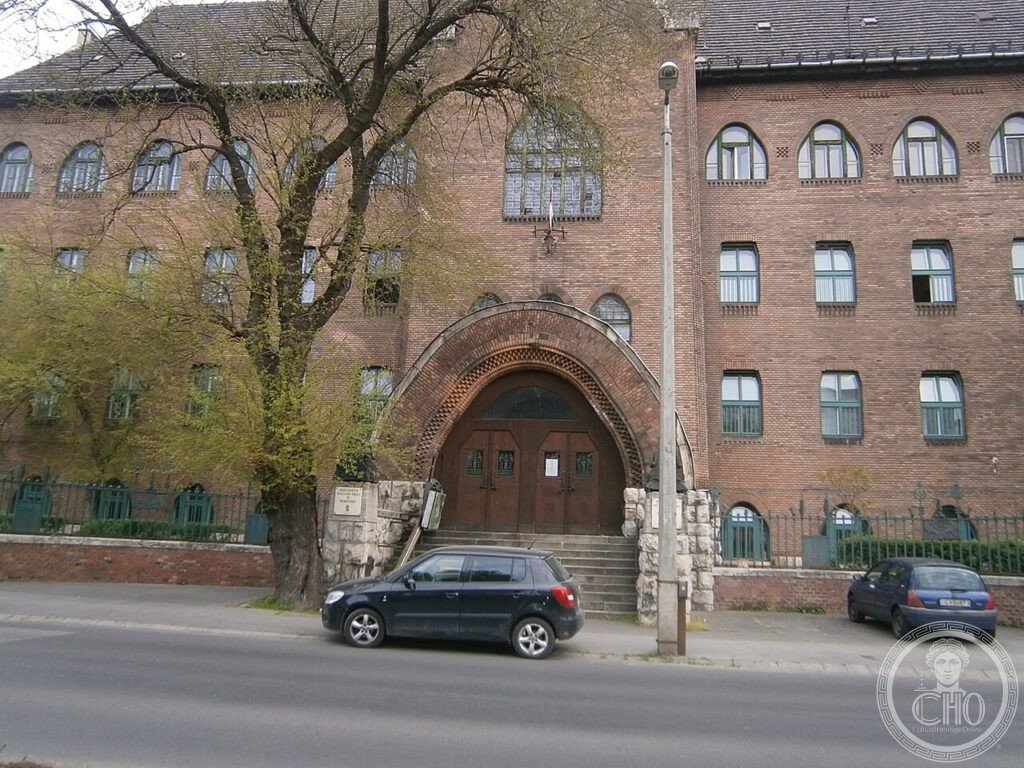

Béla Lajta designed a building its residents could read with their hands: Braille dots worked into the ironwork, quotations in raised script on the column capitals — a school for blind children that remains one of the most humane works of the Hungarian Secession.
At a glance
The red-brick institute at Mexikói út 60, in Budapest’s XIV district, was built between 1905 and 1908 to designs by Béla Lajta, the most original Hungarian architect of the generation after Lechner. It owes its existence to a bequest: the construction contractor Ignác Wechselmann and his wife Zsófia Neuschloss, childless, willed 1.4 million crowns to found an educational institution for blind children. Lajta answered with a building poised between late Secession and early modernism — and threaded through it a decorative programme addressed to its users’ fingertips as much as to any passer-by’s eyes.
Key facts
- Built: 1905–1908
- Architect: Béla Lajta
- Founders: Ignác Wechselmann and Zsófia Neuschloss, by testamentary foundation of 1.4 million crowns
- Original purpose: Boarding institute for blind children
- Signature details: Windows from Miksa Róth’s workshop framed by rivets recalling Braille dots; wrought-iron column capitals carrying quotations in Braille script
- Since the early 1950s: School and dormitory for young people with mobility disabilities (today’s Mozgásjavító school)
- Address: Mexikói út 60, Budapest
- GPS: 47.5155895, 19.0970792 — View on Google Maps
History
Ignác Wechselmann had built much of representative Budapest as the contractor of, among others, the Great Synagogue on Dohány utca; wealthy, he and his wife directed their fortune to a purpose then barely served by the state — the education of blind children. The institute their foundation built opened in 1908 and carried their names. Lajta, then in his early thirties and moving beyond his apprenticeship with Lechner’s national style, treated the commission as an ethical brief: the building had to serve children who would never see it.
The institution served blind pupils until the Second World War and its aftermath swept away the world that had endowed it. Since the early 1950s the building has housed the Mozgásjavító school for young people with mobility disabilities — a continuity of care, if under a different name. Lajta’s architecture survives around its students: the brick mass, the ironwork, the Róth glass. The building stands as both a Secession landmark and a monument of Jewish philanthropy in Budapest.
What you see
Lajta composed the street front in dark red brick — a material he would make his trademark — over massing that already points past the Secession toward the clarity of early modernism. The ornament rewards close attention. The window frames from Miksa Róth’s celebrated workshop sit inside borders of rivets arranged like the dots of Braille cells, translating the alphabet of the residents into the building’s skin. On the wrought-iron column capitals, biblical and Hungarian literary quotations appear in Braille script. Ornamental detail was executed with the sculptor Galambos’s workshop; folk-art geometry, filtered through Lajta’s hand, runs through gates and grilles.
Practical information
- The building is a working school — interiors are not open to casual visitors; the exterior and gates are visible from Mexikói út
- The Braille-dot window frames and capitals are on the street elevation — visible from the pavement without entering
- Respect the school’s daily operation when photographing
Getting there
Mexikói út runs along the eastern edge of Zugló, at the end of the M1 metro line (Mexikói út terminus) — the institute is a few minutes on foot from the station, and trams along Mexikói út stop nearby. From the City Park it is a 15–20 minute walk along the Ajtósi Dürer sor.
Nearby
- Hungarian Geological Institute — Lechner’s blue-roofed institute on Stefánia út, ten minutes south
- Elephant House, Budapest Zoo — the zoo’s Art Nouveau pavilion across the City Park
- Kőrössy Villa — the architect’s own French-style Art Nouveau villa on Városligeti fasor
- Budapest — Ödön Lechner and the Hungarian Szecesszió — the CHO city guide
Sources
- Lajta Béla Virtual Archive (lajta.bparchiv.hu), “Boarding School for Blind Children founded by Ignác Wechselmann and Zsófia Neuschloss” — commission, dates, foundation
- budapestcity.org monument file — building description, Róth windows, Braille capitals, post-1950s use
- Köztérkép (kozterkep.hu) — wrought-iron column capitals with Braille quotations
- Wikidata Q24007916 — coordinates and 1908 completion
Find it on the map
See this place and what’s around it →Record researched and written by Luigi De Marchi for Cultural Heritage Online, 2026.
📷 Become a Cultural Heritage Online photographer
Share your photos of places: they stay published under your name as the author. The more they're seen, the more you get noticed — and soon a contest will reward the most appreciated photos.
Log in or sign up free to add a photoIs this page about you?
This page is read by travellers and heritage enthusiasts who find it on Google. Tell us how you are connected to this place and we will take it from there.