

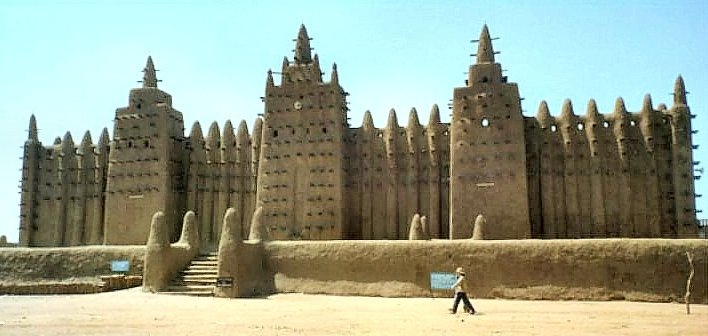
An ancient occupation mound in Mali’s Niger River Valley, Djenné-Djeno ranks among West Africa’s oldest urban centers and most significant archaeological sites, revealing sophisticated trade networks that flourished centuries before external contact.
At a glance
Djenné-Djeno lies three kilometers from the modern town of Djenné. This archaeological site—a mound rising six meters high and covering 33 hectares when first mapped in 1977—provides compelling evidence of early West African civilization. Excavations led by Roderick and Susan McIntosh documented occupation spanning from 250 BC to 1400 AD.
History
The site was likely established by Mande progenitors of the Bozo people, whose occupation extended from the 3rd century BCE through the 14th century CE. Djenné-Djeno contradicts earlier scholarly assumptions that advanced societies and long-distance trade networks in West Africa emerged only after northern traders arrived. Archaeological evidence demonstrates that complex egalitarian civilization, rice domestication, and extensive commerce flourished here independently and well before outside contact.
What you see
The site presents an occupation mound—a stratigraphic record built up over centuries of continuous habitation. Its six-meter elevation and 33-hectare expanse contain layers documenting residential, commercial, and domestic activities across more than 1,600 years of continuous settlement.
Cultural significance
Djenné-Djeno fundamentally altered understanding of West African history. Its evidence of early urbanization, indigenous trade networks, and sophisticated society challenges narratives that positioned the region as culturally dormant before external intervention. The site documents the deep historical roots of Mande and Bozo peoples.
Key facts
- UNESCO World Heritage Site
- Location: Niger River Valley, Mali
- Coordinates: 13.89°N, 4.54°W
- Occupied: 250 BC–1400 AD
- Site area: 33 hectares; mound height: 6 meters
- Excavated primarily by Roderick and Susan McIntosh
Practical information & getting there
The site is located approximately three kilometers from Djenné town in central Mali’s Niger River Valley. As an active archaeological site, visit conditions and access may be restricted; consult local authorities and UNESCO resources before planning a visit.
Sources & resources
Find it on the map
See this place and what’s around it →📷 Become a Cultural Heritage Online photographer
Share your photos of places: they stay published under your name as the author. The more they're seen, the more you get noticed — and soon a contest will reward the most appreciated photos.
Log in or sign up free to add a photoIs this page about you?
This page is read by travellers and heritage enthusiasts who find it on Google. Tell us how you are connected to this place and we will take it from there.