
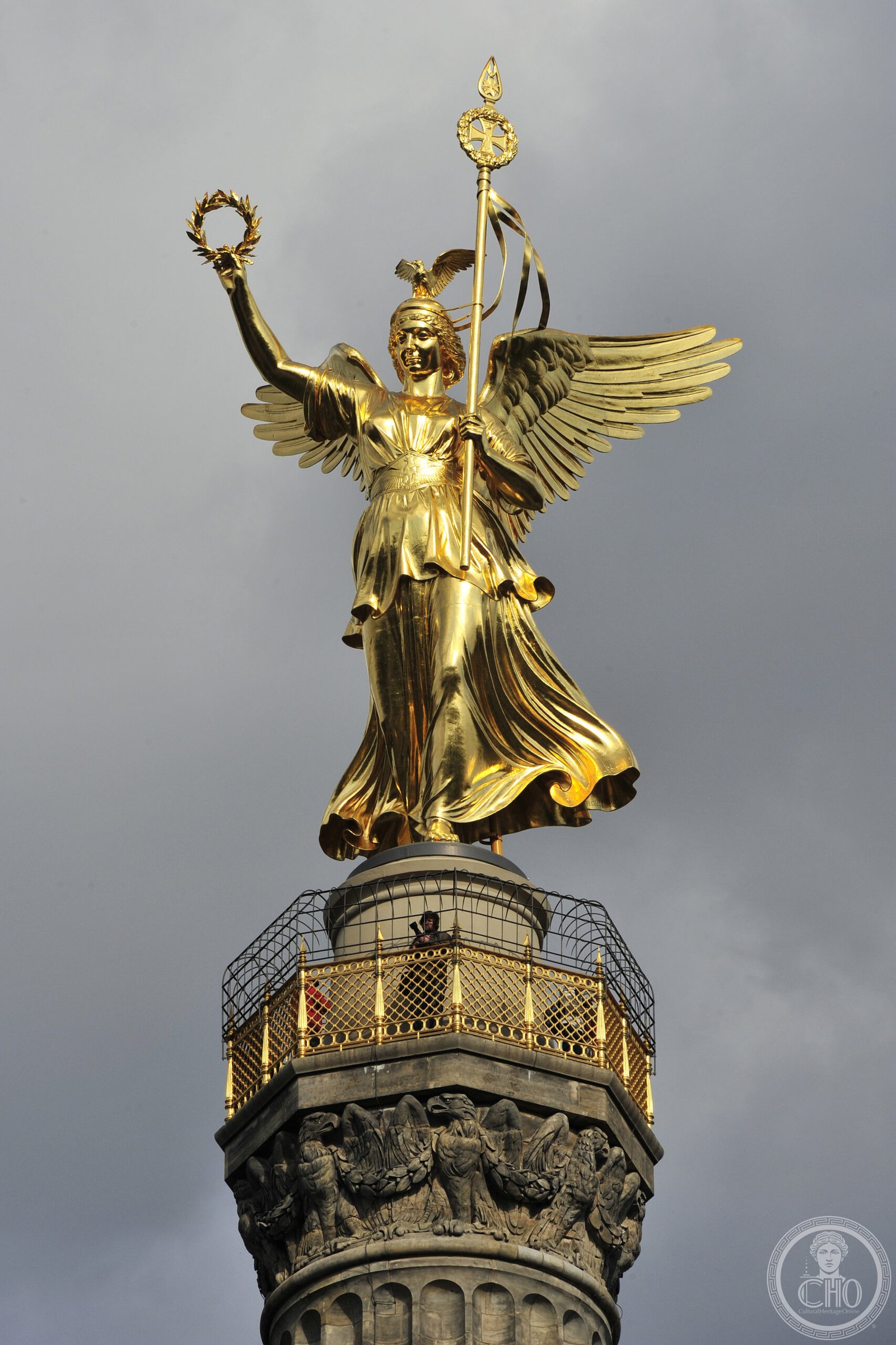
Victory Column
The Victory Column (Siegessäule) is a 67-metre triumphal column in the Tiergarten park of central Berlin, one of the most recognisable landmarks of the German capital. Designed by Heinrich Strack and erected in 1873 to commemorate Prussian military victories over Denmark (1864), Austria (1866), and France (1870–71), it was relocated to its current position in the Großer Stern roundabout by the Nazi government in 1939 as part of Albert Speer’s monumental replanning of Berlin. The gilded bronze figure of Victoria at its summit — nicknamed “Goldelse” by Berliners — is visible from kilometres away.
At a glance
- Type
- Triumphal column with viewpoint platform
- Period
- Inaugurated 2 September 1873; relocated and heightened 1939
- Style
- Historicist / Prussian classicism (Heinrich Strack)
- Location
- Großer Stern, Tiergarten, Berlin, Germany · 52.5145° N, 13.3479° E
Overview
The column shaft is clad in red granite with bronze reliefs depicting the three wars of German unification. The gilded Victoria figure at the top, 8.3 metres tall and cast in bronze by Friedrich Drake, holds a laurel wreath and an Iron Cross standard. Visitors can climb 285 steps inside the column to an observation platform at 50 metres height for panoramic views across the Tiergarten, the Brandenburg Gate, the Reichstag, and the Berlin skyline. The Großer Stern roundabout around the column is the convergence of five Tiergarten avenues radiating in the French-park tradition.
History
The Siegessäule was commissioned by Kaiser Wilhelm I after the Prussian victory over Denmark in 1864; by the time it was completed in 1873, two further victorious wars had been fought, and the column was given a fourth drum section to represent them all. It originally stood in front of the Reichstag building on Königsplatz. Between 1938 and 1939, Albert Speer’s team dismantled and reassembled it 1.5 km to the southwest, adding a fourth granite drum that raised its total height from 51 to 67 metres, as part of Hitler’s unrealised “Germania” redesign of Berlin. The column survived World War II intact, except for the bronze reliefs looted by French occupation forces in 1946.
What you see
The base of the column houses a circular rotunda with a mosaic programme (1873) glorifying the wars of unification, executed by Anton von Werner. The internal staircase winds through the granite drums; at the observation deck level, a viewing balustrade gives a 360-degree panorama. The four bronze bas-relief friezes on the exterior shaft depict key battle scenes. The surrounding Großer Stern is one of the few places in Berlin where the Tiergarten’s old axial geometry — planned by Peter Joseph Lenné in the 1830s — is still clearly legible. The column is floodlit after dark and is a major visual landmark by night.
Cultural significance
The Siegessäule occupies a complex position in German memory: it was a monument to Prussian military triumph repurposed by the Nazi regime as a symbol of its own ambitions, yet it survived the war and now serves as a civic landmark and a venue for peaceful mass gatherings — most memorably, Barack Obama’s 2008 Berlin speech drew an audience of 200,000 around the column. It is also the endpoint of the Christopher Street Day (CSD) Pride Parade, the largest Pride event in Germany.
Practical information
- Address
- Großer Stern, 10557 Berlin, Germany
- Opening hours
- Mon–Fri 09:30–18:30, Sat–Sun 09:30–19:00 (Apr–Oct); Mon–Fri 09:30–17:30, Sat–Sun 09:30–17:30 (Nov–Mar)
- Admission
- Small fee to climb the column; outdoor viewing free
Getting there
Bus 100 stops at Großer Stern/Siegessäule directly. S-Bahn S3, S5, S7, S9 stop at Tiergarten station, a 12-minute walk through the park. U-Bahn U9 stops at Hansaplatz, then a 15-minute walk. By bicycle, the column is easily reached via the Tiergarten cycling paths from central Berlin. No direct U-Bahn or S-Bahn station is immediately adjacent.
Sources & resources
Find it on the map
See this place and what’s around it →📷 Diventa un fotografo di Cultural Heritage Online
Condividi le tue foto dei luoghi: restano pubblicate con la tua firma come autore. Più vengono viste, più ti fai conoscere — e presto un concorso premierà le foto più apprezzate.
Accedi o registrati gratis per aggiungere una foto