
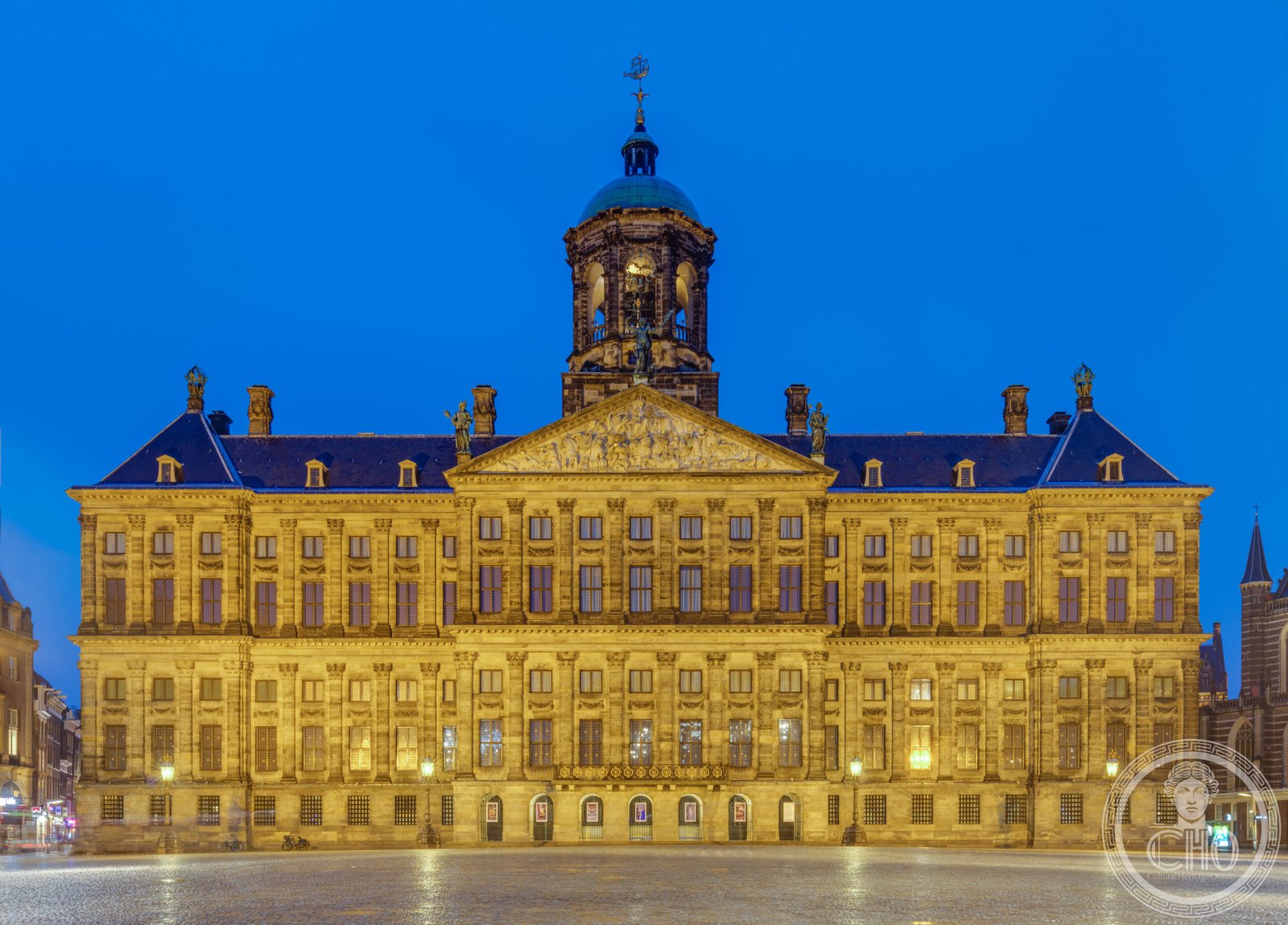
Royal Palace Amsterdam — Koninklijk Paleis
The Royal Palace of Amsterdam is a monumental 17th-century building on Dam Square that stands as one of the supreme achievements of Dutch Classical architecture. Built between 1648 and 1665 as the new town hall of Amsterdam — the most ambitious civic building of the Dutch Golden Age — it was converted into a royal palace by Louis Bonaparte in 1808 and has served the Dutch Royal House ever since. Its public floors function as a museum open to visitors throughout most of the year.
At a glance
- Type
- Royal palace / civic monument / museum
- Period
- Construction 1648–1665; converted to palace 1808
- Style
- Dutch Classicism
- Location
- Dam Square, 1012 JS Amsterdam, Netherlands
- Coordinates
- 52.3732° N, 4.8892° E
Overview
The Royal Palace stands on the west side of Dam Square, facing the National Monument and next to the Nieuwe Kerk. It is one of three Dutch palaces placed at the disposal of the monarch by Act of Parliament, though it is primarily used for state receptions and public cultural access. During the Batavian Republic and the reign of Louis Bonaparte, the building housed the first public museum in Amsterdam, briefly displaying art that would later form the core of the Rijksmuseum collection.
History
Amsterdam’s medieval town hall burned down in 1652, prompting the city to commission an entirely new civic building on the same square. Architect Jacob van Campen designed the replacement as an explicit statement of Amsterdam’s global mercantile power and republican pride, modelling it loosely on the Pantheon in Rome while embedding Dutch symbolism throughout. Construction was completed in 1665, with the building resting on 13,659 wooden piles driven into the soft Amsterdam soil. Napoleon’s brother Louis Bonaparte converted it into a royal residence in 1808, furnishing it with the Empire-style interiors that are still largely in place today.
What you see
The interior is dominated by the vast Citizen’s Hall — an allegorical marble-floored hall representing the cosmos with Amsterdam at its centre — flanked by the Burgomasters’ Chamber and the Court of Justice. Sculptural programmes by Artus Quellinus decorate the exterior pediments and interior spaces with mythological and civic allegories. The Empire-period state apartments preserve furnishings commissioned for Louis Bonaparte, giving the palace an unusual dual identity: Dutch Classicism on the outside, Napoleonic splendour within.
Cultural significance
The Royal Palace is listed as a national monument and widely regarded as the finest expression of Dutch Classical architecture in existence. It embodies the peak confidence of the Dutch Republic at the height of the Golden Age, encoding the commercial and political ambitions of the world’s leading trading power in stone and marble. The Citizen’s Hall alone, with its inlaid marble floor mapping the known world, is considered one of the great interior spaces of 17th-century Europe.
Practical information
- Address
- Dam Square, 1012 JS Amsterdam
- Opening hours
- Open most days of the year; check official website for current schedule and closures during royal functions
- Admission
- Check official website for current prices
- Website
- paleisamsterdam.nl
Getting there
Dam Square is in the very centre of Amsterdam and is served by trams 2, 11, 12 and 17 stopping at Dam. Amsterdam Centraal station is a 10-minute walk along Damrak. The palace is easily reached on foot from most parts of the historic centre. Bicycle parking is available in the surrounding streets.
Sources & resources
Find it on the map
See this place and what’s around it →📷 Diventa un fotografo di Cultural Heritage Online
Condividi le tue foto dei luoghi: restano pubblicate con la tua firma come autore. Più vengono viste, più ti fai conoscere — e presto un concorso premierà le foto più apprezzate.
Accedi o registrati gratis per aggiungere una foto