
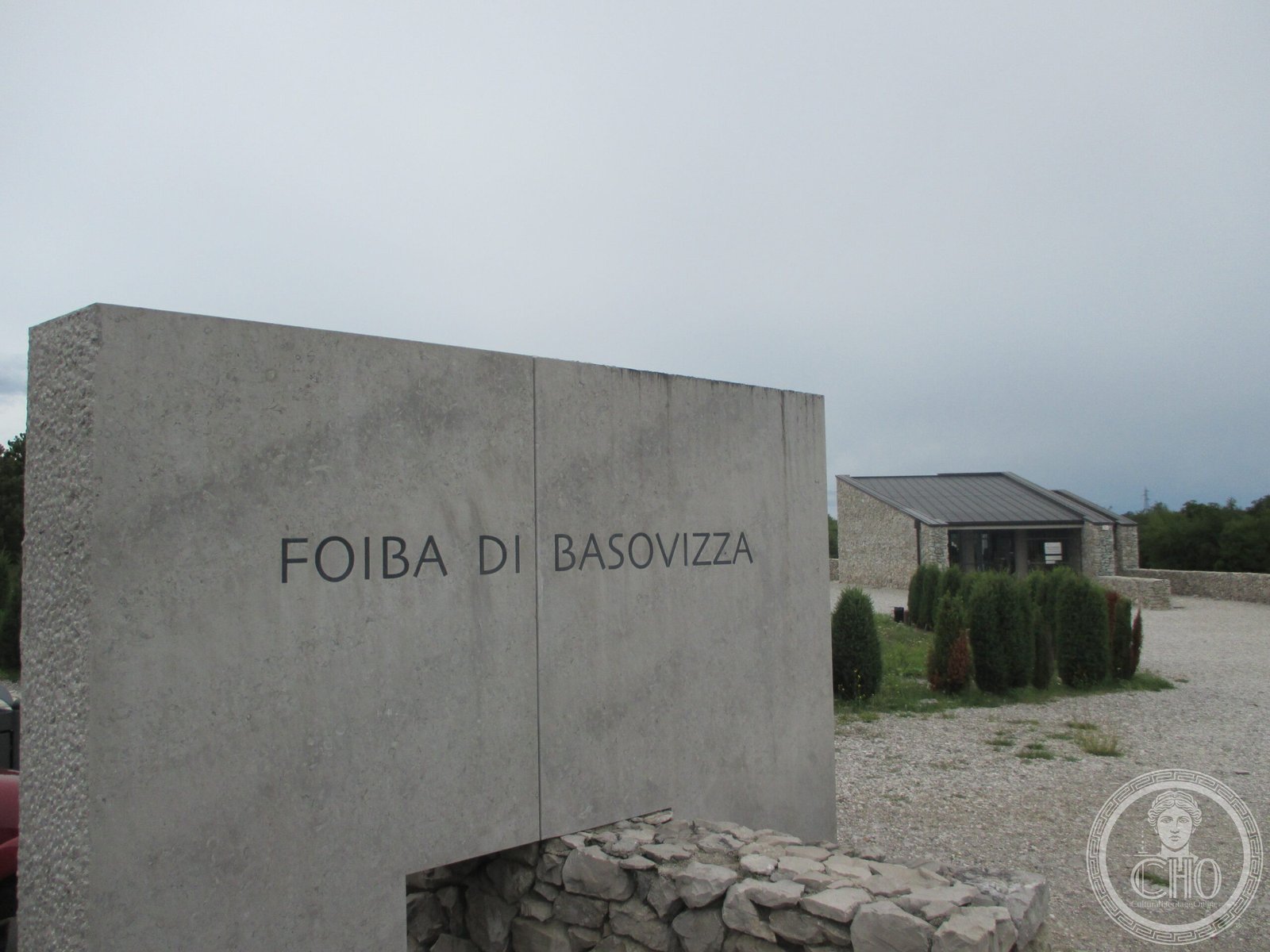
Foiba di Basovizza
The Foiba di Basovizza is a deep artificial cavity near the village of Basovizza on the Karst plateau east of Trieste, used by Yugoslav partisan forces at the end of World War Two as a site of mass execution. More than 200 metres deep and approximately 4 metres wide, the shaft was originally sunk in the early 20th century for coal extraction. In the spring of 1945, Communist Yugoslav Partisans used it to dispose of the bodies of soldiers, police officers, Italian civilians, and political opponents killed in summary executions. Declared a national monument of Italy in 1992, the site is a place of contested memory at the centre of ongoing Italian–Slovenian historical dialogue.
- Type
- National monument; memorial site
- Period
- Shaft dug early 20th century (coal extraction); used as mass grave spring 1945; national monument declared 1992
- Style
- Open-air memorial with commemorative monument
- Location
- Basovizza (Bazovica), Comune di Trieste, Friuli Venezia Giulia, Italy
Overview
The Foiba di Basovizza sits at 377 metres on the Karst plateau, in a landscape of limestone outcrops and scrub forest a few kilometres from the Slovenian border. Despite its name — foiba, a Karst sinkhole — the cavity is not a natural geological feature but an abandoned industrial shaft. The monument erected at the site commemorates the victims of the “foibe massacres,” a broader wave of killings carried out by Yugoslav forces against the Italian population of Istria and the Julian March between 1943 and 1945.
History
The shaft was drilled around 1902 during an early attempt to locate coal deposits in the Karst; the effort was soon abandoned as unproductive. In the chaotic weeks following the German capitulation in May 1945, Yugoslav Partisan units under Tito’s command occupied Trieste and the surrounding Karst. During this period, thousands of Italians and anti-Communist Slavs were killed across the region; at Basovizza, bodies were thrown into the shaft. The Italian government formally declared the site a national monument by decree of President Oscar Luigi Scalfaro on 11 November 1992. A memorial stone and a symbolic tomb were erected at the opening of the shaft. Since 2004 Italy has observed 10 February as the “Day of Memory” (Giorno del Ricordo) to commemorate the victims of the foibe and the subsequent exodus of Italians from Istria.
What you see
At the surface, the shaft opening is covered by a steel grate and surrounded by a low stone monument inscribed with the names of those commemorated. A larger stone monument nearby bears a dedicatory inscription in Italian. The surrounding Karst landscape — limestone outcrops, doline depressions, scattered pines — is typical of the region. The site is simple and unembellished, its power deriving from the knowledge of what lies below rather than any architectural intervention. Visitors typically find wreaths and votive offerings left by commemorative associations on and around the monument.
Cultural significance
The Foiba di Basovizza is the primary symbolic site for the commemoration of the foibe massacres and the Istrian-Dalmatian exodus in Italy, and its significance in Italian collective memory has grown considerably since the establishment of the Giorno del Ricordo in 2004. The site is also part of a broader Italian–Slovenian process of historical reconciliation, with both governments having acknowledged the killings as crimes. It occupies a uniquely charged place in the heritage landscape of the northeastern border, where the layered histories of fascism, wartime occupation, Communist repression, and postwar border settlement are all concentrated.
Practical information
Address: Via Basovizza, 34149 Basovizza (Trieste). Coordinates: 45.6348° N, 13.8710° E. The site is an open-air national monument accessible at all times with no admission charge. Major commemorative ceremonies take place on 10 February each year. Check the official Comune di Trieste website for guided visit information.
Getting there
From Trieste city centre, take bus line 42 to the Basovizza village stop (approximately 30 minutes), then walk approximately 10 minutes to the monument. By car, follow the SP1 road east from Trieste towards Basovizza; the monument is signposted from the village. The site is approximately 8 km from the Trieste Centrale station.
Sources & resources
Find it on the map
See this place and what’s around it →📷 Diventa un fotografo di Cultural Heritage Online
Condividi le tue foto dei luoghi: restano pubblicate con la tua firma come autore. Più vengono viste, più ti fai conoscere — e presto un concorso premierà le foto più apprezzate.
Accedi o registrati gratis per aggiungere una foto