
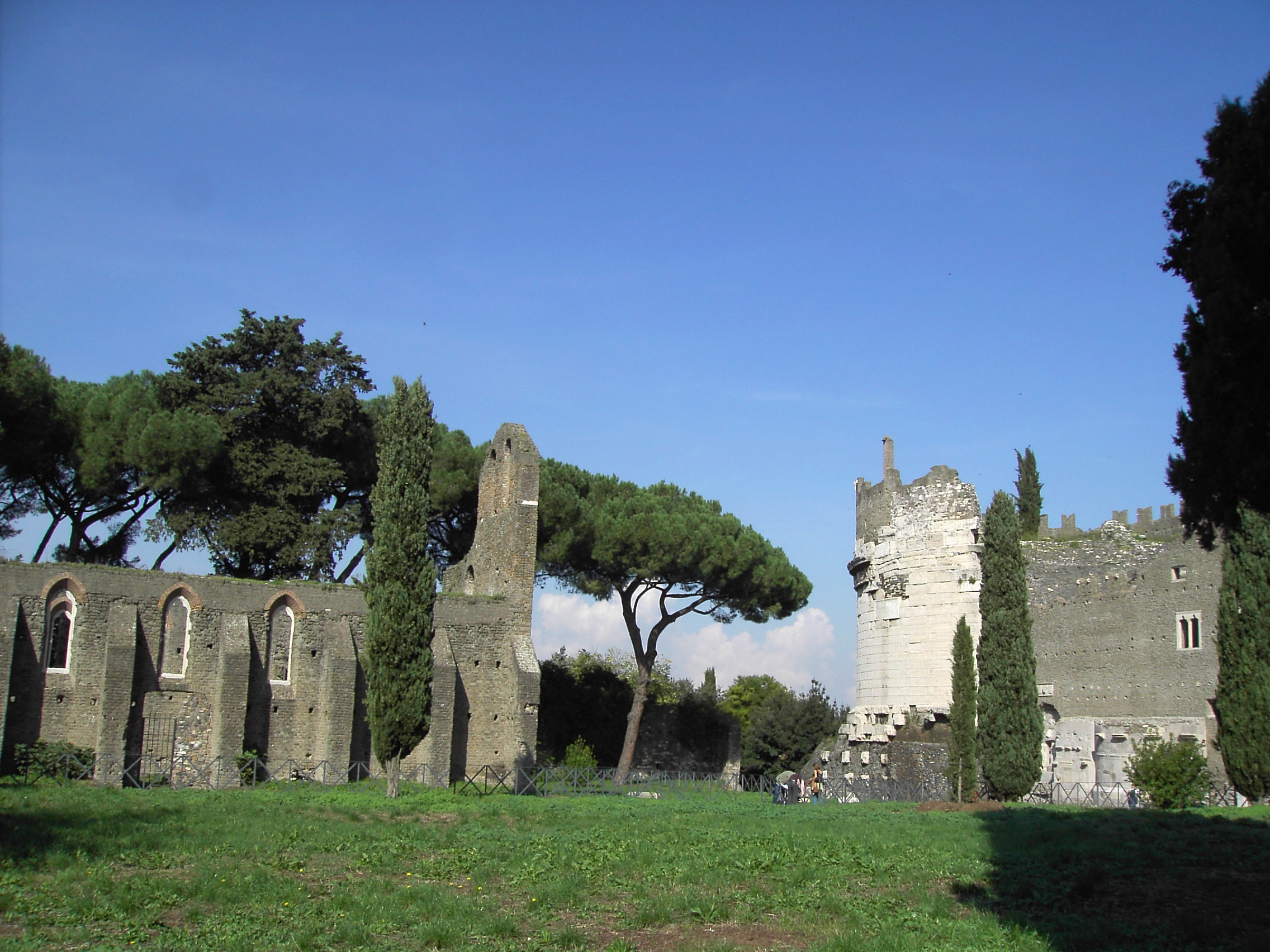
The Church of San Nicola in Capo di Bove
The Church of San Nicola in Capo di Bove is a small Romanesque church embedded within the medieval fortified complex built by the Caetani family immediately adjacent to the Mausoleum of Cecilia Metella on the Via Appia Antica. Dating in its current form to the early fourteenth century, it is a rare surviving example of a Gothic-influenced mendicant church on the outskirts of Rome and is now included in the state archaeological area that encompasses the mausoleum, the Circus of Maxentius, and the Villa of Maxentius.
At a glance
- Type
- Medieval fortified church (Gothic-Romanesque)
- Period
- Early 14th century (Caetani construction); earlier foundations possibly 11th–12th century
- Style
- Romanesque with Gothic lancet elements; Roman spolia incorporated
- Location
- Via Appia Antica 153, 00178 Rome, Italy (41.8518° N, 12.5206° E)
Overview
San Nicola in Capo di Bove stands beside the Mausoleum of Cecilia Metella on the third milestone of the ancient Via Appia. The name “Capo di Bove” (ox-head) refers to the bucranium frieze that decorates the mausoleum drum nearby. The church forms part of a larger medieval complex that the Caetani family constructed to transform the mausoleum into a fortified stronghold during the early fourteenth century.
History
The Caetani, the most powerful Roman noble family of the early 1300s and patrons of Pope Boniface VIII, converted the ancient tomb of Cecilia Metella into a fortified toll gate on the Via Appia. As part of this project they built or rebuilt the church of San Nicola to serve as a private chapel for the compound. Roman spolia — fragments of ancient columns, capitals, and inscriptions — were incorporated into the church fabric, a common medieval Roman practice known as opus reticulatum reuse. After Boniface VIII appropriated the complex, both the mausoleum and the church passed through various ecclesiastical and noble hands before entering state ownership.
What you see
The church presents a simple single-nave plan with thick rubble walls and lancet-arched windows typical of central Italian mendicant architecture. The interior preserves traces of medieval fresco decoration and several reused Roman architectural fragments. The exterior blends with the surrounding Caetani walls, making the church difficult to distinguish from the fortification until you stand directly before its entrance portal. The apse faces eastward following canonical orientation.
Cultural significance
San Nicola in Capo di Bove is an understudied monument that illustrates how medieval Rome continuously recycled its ancient fabric for new civic, religious, and military purposes. Together with the mausoleum and circus, it contributes to one of the most layered archaeological landscapes in Europe.
Practical information
The church is accessible as part of the combined ticket for the Cecilia Metella archaeological area, managed by Coopculture on behalf of the Soprintendenza Speciale di Roma. Open Tuesday to Sunday; check the official website for current hours and admission fees.
Getting there
From central Rome, take bus 118 or 218 from Circo Massimo (Metro Line B) southbound along the Via Appia Antica. The site is approximately 6 km from the historic centre. A scenic cycling route follows the pedestrian section of the Appian Way from Porta San Sebastiano, particularly pleasant on Sundays when the road is closed to private traffic.
Sources & resources
- Wikipedia — Mausoleum of Cecilia Metella (includes Caetani complex)
- Cultural Heritage Online — culturalheritageonline.com
Find it on the map
See this place and what’s around it →📷 Diventa un fotografo di Cultural Heritage Online
Condividi le tue foto dei luoghi: restano pubblicate con la tua firma come autore. Più vengono viste, più ti fai conoscere — e presto un concorso premierà le foto più apprezzate.
Accedi o registrati gratis per aggiungere una foto