
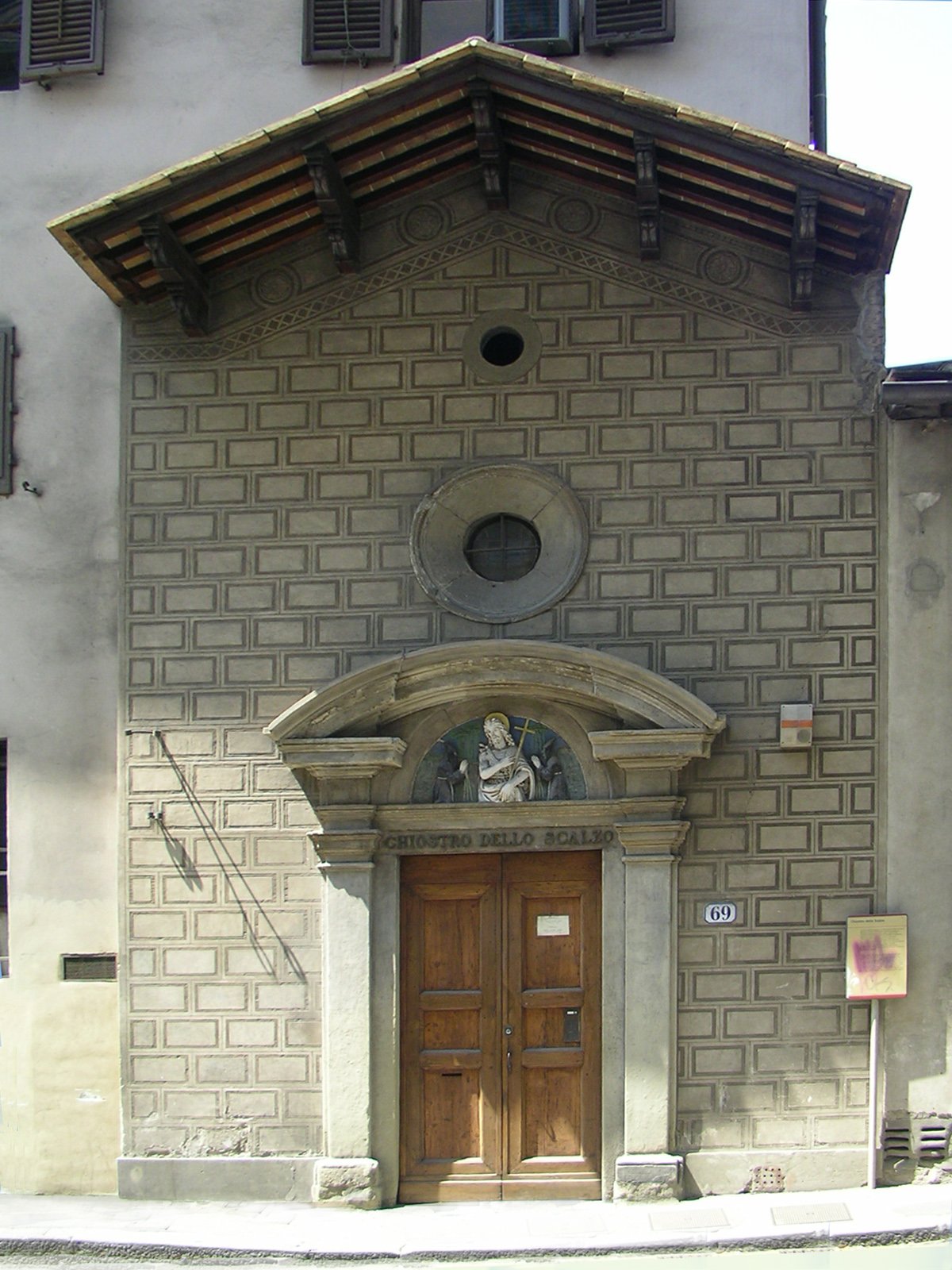
Chiostro dello Scalzo
The Chiostro dello Scalzo is a small Renaissance cloister in central Florence, celebrated for its complete cycle of grisaille frescoes depicting the Life of Saint John the Baptist, painted by Andrea del Sarto between 1511 and 1526, with two scenes added by Franciabigio. The cloister belonged to the Confraternity of Saint John the Baptist — whose members walked barefoot (scalzo) in processions, hence the name — and survives today as a state monument under the Uffizi Galleries administration, offering an intimate and often overlooked encounter with one of the High Renaissance’s most accomplished fresco cycles.
At a glance
- Type
- Renaissance cloister with fresco cycle (state monument)
- Period
- Cloister built early 16th century; frescoes 1511–1526
- Style
- High Renaissance; grisaille (chiaroscuro fresco technique)
- Location
- Via Cavour 69, Florence, Tuscany
- Coordinates
- 43.7796° N, 11.2595° E
- Artists
- Andrea del Sarto (principal artist); Franciabigio (2 scenes)
- Management
- Gallerie degli Uffizi (Ministry of Culture)
Overview
The Chiostro dello Scalzo is one of Florence’s hidden masterpieces: a single-storey rectangular cloister whose entire interior arcade is decorated with twelve scenes from the Life of Saint John the Baptist and four Cardinal Virtues, all executed in monochrome grisaille — a technique that simulates stone relief and demonstrates the draughtsmanship of its creator, Andrea del Sarto, at the peak of his powers. The cloister is small enough to be absorbed in a single visit yet rich enough to reward close attention, and its relative obscurity compared to major Florentine museums means it can usually be visited in quiet contemplation.
History
The Compagnia di San Giovanni Battista dello Scalzo was a lay confraternity founded in Florence in the 15th century whose members participated in the city’s religious processions barefoot (scalzo) as an act of penitence and humility. The confraternity commissioned Andrea del Sarto to decorate their cloister in 1511, and the artist returned repeatedly to the project over fifteen years, completing twelve of the fourteen scenes himself between 1511 and 1526. The two scenes he left unfinished or delegated were executed by his collaborator Franciabigio. After the suppression of the confraternity in the Napoleonic period, the cloister passed to the Italian state, which has conserved it as a public monument since the 19th century.
What you see
The fresco cycle unfolds around three sides of the rectangular cloister arcade, beginning with the Annunciation of the Angel to Zacharias and ending with the Beheading of Saint John the Baptist, with scenes of the Naming of the Baptist, the Baptism of Christ, and the Feast of Herod among the highlights. The grisaille technique — entirely in shades of grey and brown without colour — gives the cycle a sculptural quality that is unlike anything else in Florentine fresco painting, and it anticipates the tonal sophistication for which Andrea del Sarto would become famous. The figure drawing is of exceptional quality, and the spatial compositions show the influence of Leonardo da Vinci’s Florentine period.
Cultural significance
The Chiostro dello Scalzo represents a key moment in the development of High Renaissance painting in Florence, and it is one of the most complete surviving examples of Andrea del Sarto’s work on a monumental scale in situ. Giorgio Vasari described del Sarto as the “faultless painter” (pittore senza errori), and the Scalzo cycle remains the primary evidence for this reputation. The site is also an important document of Florentine confraternity culture, a vital but often overlooked aspect of Renaissance civic and religious life.
Practical information
- Address
- Via Cavour 69, 50129 Firenze FI, Italy
- Hours
- Currently open Monday and Thursday mornings; check the Uffizi Galleries website for current hours, as access is limited
- Admission
- Free entry (state monument); no booking required but verify current access conditions via uffizi.it
- Website
- uffizi.it
Getting there
The Chiostro dello Scalzo is located on Via Cavour in the San Marco neighbourhood of Florence, approximately 800 m north of the Duomo. The nearest bus stop is served by ATAF/Busitalia lines running along Via Cavour and Via San Gallo. By foot from Florence Santa Maria Novella railway station, allow approximately 20 minutes; from the Duomo, approximately 10 minutes. There is no dedicated parking nearby; the historic centre is best explored on foot or by bicycle.
Sources & resources
Find it on the map
See this place and what’s around it →📷 Diventa un fotografo di Cultural Heritage Online
Condividi le tue foto dei luoghi: restano pubblicate con la tua firma come autore. Più vengono viste, più ti fai conoscere — e presto un concorso premierà le foto più apprezzate.
Accedi o registrati gratis per aggiungere una foto