
The Basilica of Santa Prassede
Santa Prassede is a titular basilica in the Esquiline district of Rome, built by Pope Paschal I between 817 and 824 on a site venerated since the earliest centuries of Christianity. It houses one of the finest concentrations of Byzantine mosaics outside Ravenna, most spectacularly in the Chapel of San Zeno — called the “Garden of Paradise” — whose gold-ground tesserae rank among the supreme achievements of 9th-century sacred art in the Western world.
At a glance
- Type
- Titular basilica, Roman Catholic church
- Period
- Founded traditionally 1st–2nd century; current structure 817–824 AD
- Style
- Early Christian / Byzantine
- Location
- Via Santa Prassede 9a, 00184 Rome, Italy
- Coordinates
- 41.8964° N, 12.4966° E
Overview
Santa Prassede is one of Rome’s oldest and most artistically significant early Christian churches, dedicated to Saint Praxedes, daughter of the Roman senator Pudens and sister of Saint Pudentiana. The basilica was rebuilt in its present form by Pope Paschal I (817–824) as part of his ambitious programme of church construction and mosaic decoration in Rome. It preserves an extraordinary cycle of Byzantine-influenced mosaics that represent the artistic highpoint of the Carolingian papacy.
History
An early oratory on this site on the Esquiline Hill was associated with the Christian community meeting at the house of Pudens in the 2nd century. Pope Paschal I, who also rebuilt Santa Maria in Domnica and Santa Cecilia in Trastevere, razed an earlier structure and erected the present three-aisled basilica between 817 and 824. Paschal transferred the relics of 2,300 martyrs to the church and had them placed beneath the high altar. The church received the Column of the Flagellation — the pillar to which Christ was bound during his Passion — brought from Jerusalem in 1223 by Cardinal Giovanni Colonna, which remains one of the basilica’s most venerated relics.
What you see
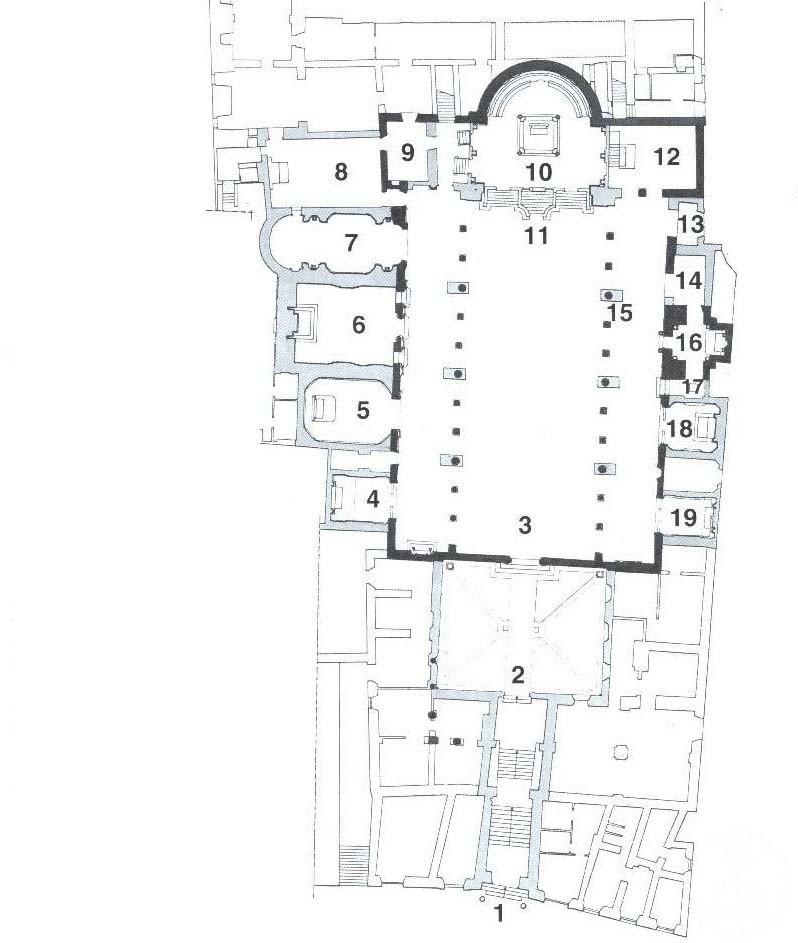
The interior retains its original basilican plan with a nave and two aisles separated by ancient marble columns, and the apse is dominated by a spectacular 9th-century mosaic showing Christ flanked by saints, with Pope Paschal I identified by his square nimbus indicating he was alive when the mosaic was made. The Chapel of San Zeno, added by Paschal I as a mausoleum for his mother Theodora, is entirely encrusted with gold-ground mosaics of Byzantine quality and is considered the finest example of 9th-century mosaic art in Rome. On the left side of the nave stands the Column of the Flagellation, enclosed in a porphyry case, a relic believed to be part of the column used during Christ’s scourging.
Cultural significance
Santa Prassede is inscribed among Rome’s most important early Christian monuments and is essential to understanding the Carolingian Renaissance in religious art. The Chapel of San Zeno preserves the only intact programme of Byzantine-style gold mosaic in Rome, making the basilica a critical reference for scholars of medieval iconography and papal patronage.
Practical information
- Address
- Via Santa Prassede 9a, 00184 Rome, Italy
- Hours
- Check official website or contact the basilica for current opening times
- Admission
- Free entry to the basilica; small fee for the Chapel of San Zeno
Getting there
The basilica is a short walk from Rome Termini station (approx. 5 minutes on foot). Take Metro Line A or B to Termini, then walk south along Via Cavour and turn onto Via Santa Prassede. Bus lines stopping near Santa Maria Maggiore also serve the area. The church is close to the Piazza Santa Maria Maggiore landmark.
Sources & resources
Find it on the map
See this place and what’s around it →Historical events at this place (3)
📷 Diventa un fotografo di Cultural Heritage Online
Condividi le tue foto dei luoghi: restano pubblicate con la tua firma come autore. Più vengono viste, più ti fai conoscere — e presto un concorso premierà le foto più apprezzate.
Accedi o registrati gratis per aggiungere una foto