
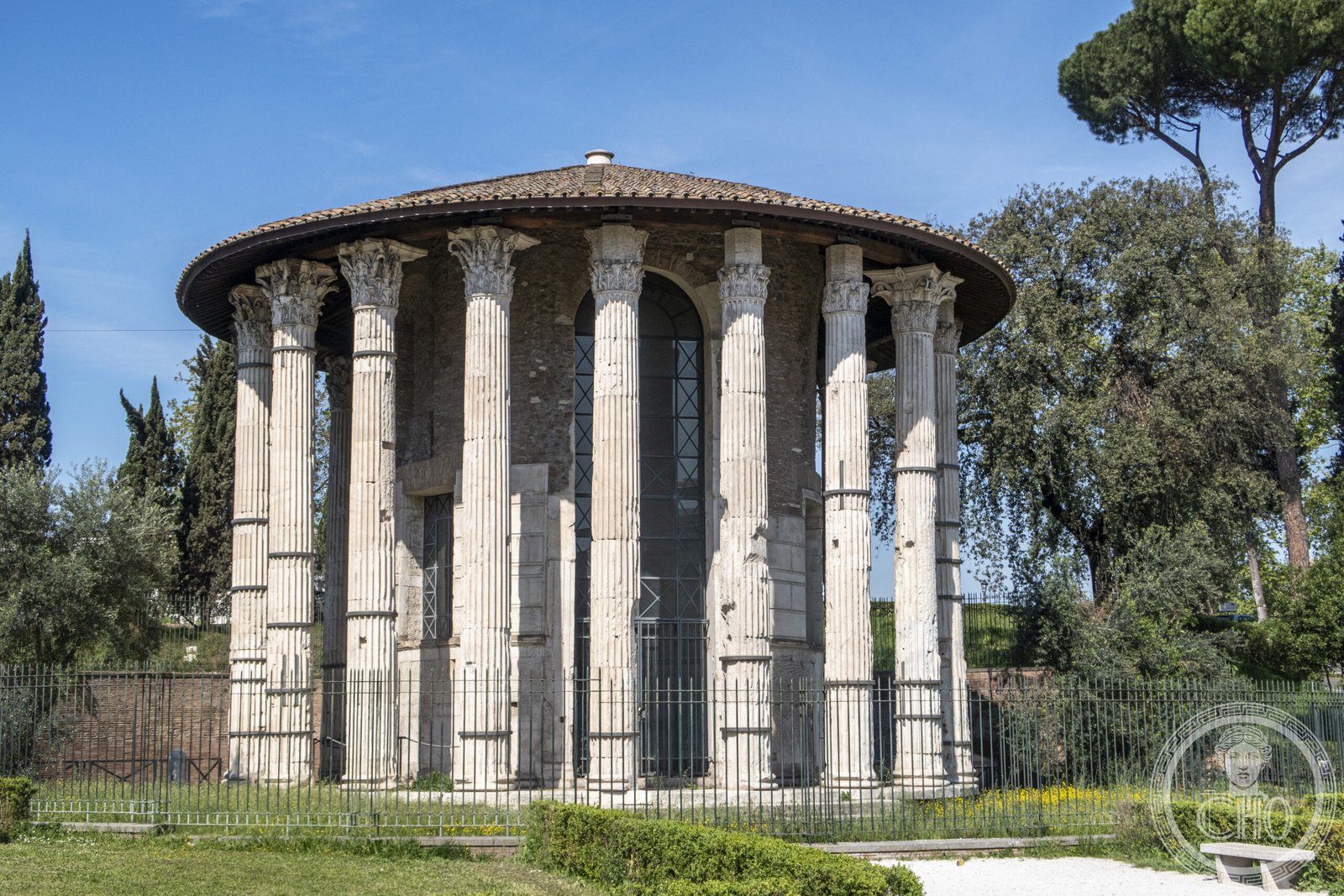
Temple of Hercules Victor
The Temple of Hercules Victor, also known as Hercules Olivarius, is a Roman temple in Piazza Bocca della Verità — the ancient Forum Boarium — in Rome. A tholos in the Greek peripteral tradition, it is entirely surrounded by a Corinthian colonnade of 20 columns and is the oldest surviving marble building in Rome, erected most likely in the late 2nd or early 1st century BC. Long mistaken for a temple of Vesta due to its circular form, it was correctly identified in the 19th century as a sanctuary dedicated to Hercules, patron deity of merchants and traders.
At a glance
- Type
- Roman Republican temple (tholos)
- Period
- Late 2nd – early 1st century BC
- Style
- Greek peripteral (tholos); Corinthian order; entirely in marble
- Location
- Piazza Bocca della Verità, Forum Boarium, Rome, Italy
Overview
The Temple of Hercules Victor is a Roman temple situated in Piazza Bocca della Verità in the former Forum Boarium area of Rome. It is a tholos — a round temple of Greek peripteral design — completely surrounded by a colonnade of Corinthian columns. For many centuries it was mistakenly identified as a Temple of Vesta because of its circular plan, before Napoleon’s Prefect of Rome, Camille de Tournon, established its correct attribution to Hercules in the early 19th century.
History
Built most probably in the late 2nd or early 1st century BC, the temple is the oldest surviving marble structure in Rome, constructed at a time when Greek architectural influences were transforming Roman religious building. It is believed to have been commissioned by a wealthy merchant associated with the olive oil trade — reflected in the alternative name Hercules Olivarius. The temple survived the medieval and Renaissance periods intact, having been converted to Christian use at various points, which helped preserve it from destruction or spoliation.
What you see
The temple stands on a low podium and retains 19 of its original 20 Corinthian columns, their capitals and entablature largely preserved. The circular cella is constructed entirely of Pentelic marble, giving the structure a luminous, refined quality distinct from Rome’s later Imperial buildings. The surrounding Piazza Bocca della Verità also contains the Temple of Portunus and the medieval church of Santa Maria in Cosmedin, creating a remarkably dense archaeological setting.
Cultural significance
As the oldest intact marble building in Rome, the Temple of Hercules Victor is a landmark of Roman Republican architecture and of the deep Greek cultural influence on early Roman religious practice. Its excellent state of preservation, achieved partly through continuous sacred use, makes it one of the most valuable ancient monuments in the city. It stands as tangible evidence of the commercial prosperity and cosmopolitan character of Republican Rome’s riverfront.
Practical information
- Address
- Piazza Bocca della Verità, 00186 Rome, Italy (41.8887° N, 12.4808° E)
- Opening hours
- Outdoor area accessible at all times; viewable from the piazza at no charge
- Admission
- Free (exterior viewing)
Getting there
The nearest Metro station is Circo Massimo (Line B), a 5-minute walk. Bus lines serving the Lungotevere Aventino and Piazza Bocca della Verità stop directly adjacent. The temple is within easy walking distance of the Circus Maximus and the Palatine Hill.
Sources & resources
Find it on the map
See this place and what’s around it →📷 Diventa un fotografo di Cultural Heritage Online
Condividi le tue foto dei luoghi: restano pubblicate con la tua firma come autore. Più vengono viste, più ti fai conoscere — e presto un concorso premierà le foto più apprezzate.
Accedi o registrati gratis per aggiungere una foto