
Sutri
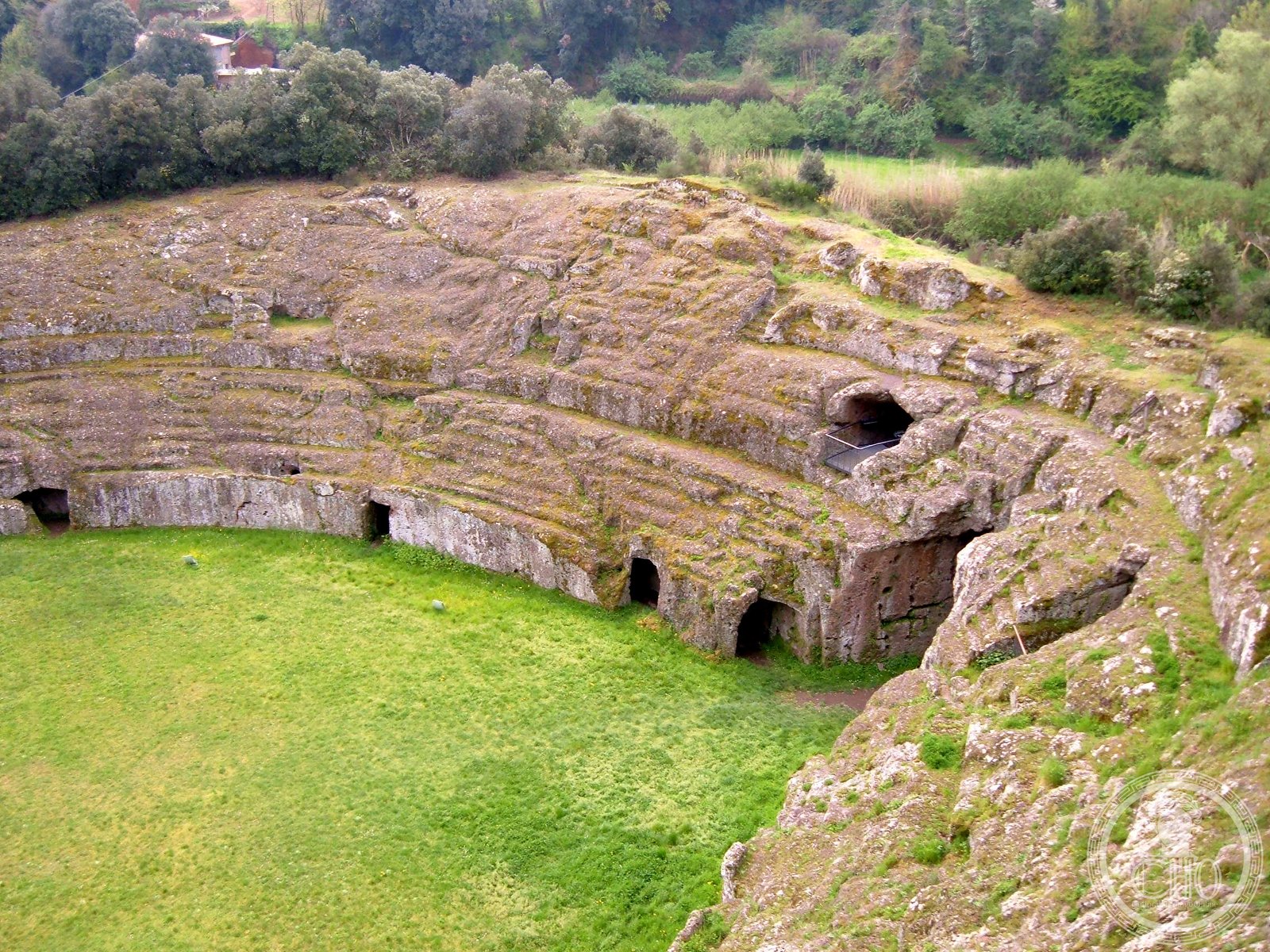
Sutri is an ancient hill town in the Province of Viterbo, northern Lazio, situated on a tufa ridge above the Via Cassia about 50 kilometres north of Rome. Occupied continuously since at least the 6th century BC, the town served as an Etruscan stronghold, a Roman municipium on the consular road to Etruria, and a Lombard duchy before passing in 728 AD to the papacy — a donation by the Lombard king Liutprand that historians regard as the founding act of the Papal States. Sutri’s extraordinary open-air archaeological park preserves a rock-cut Etruscan necropolis, a Roman amphitheatre carved entirely from the living tufa, and a Mithraic sanctuary later converted into a Christian church.
At a glance
- Type
- Historic hill town with Etruscan necropolis, Roman amphitheatre, and early Christian church; archaeological park
- Period
- Occupied from at least 6th century BC; major Roman phase 1st century BC–3rd century AD; Donation of Sutri 728 AD
- Style
- Etruscan rock-cut architecture; Roman civic engineering; early Christian adaptation of pagan spaces
- Location
- Province of Viterbo, Lazio, Italy; Via Cassia km 49
Overview
Sutri occupies a narrow tufa promontory above the ancient Via Cassia, and its strategic position between Rome and Etruria made it a significant centre across many civilisations. The modern town retains its medieval character, with a Romanesque cathedral and a tight web of lanes on the tufa ridge, but it is the surrounding landscape that draws heritage visitors: an unbroken sequence of Etruscan chamber tombs cut into the cliffs, a remarkably intact Roman amphitheatre hewn from solid rock, and a small temple converted first to a Mithraic sanctuary and later to the early Christian church of the Madonna del Parto. Together these form one of the most layered and accessible ancient sites in central Italy.
History
Sutri appears as a major Etruscan centre (Sutrina or Sutrinum) from at least the 6th century BC; it was conquered by Rome in 383 BC and became a Latin colony and later a Roman municipium, sitting astride the Via Cassia that connected Rome with Florentia. The Roman phase produced the amphitheatre and a network of cisterns and roads still visible today. After the fall of the Western Roman Empire, Sutri became a Lombard duchy until 728 AD, when King Liutprand ceded it to Pope Gregory II — the so-called Donation of Sutri, traditionally seen as the origin of papal temporal power. The medieval town grew on the same tufa spur, and Sutri was long a residence of popes and a staging post for the Frankish armies of Charlemagne.
What you see
The archaeological park outside the town walls centres on the Roman amphitheatre — an oval arena entirely carved from the tufa hillside, with seating for several thousand spectators and a remarkably complete cavea still visible after two millennia. Immediately adjacent, the Necropolis of Sutri stretches for several hundred metres along the tufa cliff, with dozens of Etruscan chamber tombs of varying complexity cut directly into the rock face. A short walk away, the church of Madonna del Parto occupies a rock-cut chamber that served successively as an Etruscan tomb, a Mithraic temple (its frescoed interior includes scenes from the Roman mystery cult), and finally a Christian place of worship — an unparalleled sequence of religious use. The medieval cathedral of the Assunta in the town centre retains its Romanesque apse and crypt.
Cultural significance
Sutri’s Donation of 728 AD is one of the key moments in European history, establishing the legal and territorial precedent for the Papal States that shaped Italian and Catholic political geography for over a millennium. The site’s seamless layering of Etruscan, Roman, and Christian heritage within a single accessible landscape makes it exceptionally valuable for understanding the long-term cultural history of central Italy. Its relative obscurity compared to more visited Etruscan sites such as Tarquinia or Cerveteri makes it especially rewarding for independent travellers seeking depth over crowds.
Practical information
- Address
- Parco Regionale di Sutri, Via Cassia km 49, 01015 Sutri VT, Italy
- Opening hours
- Archaeological park open daily except Mondays; hours vary by season — check official website
- Admission
- Entrance fee for archaeological park; town and cathedral freely accessible
- Coordinates
- 42.2418° N, 12.2247° E
Getting there
Sutri is located on the Via Cassia (SS2), approximately 50 km north of Rome. By public transport, COTRAL buses connect Rome (Saxa Rubra terminal, reached by Roma-Nord tram) to Sutri in about 1 hour. By car from Rome, take the Via Cassia (exit toward Viterbo) or the A1 motorway to Nepi and then local roads. The nearest railway station with services is Capranica-Sutri on the Roma Ostiense–Viterbo line, about 7 km from the town. From Viterbo, buses and regional trains serve the area.
Sources & resources
Find it on the map
See this place and what’s around it →Historical events at this place (1)
📷 Diventa un fotografo di Cultural Heritage Online
Condividi le tue foto dei luoghi: restano pubblicate con la tua firma come autore. Più vengono viste, più ti fai conoscere — e presto un concorso premierà le foto più apprezzate.
Accedi o registrati gratis per aggiungere una foto