
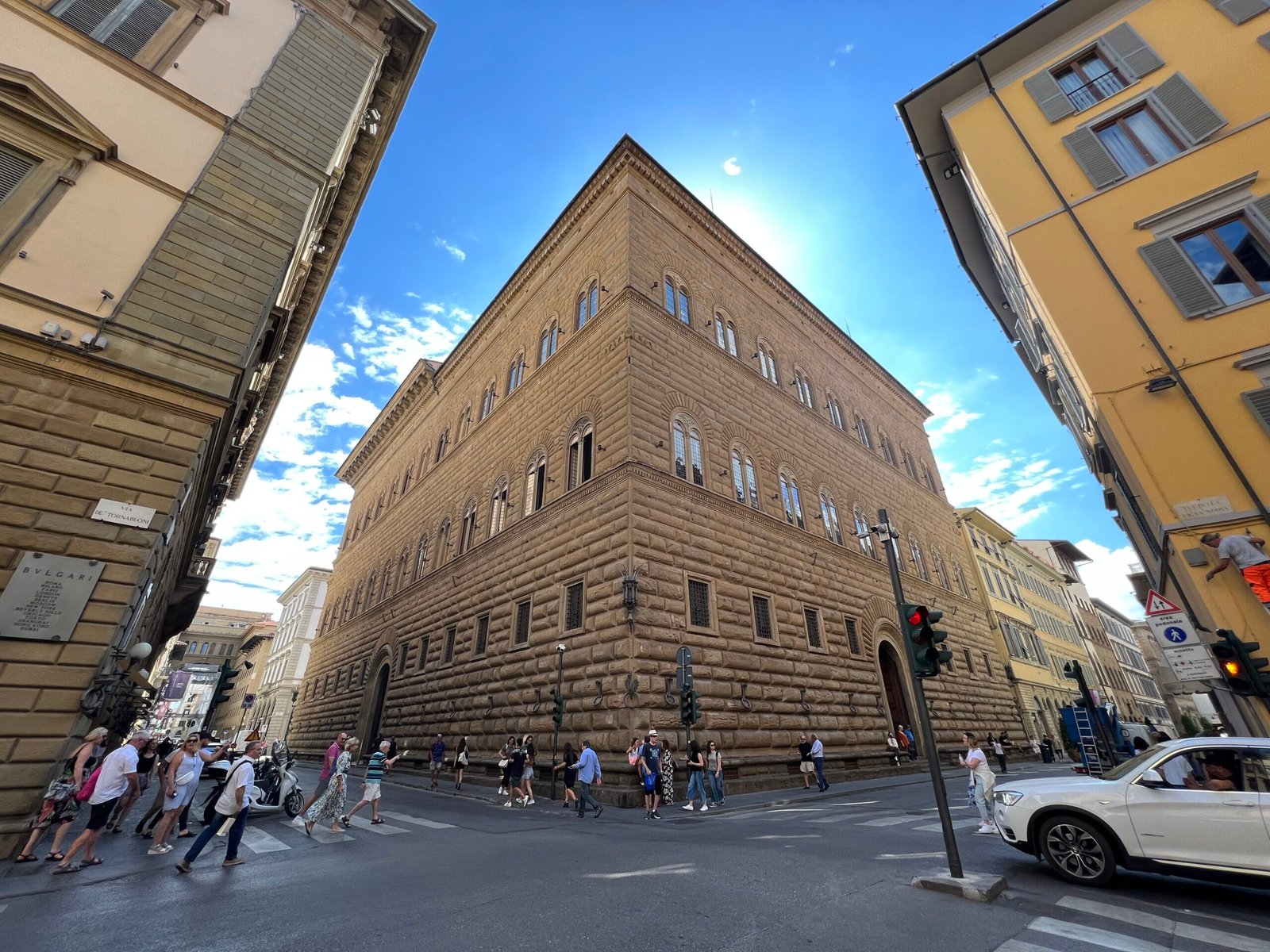
Palazzo Strozzi
Palazzo Strozzi is a large Renaissance palace in central Florence, built between 1489 and 1538 for the banker Filippo Strozzi the Elder and designed successively by Benedetto da Maiano, Giuliano da Sangallo, and Simone del Pollaiolo (il Cronaca). One of the finest examples of Florentine Renaissance domestic architecture, its bold rusticated facade and regular square plan around a central cortile set a template widely imitated across Italy. Today it is one of Italy’s leading exhibition venues and a lively cultural hub.
At a glance
- Type
- Renaissance urban palace; contemporary art and culture venue
- Period
- Construction 1489–1538 (facade and cortile substantially complete by 1504)
- Style
- Florentine Renaissance
- Location
- Piazza degli Strozzi, 50123 Florence, Italy
- Coordinates
- 43.7713° N, 11.2520° E
- Architects
- Benedetto da Maiano (original plan, 1489); Giuliano da Sangallo; Simone del Pollaiolo called il Cronaca (cortile and cornice)
- Patron
- Filippo Strozzi the Elder; continued by his heirs
Overview
Palazzo Strozzi was conceived as a direct rival to the Medici Palace a few blocks away, designed to assert the Strozzi family’s wealth and political ambitions through sheer scale and architectural authority. Construction stalled after Filippo’s death in 1491 and continued sporadically under his sons; the building was never entirely finished — the cornice on the third storey was left incomplete. Today the palace is managed by Fondazione Palazzo Strozzi, which organises major international art exhibitions several times a year.
History
Filippo Strozzi the Elder had accumulated enormous wealth as a banker in Naples before returning to Florence and acquiring the city block for his ambitious palace project in 1489. He reportedly consulted an astrologer on the auspicious date to lay the foundation stone. After his death in 1491, construction continued under Giuliano da Sangallo, then Simone del Pollaiolo (il Cronaca), who designed the elegant cortile. The Strozzi family lost political favour after 1538 and the palace passed through various institutional uses over the centuries — a customs house, a stock exchange, barracks — before its restoration in the 20th century.
What you see
The exterior presents three storeys of regular rusticated pietra forte stonework, the blocks graduating from deeply channelled at ground level to finer-jointed above — a Florentine convention codified here at monumental scale. Each storey is punctuated by round-headed bifore windows with central columns, and the building is crowned by a projecting iron lantern at each corner. The interior cortile, designed by il Cronaca, is an arcade of round arches on Corinthian columns with pietra serena detailing, open to the sky. A loggia inside the cortile serves as a café and events space.
Cultural significance
Palazzo Strozzi is considered one of the three great Florentine Renaissance palaces — alongside Palazzo Medici Riccardi and Palazzo Rucellai — that defined the type of the large urban residence for the following two centuries across Italy and beyond. Its cortile influenced Andrea Palladio and later architects working in the Renaissance tradition. As a contemporary exhibition venue it has hosted major retrospectives of Picasso, Botticelli, and Pontormo, combining heritage architecture with leading international curatorial programming.
Practical information
The cortile (inner courtyard) is open to the public daily at no charge. The exhibition spaces open for each show’s duration; tickets are required. The rooftop terrace and ground-floor café-bookshop are also accessible during opening hours. For current exhibition programmes and ticket prices, check the Fondazione Palazzo Strozzi website.
Getting there
Palazzo Strozzi is in the heart of Florence’s historic centre, a 5-minute walk from Piazza della Repubblica and 10 minutes from Piazza del Duomo. The nearest ATAF bus stops are on Via de’ Tornabuoni and Via Strozzi. The palace is not reachable by tram or Metro; the city centre is a Limited Traffic Zone (ZTL), so private cars require a permit. From Santa Maria Novella railway station, the walk via Via de’ Tornabuoni takes approximately 12 minutes.
Sources & resources
Find it on the map
See this place and what’s around it →Historical events at this place (1)
📷 Diventa un fotografo di Cultural Heritage Online
Condividi le tue foto dei luoghi: restano pubblicate con la tua firma come autore. Più vengono viste, più ti fai conoscere — e presto un concorso premierà le foto più apprezzate.
Accedi o registrati gratis per aggiungere una foto