
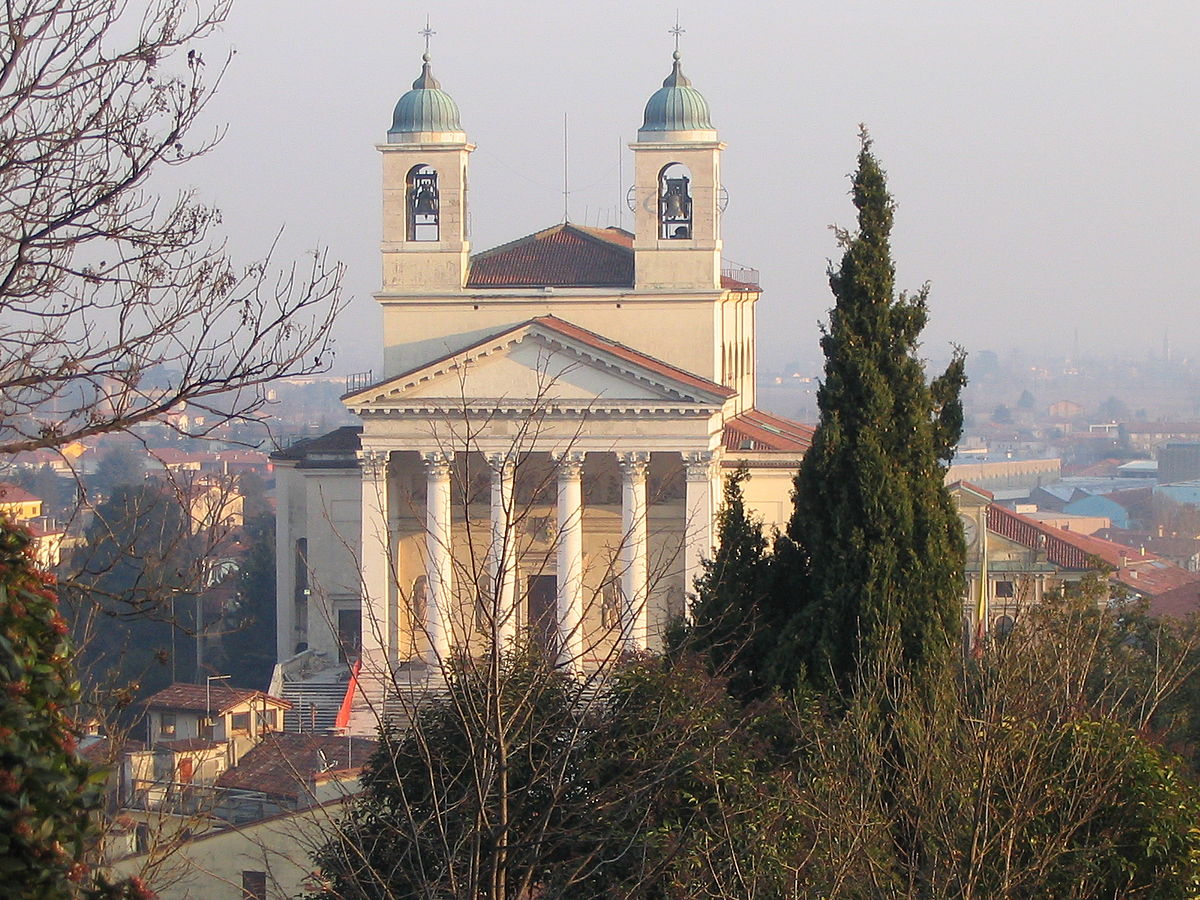
Schio
Schio is a town and comune in the province of Vicenza, in the Veneto region of northeastern Italy, set at the mouth of the Val Leogra where the Alpine foothills meet the Padana plain. Known historically as the “Manchester of Italy” for the pioneering wool textile industry developed by the industrialist Alessandro Rossi in the nineteenth century, Schio preserves an extraordinary ensemble of industrial-age architecture and workers’ housing.
At a glance
- Type
- Town and comune
- Province
- Vicenza, Veneto, Italy
- Population
- Approximately 39,000
- Period of note
- Industrial heritage: 1817–1900 (Rossi woollen mills)
- Style
- Neo-Gothic and eclectic industrial architecture; workers’ village (Quartiere Nuovo)
- Coordinates
- 45.7138° N, 11.3587° E
Overview
Schio is the principal urban centre of the Altovicentino sub-region and one of the most important industrial heritage sites in northeastern Italy. Its name became synonymous with the early Italian Industrial Revolution through the enterprise of Alessandro Rossi (1819–1898), who transformed the town’s pre-existing woollen craft tradition into one of Europe’s largest integrated textile manufacturing complexes. The resulting landscape — mills, workers’ cottages, schools, churches and a model neighbourhood — constitutes an exceptional document of nineteenth-century social and economic history.
History
Wool working in Schio is documented from at least the fifteenth century, when the Venetian Republic encouraged cloth production in the sub-Alpine valleys. The decisive transformation came in the nineteenth century under the Rossi family: Giovanni Rossi established the first mechanised mill in 1817, and his son Alessandro expanded it dramatically after 1850, importing British machinery and engineers and creating what contemporaries described as Italy’s first fully integrated industrial district. Alessandro Rossi also built the Quartiere Nuovo (New Quarter) from the 1870s, a model workers’ neighbourhood inspired by social paternalism and British precedents such as Saltaire. By the late nineteenth century Schio’s mills employed thousands of workers and exported cloth across Europe and beyond.
What you see
The surviving mill complex — including the monumental Fabbrica Alta (1862), a five-storey Neo-Gothic industrial building in brick — dominates the town centre and is now under discussion for cultural reuse. The Quartiere Nuovo presents a remarkably intact urban tissue of two-storey workers’ cottages, a large public park (Giardino Rossi), a neo-Gothic church (Sant’Antonio Abate) and a school, all commissioned by Alessandro Rossi as part of his social programme. The town hall, the Casa Rossi and the Duomo complete a civic centre of considerable formal ambition. The surrounding valley gives access to World War I memorials and walking trails on the Piccole Dolomiti.
Cultural significance
Schio’s industrial heritage has been recognised by Italian heritage authorities and urban planners as a site of exceptional significance for the history of industrialisation in Italy and Europe. The Quartiere Nuovo is one of the earliest and best-preserved examples of a paternalistic workers’ village on the Italian peninsula, comparable in ambition (if smaller in scale) to Robert Owen’s New Lanark or Crespi d’Adda in Lombardy, the latter a UNESCO World Heritage Site. Ongoing efforts to reconvert the Fabbrica Alta and surrounding mill buildings into cultural and creative spaces aim to reactivate this heritage for the twenty-first century.
Practical information
- Tourist information
- IAT Schio, Piazza Statuto
- Fabbrica Alta visits
- Occasional open days; check local tourism website for current programme
- Giardino Rossi
- Public park, open daily
Getting there
Schio is connected to Vicenza by the historic Vicenza–Schio railway (journey approximately 35 minutes). By road, the SP46 runs south to Vicenza and north into the Val Leogra. Regular FTV bus services link Schio with Thiene and Vicenza. The town is approximately 30 kilometres north of Vicenza and 90 kilometres west of Venice.
Sources & resources
Find it on the map
See this place and what’s around it →Historical events at this place (1)
📷 Diventa un fotografo di Cultural Heritage Online
Condividi le tue foto dei luoghi: restano pubblicate con la tua firma come autore. Più vengono viste, più ti fai conoscere — e presto un concorso premierà le foto più apprezzate.
Accedi o registrati gratis per aggiungere una foto