
San Giustino
A vital center in the upper Tiber valley, San Giustino bridges ancient Roman heritage with medieval Christian foundations, anchored by its namesake archpriest church and the archaeological remains of Pliny the Younger’s celebrated villa.
At a glance
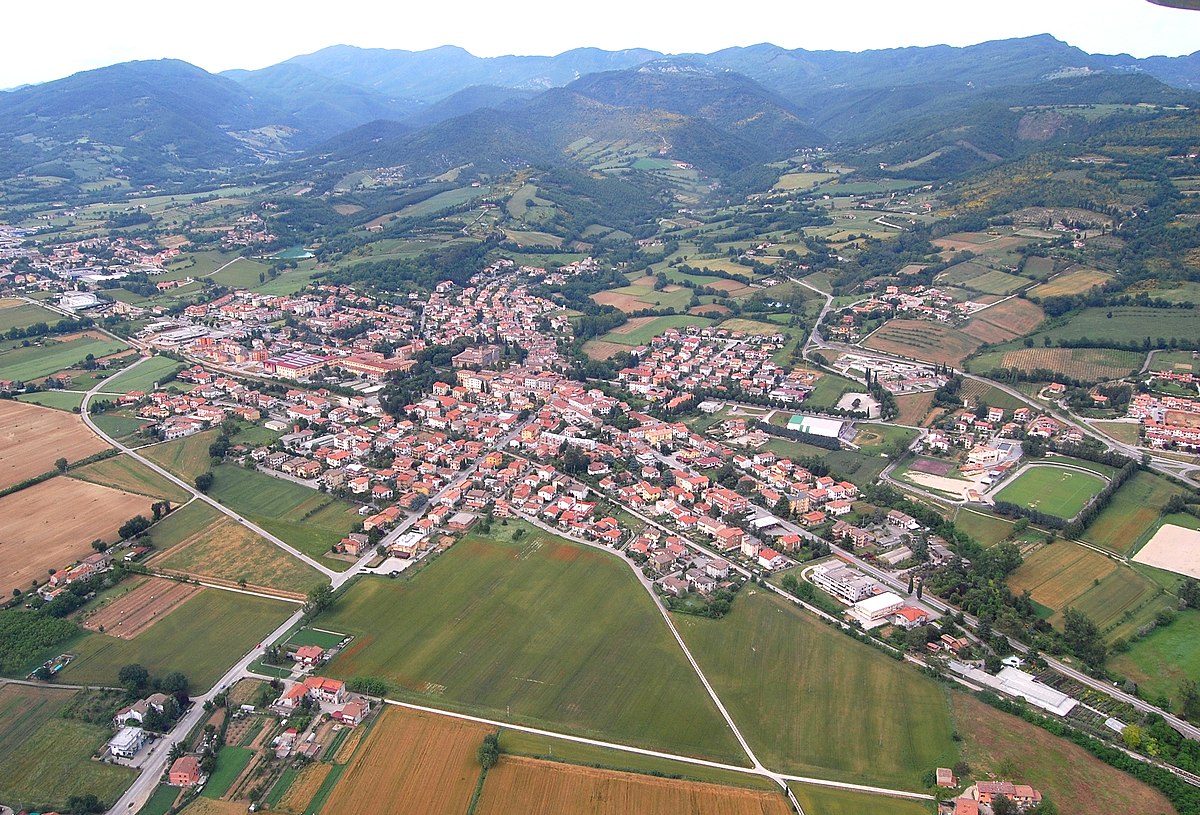
San Giustino forms a single urban agglomeration with the neighboring Tuscan city of Sansepolcro, together hosting about 26,000 inhabitants. Despite belonging to different regions and provinces today, the two cities share deep territorial and demographic ties stretching back to antiquity. The municipality centers on its archpriest church, dedicated to the Christian martyr Justin, with medieval fortifications and Renaissance art completing the civic landscape.
History
Early Christian settlement here is confirmed by Arezzo archives documenting remains of a 7th-century parish church. The city takes its name from Saint Justin, the Christian martyr killed at Pieve de’ Saddi in nearby Pietralunga. Beneath the archpriest church lies an early Christian crypt constructed with material from Colle Plinio, a hilltop location long identified with the Villa in Tuscis owned by Pliny the Younger, the celebrated Roman letter-writer and nephew of Pliny the Elder.
The Bufalini Castle emerged as the defining symbol of the city during the medieval period, while the Church of the Santissimo Crocifisso was built under the patronage of Cardinal Giovanni Ottavio Bufalini, later archbishop of Ancona. Cospaia, a nearby village, maintained an independent republic until the early 19th century.
What you see
The archpriest church of San Giustino dominates the city center and serves as the principal church for all surrounding parishes within the diocese of Città di Castello. Bufalini Castle stands with characteristic elegance and majesty, its presence unmistakable across the urban fabric.
The Church of the Santissimo Crocifisso showcases notable Renaissance decoration, its interior enriched with frescoes and stuccos attributed to the Della Robbia brothers. The façade, facing the Town Hall square, features a gabled design. Above the city, Roccolo Municipal Park offers a wooded retreat with a summer stage and kiosk, organically accessible from the piazza below.
Cultural significance
San Giustino represents a rare archaeological and historical palimpsest: the superposition of early Christian spirituality, medieval civil authority, and classical Roman elite culture. The villa of Pliny the Younger, celebrated in the literary record, renders the locality significant to classical studies and Roman provincial archaeology. The integration of Renaissance religious patronage through the Della Robbia works connects the town to broader Italian artistic movements.
Key facts
- Address: Piazza del Municipio 17, 06016 San Giustino (PG), Umbria
- Coordinates: 43.5483959, 12.1770577
- Phone: 075 861 84 11
- Official website: http://www.comunesangiustino.it/
- Museum of the Villa di Plinio in Tuscis located at Villa Graziani in Celalba
Practical information
The Museum of the Villa di Plinio in Tuscis, housed at Villa Graziani, is open April through September on Saturdays, Sundays, and public holidays from 10:00–13:00 and 15:30–18:30. October through March hours are 10:00–13:00 and 14:30–17:30 on Sundays and public holidays. Weekday visits are available by reservation. Archaeological excavations of the villa and educational workshops for schools may also be arranged in advance.
Getting there
San Giustino is located in the upper Tiber valley and adjoins Sansepolcro across the regional border. By car, you can access Roccolo Municipal Park via the large parking lot above the city center, with stairs leading upward into the wooded grounds. For detailed transport options, consult the municipal website or contact the town office.
Sources & resources
- Municipality of San Giustino: http://www.comunesangiustino.it/
- Cultural Heritage Online: https://culturalheritageonline.com
Find it on the map
See this place and what’s around it →📷 Diventa un fotografo di Cultural Heritage Online
Condividi le tue foto dei luoghi: restano pubblicate con la tua firma come autore. Più vengono viste, più ti fai conoscere — e presto un concorso premierà le foto più apprezzate.
Accedi o registrati gratis per aggiungere una foto