
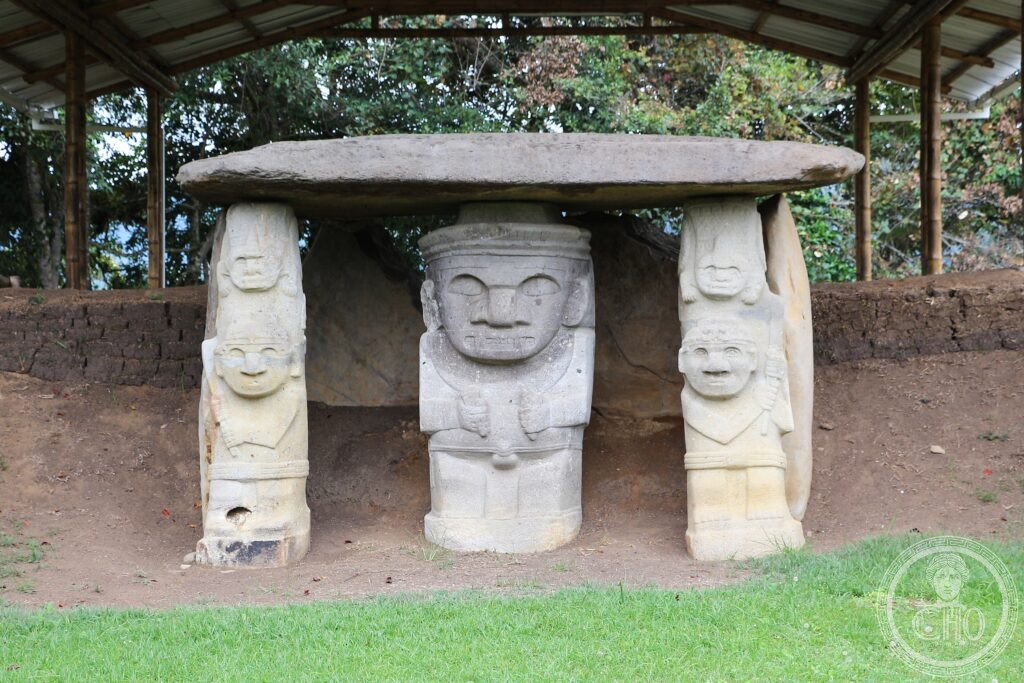
Scattered across the Andean highlands where the Magdalena River begins, San Agustín holds the largest concentration of pre-Columbian stone statues in South America. Carved by a civilisation with no name of its own and no known descendants, the figures still guard the earthen burial mounds they were made to watch over.
At a glance
The San Agustín culture, as archaeologists have named it after the nearest modern town, flourished in this stretch of the Colombian Andes for several centuries before vanishing without leaving written records or a clear line of descendants. Its people carved more than 500 stone statues from volcanic tuff, sandstone and granite, ranging from small figures to monoliths several metres tall, and scattered them across a wide area at the source of the Magdalena River. There are no palaces or temples here, only burial mounds belonging to an elite, each guarded by carved figures standing sentinel over underground funerary chambers.
The recurring imagery is striking and consistent: jaguar-deity figures blending human and feline features, double-headed condors representing the sky world, fanged mouths suggesting shamanic transformation, and guardian figures with arms crossed or raised. The style is related to wider Andean traditions but remains distinctly its own.
Key facts
- Location: San Agustín, Huila Department, Colombia, in the Andean highlands at the headwaters of the Magdalena River, around 1,700 metres above sea level.
- Culture: the San Agustín culture, active roughly from the 1st to the 8th century CE, possibly with earlier origins.
- Statues: over 500 carved figures in volcanic tuff, sandstone and granite, from small pieces to monoliths several metres high.
- Function: the statues stood as guardians over underground burial chambers covered by earthen mounds.
- Status: protected as an archaeological zone by the Colombian government since 1931, administered today by the Colombian Institute of Anthropology and History, and inscribed by UNESCO as a World Heritage Site in 1995.
History
The earliest European reference to San Agustín appears in a document by Francisco de Cali in 1559. Two centuries later, the Franciscan friar Juan de Santa Gertrudis gave the first detailed European description in 1756, calling the statues Indian idols in his account and originating several later legends, including tales of tunnels beneath the mounds. Systematic scientific study began only in the early twentieth century, when the German archaeologist Konrad Theodor Preuss carried out fieldwork between 1913 and 1914 and published the first comprehensive catalogue of the site.
The Colombian ethnologist Gregorio Hernández de Alba led the first government-sponsored excavations in 1937, four years after the Colombian state had already declared San Agustín a protected archaeological zone in 1931. The site remains under the care of the Colombian Institute of Anthropology and History and was inscribed by UNESCO in 1995.
Why the San Agustín culture disappeared around the 8th century is not known. Migration, epidemic and absorption into another culture have all been suggested, but no group today identifies as its direct descendant, though the Nasa and Inga peoples of the region may share distant ancestry.
What you see
The park is divided into several excavation zones close to the town of San Agustín, known as Mesita A, B, C and D. Mesita A is the largest, holding more than twenty statues and the most complete burial chamber complex uncovered so far. Mesita B is considered the most visually striking group and includes the so-called God of Death statue. Mesita C and D are smaller but add further statue groupings to the circuit.
The burial chambers themselves are carved from volcanic tuff and roofed with stone slabs. Many retain interior paintings in red, yellow, black and white showing geometric and zoomorphic designs, among the best-preserved rock art in Colombia, and originally held burial goods including gold jewellery, ceramic vessels and carved stone objects.
A short distance away lies the Fuente de Lavapatas, a ritual water sculpture carved directly into the rock bed of a stream. Serpent channels, human faces and basins are cut into the stone so that flowing water animates the carvings, making the serpents appear to move. It is attributed to the San Agustín culture around the 3rd to 7th century CE. Further out, the Alto de los Ídolos holds the largest known monolith from the culture, a standing figure some four metres tall, though reaching it requires more time and a rougher journey than the main park.
Practical information
- Access: the main archaeological zones lie close to San Agustín town and are open to visitors on a regular schedule; current hours and admission arrangements are best checked with the Colombian Institute of Anthropology and History or the site’s official visitor channels.
- Outlying sites: the Alto de los Ídolos, some way from the town, requires separate admission and is reached by car or on horseback; horseback riding is a popular and atmospheric way to visit the more remote statue groups.
- Guides: local guides, including English-speaking ones, can be arranged at the main park entrance; rates should be confirmed locally rather than assumed in advance.
- Where to stay: San Agustín town itself, at 1,700 metres and cool year-round, is the natural base, with at least one night recommended and two more comfortable.
Getting there
San Agustín town lies well inland in Huila Department. Travellers commonly fly into Neiva, the departmental capital, and continue overland to San Agustín, or take a direct overland journey from Bogotá through the Magdalena Valley. Many visitors combine the trip with the Tatacoa Desert to the north. Current routes, schedules and fares are best checked directly with carriers or local operators before travelling.
Nearby
- Tatacoa Desert — around 90 km north of San Agustín, Colombia’s second-largest semi-desert, a dry tropical landscape of red and grey badlands with an astronomical observatory known for clear night skies and a record of significant fossil finds.
- Tierradentro — around 100 km north, another major Colombian archaeological site inscribed by UNESCO in 1995, notable for underground painted burial chambers belonging to a culture contemporary with, but stylistically distinct from, San Agustín.
- Alto de los Ídolos — the most remote of San Agustín’s own excavation zones, holding the largest known monolith of the culture.
Sources
- Wikipedia
- UNESCO
Find it on the map
See this place and what’s around it →📷 Become a Cultural Heritage Online photographer
Share your photos of places: they stay published under your name as the author. The more they're seen, the more you get noticed — and soon a contest will reward the most appreciated photos.
Log in or sign up free to add a photo