
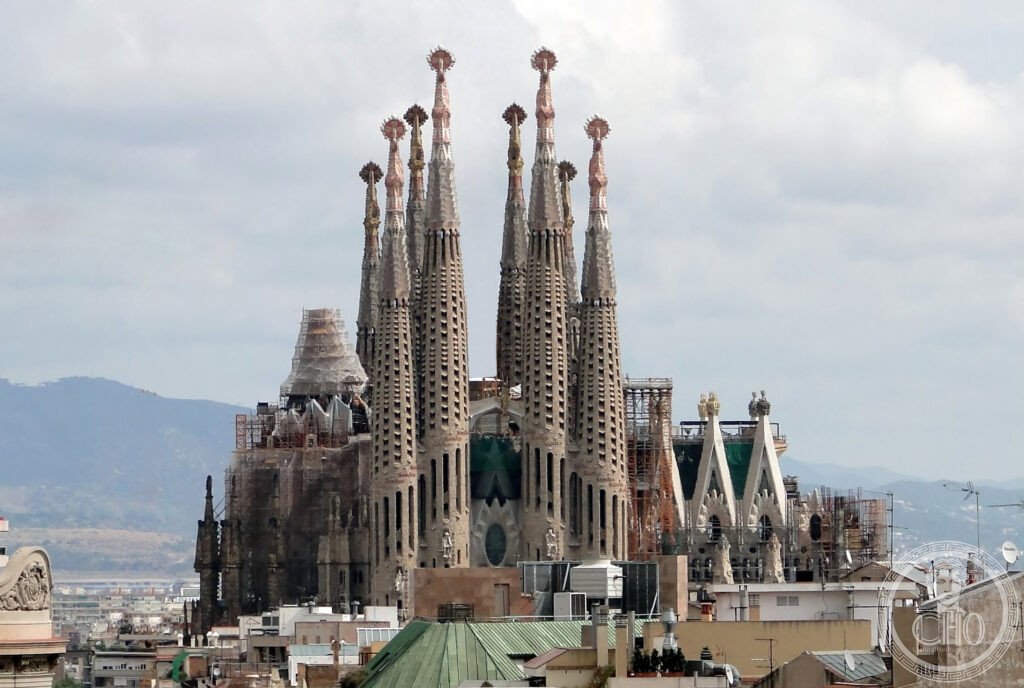
Sagrada Família — Barcelona
Antoni Gaudí devoted the last forty-three years of his life to this basilica and died in 1926 with only the crypt and one facade complete — it has been under construction for over 140 years, and when its eighteen towers are finally built, it will be the tallest church in the world.
At a glance
The Basílica de la Sagrada Família stands in the Eixample district of Barcelona, its cluster of organic stone towers visible from much of the city. Construction began in 1882 under the architect Francisco de Paula del Villar; Antoni Gaudí (1852–1926) took over in 1883 and transformed the project into an entirely original architectural expression that fused Catalan Gothic, Art Nouveau, and a deeply personal symbolic language drawn from nature and Christian theology. When Gaudí was killed by a tram in 1926, he had completed the crypt, the apse, and the Nativity facade; subsequent generations of architects, working from his models and drawings, have continued the construction using modern computer-aided methods. As of 2026, the building is approximately 70–80% complete. Despite being unfinished, it receives approximately 4.5 million visitors annually and has been protected as a UNESCO World Heritage Site since 1984 (as part of the Works of Antoni Gaudí).
Key facts
- Architect: Antoni Gaudí (1852–1926); construction begun 1882; Gaudí became principal architect 1883; Gaudí lived and worked on-site from 1906; killed by tram 1926
- Program: 18 towers when complete; the tallest (Jesus Christ tower) will reach 172.5 metres — the tallest church in the world; three facades: Nativity (Gaudí, completed 1930s), Passion (Subirachs, 1980s–2000s), Glory (under construction)
- Interior: a forest of branching columns distributing light through hyperboloid skylights; opened in stages; the interior in its current form was inaugurated by Pope Benedict XVI in 2010
- Funding: entirely funded by visitor entrance fees and private donations; no government or church funding; this has been the case since the 1880s
- Gaudí’s grave: Gaudí is buried in the crypt of the Sagrada Família; a process for his beatification (as a candidate for sainthood) has been open in the Vatican since 2003
- Heritage: UNESCO World Heritage Site as part of Works of Antoni Gaudí, inscribed 1984
- GPS: 41.4036° N, 2.1744° E
History
The project was initiated by the Josephine Spiritual Association, a conservative Catholic lay organisation that wanted to build a church dedicated to the Holy Family as an act of atonement for the sins of modern secular society. The original architect, Villar, had begun a conventional Neo-Gothic crypt when Gaudí took over; Gaudí redesigned the crypt in a more ornate Gothic manner and then gradually — over the following four decades — evolved an entirely unprecedented architectural language for the rest of the building. The Nativity facade, the east-facing facade that celebrates the birth of Christ, was the first to be designed and is the most profusely ornamented: every surface is covered with naturalistic sculpture of plants, animals, and figures, the stone surface itself textured to suggest organic growth.
Gaudí’s construction method was as unconventional as his forms. He worked with hanging chain models (catenary arches in reverse) to calculate structural loads, photographed the models inverted to reveal the vaulting systems they implied, and employed a team of craft workers — stone carvers, ceramicists, ironworkers — who executed his designs through direct collaboration rather than detailed drawings. When his studio was burned in an anarchist attack in 1936, most of his drawings and models were destroyed; reconstruction of his intentions has required decades of forensic work by the current building committee.
The building was consecrated as a basilica by Pope Benedict XVI in November 2010, making it technically complete for liturgical purposes even as construction continues. The completion date, repeatedly revised, is currently projected for the centenary of Gaudí’s death in 2026 — though as of mid-2026, this timeline remains aspirational rather than confirmed, with significant work still to be completed on the Glory facade and the central towers.
What you see
The Nativity facade (east) is Gaudí’s own completed work: three portals (Faith, Hope, Charity) surmounted by four towers, the entire surface alive with carved plants, animals, and a gospel narrative that reads from the street as a dense thicket of stone and meaning. The detail rewards slow reading — the salamanders, turtles, pelicans, and pomegranates are not ornamental but symbolic. The towers taper in parabolic arcs finished with ceramic mosaics in green and gold; the inscriptions winding up their spiral columns spell “Hosanna” and “Excelsis.”
Inside, the nave columns branch like trees at their tops, dividing and subdividing to carry the vaulting loads and direct the structural forces parabolically to the foundations. The light enters through circular skylights in the hyperboloid vaults and through windows of geometric stained glass — warm ambers and golds on the west, cool greens and blues on the east — which flood the nave with changing colour as the sun moves. Gaudí’s intention was a building that was simultaneously a forest of stone and a physical representation of theology; the interior, whatever one thinks of the exterior’s chaos, is one of the most extraordinary spaces created in the 20th century.
Practical information
- Address: Carrer de Mallorca 401, 08013 Barcelona, Spain
- Hours: daily 9 am–8 pm (summer); 9 am–6 or 7 pm (winter); Mass on Sundays 9 am (no ticket required for Mass)
- Admission: EUR 26 standard; EUR 36 with tower access; mandatory advance booking at sagradafamilia.org — the most visited monument in Spain routinely sells out days or weeks ahead
- Towers: Nativity tower (lift + stairs) offers the best views of the Nativity facade at close range; Passion tower offers views toward the city and sea; included in the EUR 36 ticket
- Free view: the outside of the Nativity facade can be appreciated for free from Plaça de Gaudí across the street
Getting there
Metro L2 or L5 to Sagrada Família (direct). From Las Ramblas: 20 minutes by metro or 30 minutes on foot. From Barcelona El Prat Airport: FGC or metro, approximately 45 minutes. GPS: 41.4036, 2.1744.
Nearby
- Casa Milà (La Pedrera) — Gaudí’s 1912 apartment building with the famous undulating stone facade and rooftop of chimneys and stairway towers; 10 minutes on foot; UNESCO WHS
- Casa Batlló — Gaudí’s 1906 remodel of a Passeig de Gràcia apartment building; the dragon-scale roof and marine interior are among his most exuberant works; 15 minutes on foot; UNESCO WHS
- Park Güell — Gaudí’s 1914 monumental park on Carmel hill; the main terrace and colonnaded hall are his most accessible public works; UNESCO WHS; 3 km north
- Palau de la Música Catalana — Lluís Domènech i Montaner’s 1908 Art Nouveau concert hall; UNESCO WHS; the interior stained glass is extraordinary; 20 minutes by metro
Sources
- Wikipedia, Sagrada Família, accessed June 2026
- Official site: sagradafamilia.org
- UNESCO, Works of Antoni Gaudí, WHS reference 320, inscribed 1984/2005
- Rainer Zerbst, Gaudí: A Life Devoted to Architecture, Taschen, 1997
Find it on the map
See this place and what’s around it →📷 Diventa un fotografo di Cultural Heritage Online
Condividi le tue foto dei luoghi: restano pubblicate con la tua firma come autore. Più vengono viste, più ti fai conoscere — e presto un concorso premierà le foto più apprezzate.
Accedi o registrati gratis per aggiungere una foto