

In 1966 more passengers landed here than anywhere in Italy except Rome, Milan and Venice. For forty years it was also a front-line NATO base.
At a glance
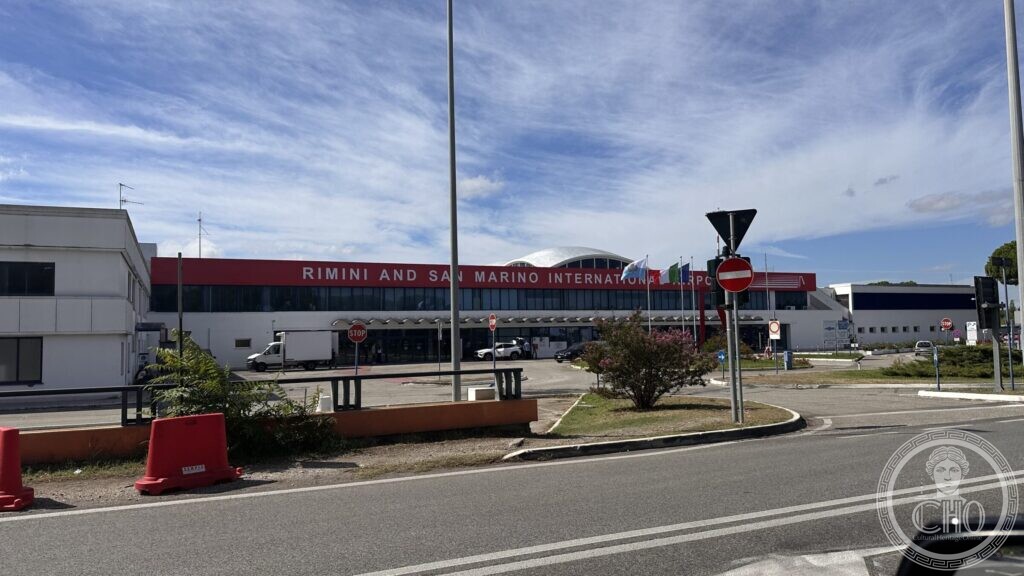
The airport at Miramare, on the southern edge of Rimini, is the reason the Romagna coast filled with foreign holidaymakers in the 1960s, and it was for four decades one of the busiest military airfields in Italy. It was inaugurated in 1929 and named after sergeant Giannetto Vassura, killed in 1918; NATO installed itself here in 1956; and civil traffic, run from 1962 by a company called Aeradria, peaked in 1966, when Rimini ranked fourth in Italy for passengers landed. The Italian-American military presence lasted until 1995 and the military unit closed in 2010. Today the terminal carries the name of Federico Fellini, and the sign across it reads RIMINI AND SAN MARINO INTERNATIONAL AIRPORT.
Key facts
- Inaugurated: 1929, as a military airfield
- Named after: sergeant Giannetto Vassura, killed in 1918
- Earlier: the Rimini-Riccione defence section operated on this ground from 19 July 1916 to 18 November 1918
- NATO: installed at Rimini in 1956 with the Aeronautica Militare and the 5a Aerobrigata
- 1967: the 5a Aerobrigata disbanded and re-formed as the 5° Stormo Caccia Bombardieri «Giuseppe Cenni»
- 1980s–1993: the 83° Gruppo SAR, search and rescue
- 1995: the Italian-American coexistence ends; the Comando Aeroporto Rimini is set up. 2010: the unit closes for good
- Civil side: a tented terminal from 1958, a passenger building in 1961, and Aeradria SpA founded on 14 September 1962
- Peak: 1966 — fourth in Italy for passengers landed, behind Rome, Milan and Venice
- Coordinates: 44.023153, 12.620269 — Google Maps
History
Flying came to this ground before the resort did. From 19 July 1916 to 18 November 1918 the Rimini-Riccione defence section operated here; the permanent airfield was inaugurated in 1929 and dedicated to sergeant Giannetto Vassura, who had been killed the year before. For the next sixty years the city of amusement lived beside a military installation, and for a good part of that time beside a front line: NATO came to Rimini in 1956 with the Aeronautica Militare and the 5a Aerobrigata, and the airfield became strategically important for Italian and Atlantic air defence.
The civil story runs alongside it, and it is startling. The historian Andrea Montemaggi has reconstructed it: a tent served as the terminal from 1958, a passenger building went up in 1961, and on 14 September 1962 Aeradria SpA was founded with a capital of five hundred thousand lire, under the presidency of Alessandro Cecchi with Giuseppe Cantoni as director general. Arrivals climbed from 1963. By 1964 thirty-eight airlines were using Miramare; in that year alone 872 aircraft came in from Britain with more than fifty-four thousand passengers, and 334 from Sweden with more than twenty-three thousand. In 1966, the peak year, the number of passengers landed put Rimini fourth in the national table, behind Rome (Ciampino and Fiumicino), Milan (Linate and Malpensa) and Venice. The decline began around 1969.
On the military side, the 5a Aerobrigata was disbanded in 1967 and re-formed as the 5° Stormo Caccia Bombardieri, named after the war pilot Giuseppe Cenni; in the 1980s the 3° Gruppo di Volo arrived, and the 83° search-and-rescue unit stayed until 1993. The Italian-American coexistence ended in 1995 with the creation of the Comando Aeroporto Rimini, and the military unit closed altogether in 2010. The field is now entirely civil.
The airport carries Federico Fellini’s name, as the Grand Hotel carries his memory and the Fulgor cinema his childhood. The commercial title on the terminal, RIMINI AND SAN MARINO INTERNATIONAL AIRPORT, records the other half of its catchment: the Republic of San Marino, twenty kilometres inland, has no airfield of its own.
What you see
Nothing of 1929 is on view from the public side. The terminal is a long low building of the late twentieth century, white and glazed, with a red band along the roofline carrying the name in capitals and a curved metal canopy over the departures hall. In front, a forecourt with flagpoles, a roundabout and a car park; behind, the runway and the buildings of the former military base.
It is included in this archive for what it stands on rather than for what it looks like. If you want to see the 1929 airfield and the NATO years, the material is in the local archives and in the centenary volume published in 2016 — not on the apron.
The airport today

Practical information
- The airport is at Miramare, on the southern edge of Rimini, alongside the railway stop of Rimini Miramare and a short way from the Colonia Bolognese and the Colonia Novarese.
- Bus 9 runs between the airport and the city centre.
- Flight information and current operations: the airport’s own site. Traffic is seasonal and the schedule changes considerably between summer and winter.
Getting there
Via Flaminia, Miramare di Rimini, about eight kilometres south of the historic centre. Bus 9 from the station and the centre; the Rimini Miramare railway stop is a few minutes away on foot.
Nearby
- Colonia Marina Bolognese, Miramare di Rimini (1932)
- Colonia Novarese — Peverelli’s Rationalist ship at Miramare (1934)
- The three abandoned colonie on viale Gabriele D’Annunzio, Riccione
- Grand Hotel Rimini, with a 360° virtual tour
Sources
- Andrea Montemaggi, L’età dell’oro dell’aeroporto di Rimini, in «Ariminum», January–February 2024 — for the tented terminal of 1958, the passenger building of 1961, the founding of Aeradria on 14 September 1962, the thirty-eight airlines of 1964, the British and Swedish traffic figures, and the fourth place in the national table in 1966.
- RomagnaZone, L’Aeronautica Militare a Rimini — for the dedication to sergeant Giannetto Vassura, the inauguration in 1929, NATO from 1956, the 5a Aerobrigata and the 5° Stormo «Giuseppe Cenni» from 1967, the 83° SAR until 1993, the end of the Italian-American presence in 1995 and the closure of the unit in 2010.
- 100 anni di Aeronautica a Rimini 1916–2016, Edizioni Tassinari — the centenary volume, for the 1916–18 defence section.
- On-site photography, 11 September 2026.
Find it on the map
See this place and what’s around it →Record researched and written by Luigi De Marchi for Cultural Heritage Online, 2026.
📷 Become a Cultural Heritage Online photographer
Share your photos of places: they stay published under your name as the author. The more they're seen, the more you get noticed — and soon a contest will reward the most appreciated photos.
Log in or sign up free to add a photo