

They called it the Stradone dei bagni, the baths road. It is the street on which Rimini invented itself as a seaside town, and it still carries the evidence — unevenly, house by house.
At a glance
Viale Principe Amedeo runs from the edge of the old city to the sea, ending at Parco Federico Fellini and the Grand Hotel. It was laid out as the spine of the new bathing quarter in the second half of the nineteenth century, and its villas are a record of that project: the first of them, Villa Lega Baldini, went up in 1870 for the brothers who had opened Rimini’s bathing establishment in 1843; Villa Solinas followed in 1874, on a plot the town council gave away free to get it built. Both are by the same man, Gaetano Urbani, the municipal engineer. After them came sixty years of villas in every fashion — eclectic Gothic, Liberty, the sober brick of the 1920s, the plain modern of the 1930s — and then, after the Second World War, the hotels. This page is about the avenue as a whole, and about the houses on it that have no monograph of their own.
Key facts
- Original name: the Stradone dei bagni, the baths road, with trees along both pavements
- Runs: from the historic centre to Parco Federico Fellini and the seafront
- The first villa: Villa Lega Baldini, 1870, by Gaetano Urbani, for counts Ruggero and Alessandro Baldini
- The second: Villa Solinas, from 1874, by the same architect, on land granted free by the town council
- The pattern: the municipality gave plots away to attract builders after it took the bathing establishment into public hands
- The study: Giovanni Rimondini, Villa Solinas. Le prime dieci ville di Marina centro e l’opera dell’ingegnere comunale Gaetano Urbani (1823–1879), Maggioli, 1998
- Coordinates (mid-avenue): 44.069900, 12.575000 — Google Maps
History
Rimini’s bathing story begins in 1843, when the counts Ruggero and Alessandro Baldini and Dr Claudio Tintori opened six wooden cabins on stilts off this shore. It took another generation for the town to follow. When it did, the municipality under mayor Pietro Fagnani municipalised the bathing establishment and set out to make a residential quarter out of the empty ground between the city and the sea. The avenue through it was the Stradone dei bagni; it acquired its royal name later.
The method was simple and effective: build a villa yourself to show it can be done, then give the land away to whoever will build the next. The Baldini brothers built first, in 1870. In 1874 Gian Maria Solinas Apostoli was awarded his plot for nothing and put up the most elaborate house on the street. The architect of both was Gaetano Urbani, the municipal engineer, whose first ten villas of Marina Centro are the subject of a book by Giovanni Rimondini.
What followed is legible from the pavement. The eclectic Gothic of the 1870s gives way to the Liberty of the years before the First World War — carved caryatids, wreathed heads over the windows, wrought iron in whiplash curves — and then to the sober brick and stone of the 1920s, with Latin mottoes cut into the friezes, and finally to the flat-fronted, hip-roofed houses of the 1930s. A photograph in the Istituto Luce archive, dated 1928 and captioned as this avenue, shows the whole of it under young trees, villa after villa, before any of the hotels.
The war and the tourist boom took most of it. On the Romagna coast hundreds of villas were pulled down after 1945 to put up hotels and boarding houses; on this avenue the survivors now stand between apartment blocks, and at least one of the best of them stands empty in a garden that has turned into a wood. What is left is a series of fragments, and it repays walking slowly.
What you see, walking down to the sea
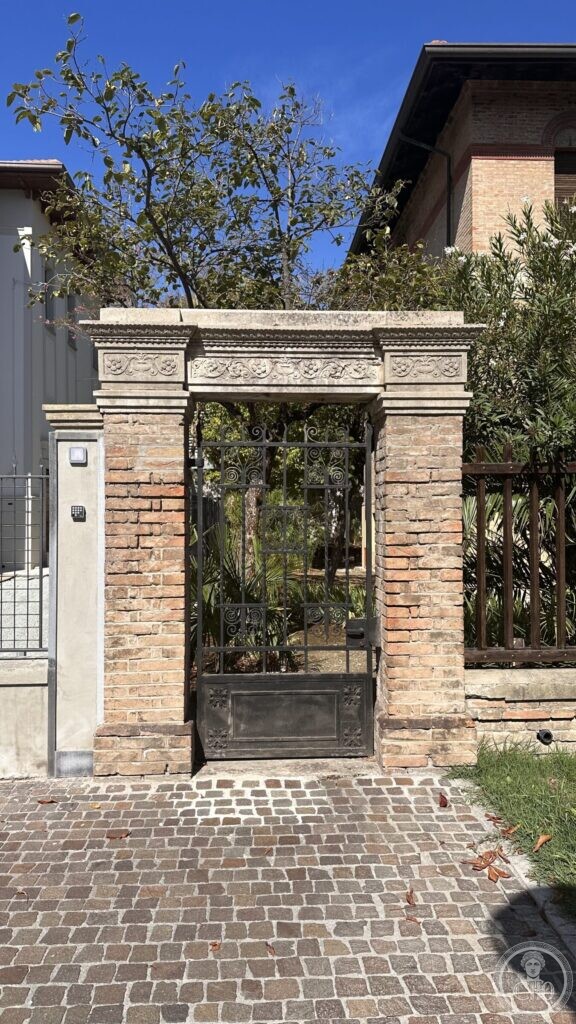
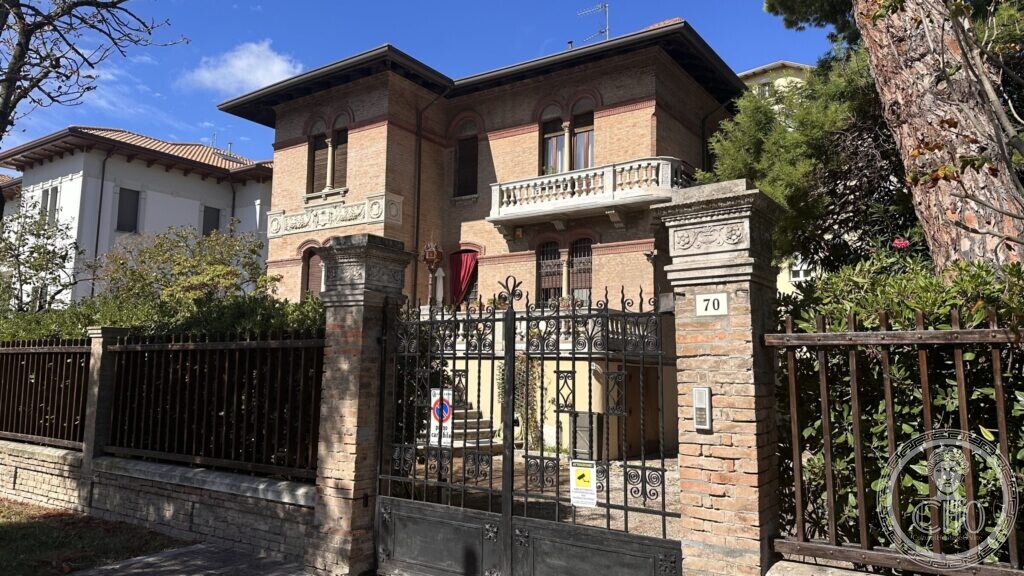
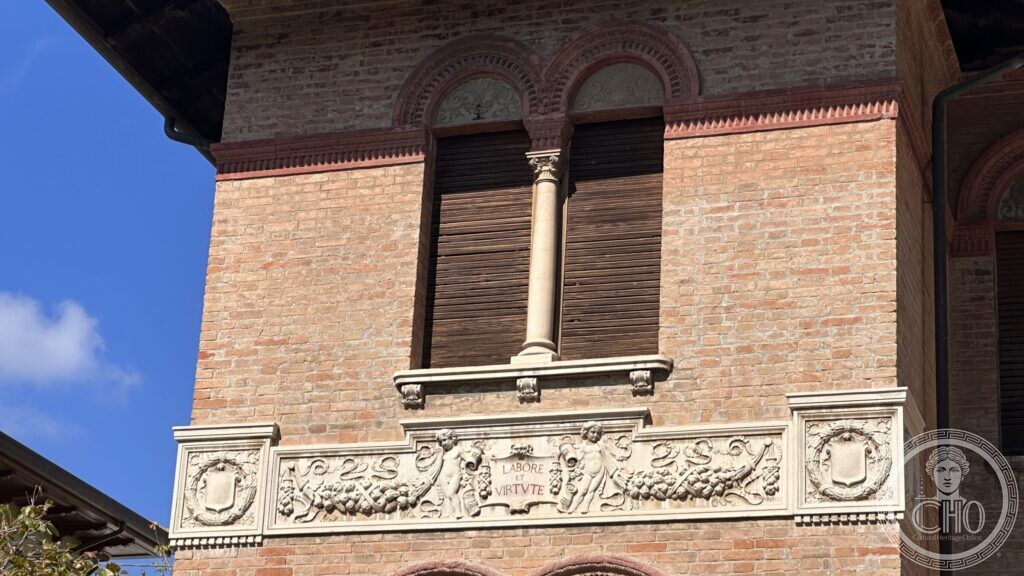
The villa at number 70 is the one to stop at first. Brick, two floors, with deep overhanging eaves and paired arched windows separated by slender stone colonettes; a white stone balcony on carved brackets; and, across the front at first-floor level, a carved frieze of putti and vine swags with a cartouche in the middle reading LABORE ET VIRTUTE — by labour and by virtue. On the garden side a stone gateway carries a lintel of festoons and rosettes. We have found no record of who built it or when.

Villa dell’Angelo, at number 54, is a plainer house of the 1930s behind a high hedge, and it earns its name from a single object: a white relief set into the garden wall beside the gate, showing an angel with a halo and folded wings playing a psaltery. The name is on the gatepost in red letters. Again, nothing documented.
Further south, towards the station end, another brick villa in the Gothic manner survives, its upper windows pointed under moulded hoods, a band of quatrefoil openwork beneath them and urns along the parapet. It is not Villa Solinas — that stands seventy metres north, beside the church of San Girolamo — and we have not been able to give it a name.
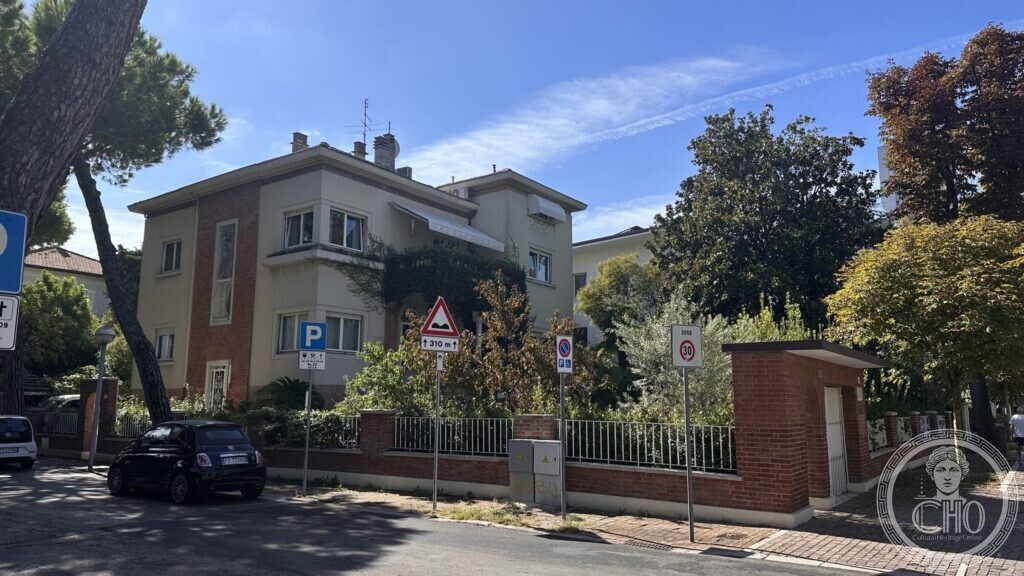
And then the ordinary ones: a cream-rendered corner house of the 1930s with a brick base and a hipped roof, of the kind that filled the gaps between the villas and that nobody photographs. They are part of the record too.
Along the avenue



Practical information
- All of these are private houses on a public street. Everything here was photographed from the pavement.
- The walk from the station to Parco Fellini takes about twenty minutes and passes every building mentioned on this page.
- Rimini runs Liberty itineraries and, in July, an Art Nouveau Week that opens buildings normally closed. Check with Rimini Turismo.
- Can you name these houses? Several of the villas on this avenue have no published record at all. If you know their families, their builders or their dates, please write to us.
Getting there
The avenue begins a few minutes from Rimini station and ends at Piazzale Fellini. Bus 11 runs along the seafront at the far end; the whole street is walkable in twenty minutes.
The villas with pages of their own
- Villa Lega Baldini, 1870 — the first villa of the marina
- Villa Solinas, 1874 — Gaetano Urbani’s Gothic villa, beside the church of San Girolamo
- The abandoned Liberty villa at the corner of viale Centauro
- The Fontana dei Quattro Cavalli in Parco Federico Fellini, at the sea end
- Grand Hotel Rimini, with a 360° virtual tour
- Kursaal di Rimini — the bathing palace of this seafront, demolished in 1948
Sources
- Giovanni Rimondini, Villa Solinas. Le prime dieci ville di Marina centro e l’opera dell’ingegnere comunale Gaetano Urbani (1823–1879), Maggioli Editore, 1998.
- Annamaria Bernucci, «Chiamami Città», republished by the Associazione Rimini Sparita as Villa Solinas, la più bella del viale (2018) — for the Stradone dei bagni, the free grant of land under mayor Fagnani, and Villa Lega Baldini of 1870 facing it.
- Associazione Rimini Sparita, Ruggero Baldini (1824–1904) and Quei lecci del Conte Baldini….
- Archivio storico Istituto Luce, photograph Lungo, ampio viale alberato con villini — viale Principe Amedeo (?), Rimini Marina, 1928.
- «Corriere Romagna», Viserba e Viserbella «reginette» del Liberty — for the scale of the post-war demolitions on the Romagna coast.
- Biblioteca Gambalunga, Rimini, photographic archive — Di foto in foto. Scatti di oltre un secolo di vita balneare riminese.
- On-site observation and photography, 11 September 2026. The names and mottoes quoted here were read on the buildings themselves; where we give no date or architect, it is because we found none.
Find it on the map
See this place and what’s around it →Record researched and written by Luigi De Marchi for Cultural Heritage Online, 2026.
📷 Become a Cultural Heritage Online photographer
Share your photos of places: they stay published under your name as the author. The more they're seen, the more you get noticed — and soon a contest will reward the most appreciated photos.
Log in or sign up free to add a photo