
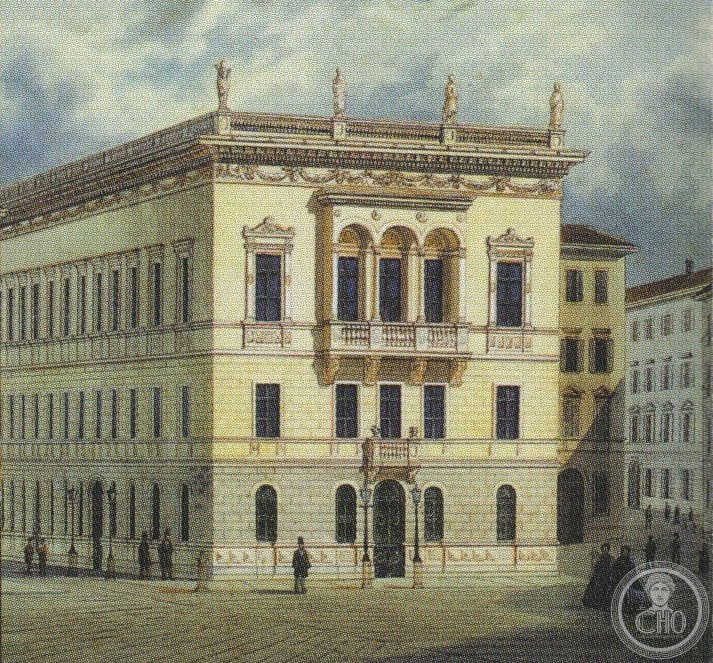
Revoltella Museum
The Revoltella Museum is Trieste’s civic gallery of modern art, housed in the neoclassical palace that Baron Pasquale Revoltella bequeathed to the city upon his death in 1869, together with his entire collection. The original 19th-century palazzo — designed by Friedrich Hitzig and completed in 1858 — was expanded in 1991 by a bold contemporary extension designed by Carlo Scarpa and Valeriano Pastor, creating a juxtaposition of historic and modern architecture that is celebrated among Italy’s most significant museum-design projects. The collection spans from the mid-19th century to the present and includes works by major Italian and European artists.
At a glance
- Type
- Civic museum of modern and contemporary art
- Period
- Palace built 1858; museum founded 1872; Scarpa extension completed 1991
- Style
- Neoclassical (original palace); Brutalist / late modernist (Scarpa extension)
- Location
- Via Armando Diaz 27, 34121 Trieste, Italy
- Coordinates
- 45.6472° N, 13.7634° E
Overview
The Revoltella is one of Italy’s oldest civic museums dedicated to modern art, and its dual identity — a patrician palazzo preserved as a period interior alongside a purpose-built contemporary gallery — makes it architecturally unique in the Italian museum landscape. The museum holds over 5,000 works including paintings, sculptures, decorative arts, and drawings, and mounts a programme of temporary exhibitions alongside the permanent display. It serves as the primary venue for Trieste’s engagement with national and international contemporary art.
History
Pasquale Revoltella was a Venetian-born baron who built his fortune as a financier in Trieste and played a key role in funding the construction of the Suez Canal. On his death in 1869, he left his palazzo, collection, and a substantial endowment to the City of Trieste with the instruction to use it as a museum of art and applied arts. The museum opened to the public in 1872. After decades of expansion needs, the city commissioned Carlo Scarpa in the 1960s to design an annex; Scarpa worked on the project until his death in 1978, and it was completed by his collaborator Valeriano Pastor and opened in 1991. The Scarpa wing is now considered one of the last major realisations of his architectural vocabulary.
What you see
The original palazzo is preserved as a 19th-century period interior with Revoltella’s furniture, decorative objects, and salon paintings arranged as he left them, giving visitors a rare glimpse into the lifestyle of a 19th-century Triestine merchant-prince. The Scarpa annex presents a sequence of top-lit galleries arranged on split levels connected by the architect’s signature concrete and terrazzo staircases. An open terrace on the top floor offers panoramic views over the Gulf of Trieste. The collection includes sculptures by Antonio Canova’s school, late-19th-century Triestine painting, and Italian art from the early 20th century through the contemporary period.
Cultural significance
The Revoltella is internationally recognised as one of Carlo Scarpa’s most important built works, and architecture students and professionals visit specifically to study the 1991 extension. As a testament to Trieste’s cosmopolitan 19th-century bourgeoisie, the baron’s palazzo also offers insights into the city’s unique Austro-Hungarian cultural heritage. The museum is a founding institution of Trieste’s cultural identity as a city at the intersection of Italian, Slavic, and Central European traditions.
Practical information
- Address
- Via Armando Diaz 27, 34121 Trieste TS, Italy
- Opening hours
- Tuesday–Sunday; check official website for current hours and ticket prices
- Admission
- Paid entry; reduced rates for students, seniors, and groups
Getting there
The museum is in central Trieste, a 10-minute walk from Piazza Unità d’Italia and the waterfront. Trieste Centrale railway station is approximately 15 minutes on foot or reachable by several city bus lines. The city is served by direct trains from Venice (about 2 hours) and by Trieste Airport (Ronchi dei Legionari), roughly 30 km north, connected by bus shuttle.
Sources & resources
Find it on the map
See this place and what’s around it →Historical events at this place (1)
📷 Diventa un fotografo di Cultural Heritage Online
Condividi le tue foto dei luoghi: restano pubblicate con la tua firma come autore. Più vengono viste, più ti fai conoscere — e presto un concorso premierà le foto più apprezzate.
Accedi o registrati gratis per aggiungere una foto