
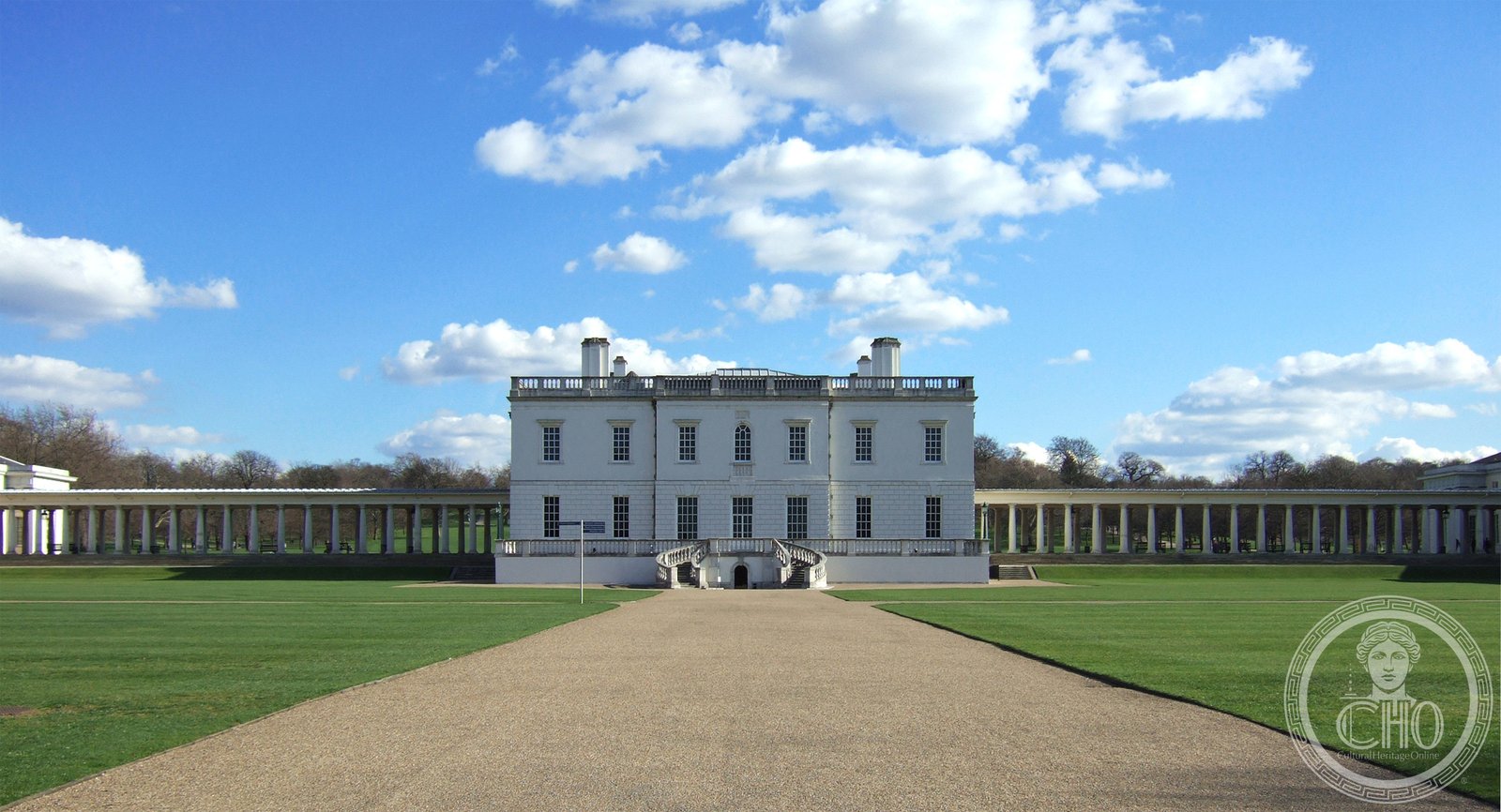
A revolutionary classical palace in Greenwich that anchors the Old Royal Naval College, now a museum displaying maritime art within one of Britain’s most historically significant buildings.
At a glance
Queen’s House stands on the grounds of the former Greenwich Palace, a few miles downriver from London’s City. Designed by Inigo Jones and commissioned by queens Anne of Denmark and Henrietta Maria, it functioned as a royal retreat and art gallery. Today it forms the visual centerpiece of the Old Royal Naval College complex and serves as a public art gallery within the National Maritime Museum, displaying maritime paintings and portraits.
History
Construction took place between 1616 and 1635 for two successive queens. Jones undertook the commission following his 1613–1615 grand tour through Italy, where he studied Roman, Renaissance, and Palladian architecture.
After the monarchy’s departure, the House was integrated into the expanding Royal Hospital for Seamen. Its commanding axial view to the Thames significantly influenced the dramatic layout of the later English Baroque hospital complex. Neoclassical colonnades and wings were added in the early nineteenth century for a Seaman’s school.
What you see
The Queen’s House remains the first consciously classical building constructed in England. While earlier buildings like Longleat borrowed from classical elements, the Queen’s House was the first to be structurally informed by classical precedents—an approach that appeared revolutionary in its time.
Jones’s distinctive design features the Tulip Stairs, an intricate wrought-iron staircase that appears to support itself, and the Great Hall, a geometrically perfect cube. The Great Hall’s ceiling displays Orazio Gentileschi’s Allegory of Peace and the Arts, commissioned by the queens for their art collection.
The 115-foot-wide axial vista extending from the House to the River Thames remains a defining architectural element. Though the design diverges from strict Palladian mathematics, Jones is credited with introducing Palladianism to England through this building.
Cultural significance
Queen’s House holds paramount importance in British architectural history as the nation’s first genuinely classical structure. It marked a watershed moment when English architecture moved from decorative borrowing to systematic study of classical principles.
The building’s integration into the Old Royal Naval College complex demonstrates how a single structure shaped an entire institutional landscape—its proportions and vista became foundational to one of Britain’s most ambitious architectural ensembles, now part of Maritime Greenwich, a World Heritage Site.
Key facts
- Location: Greenwich, United Kingdom
- Coordinates: 51.48°N, 0.00°W
- Built: 1616–1635
- Architect: Inigo Jones
- Commissioned by: Queen Anne of Denmark and Queen Henrietta Maria
- Status: Grade I listed building and scheduled monument
- UNESCO World Heritage Site: Maritime Greenwich
Practical information & getting there
Queen’s House operates as part of the National Maritime Museum and is open to the public as an art gallery. It is located in Greenwich, accessible by riverboat, rail, or road from central London. Specific opening hours and current exhibitions should be confirmed directly with the National Maritime Museum website.
Sources & resources
Find it on the map
See this place and what’s around it →📷 Become a Cultural Heritage Online photographer
Share your photos of places: they stay published under your name as the author. The more they're seen, the more you get noticed — and soon a contest will reward the most appreciated photos.
Log in or sign up free to add a photoIs this page about you?
This page is read by travellers and heritage enthusiasts who find it on Google. Tell us how you are connected to this place and we will take it from there.