
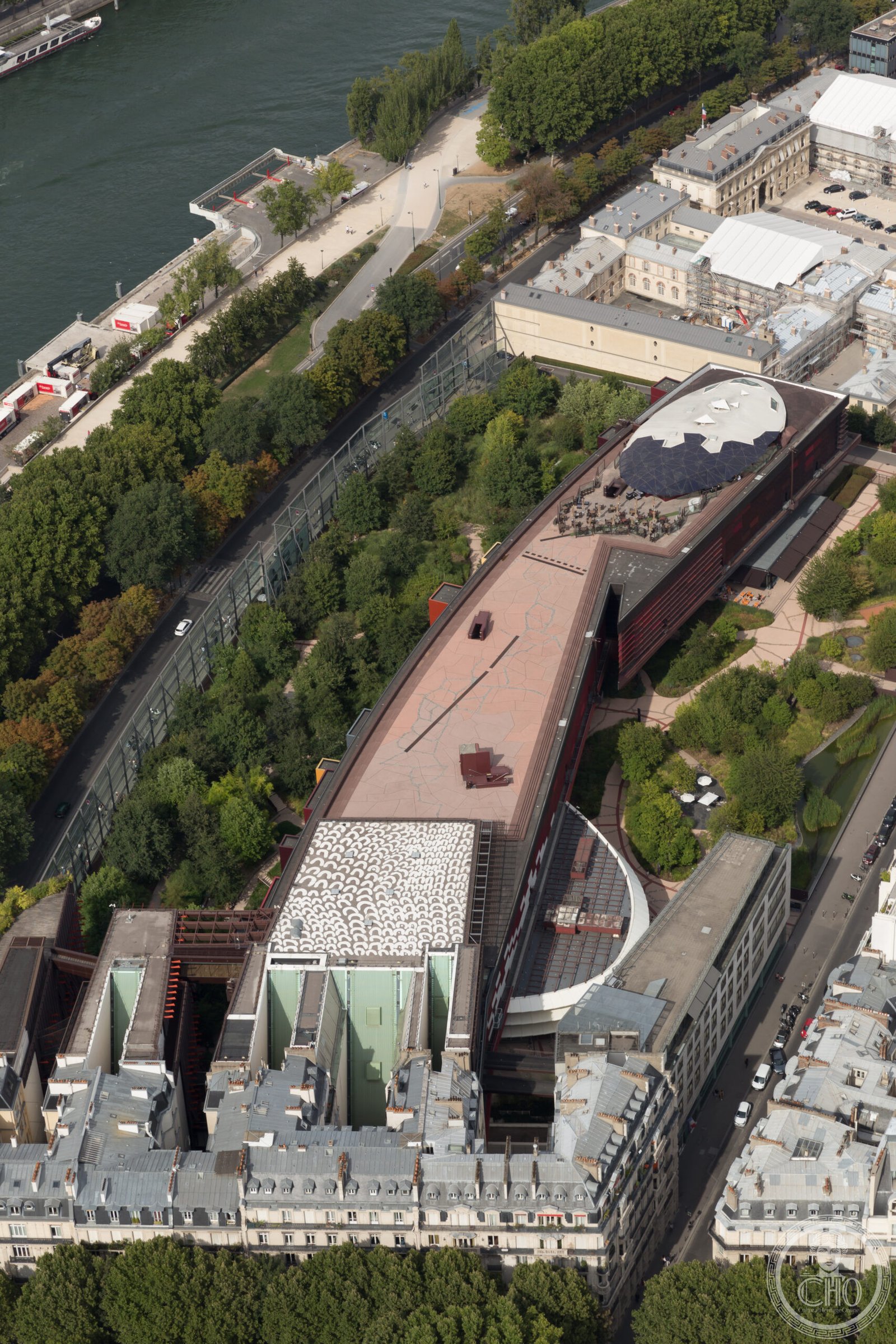
Musée du quai Branly — Museum of Indigenous Arts
The Musée du quai Branly – Jacques Chirac is a museum on the Left Bank of the Seine in Paris, designed by French architect Jean Nouvel and opened in 2006. Dedicated to the indigenous art and cultures of Africa, Asia, Oceania, and the Americas, its collection of over one million objects — 3,500 on permanent display — constitutes one of the world’s most comprehensive repositories of non-Western cultural heritage.
At a glance
- Type
- Ethnographic and indigenous arts museum
- Period
- Opened 20 June 2006
- Style
- Contemporary (Jean Nouvel); landscaped garden by Gilles Clément
- Location
- 37 Quai Branly, 7th arrondissement, Paris, France
- Coordinates
- 48.8609° N, 2.2957° E
Overview
The Musée du quai Branly – Jacques Chirac brings together collections formerly divided between the Musée de l’Homme and the Musée national des Arts d’Afrique et d’Océanie, both of which closed before the new institution opened. The museum’s mission is to preserve, study, and present the arts of civilisations outside Europe, spanning objects from Oceanian canoe prows and African ceremonial masks to pre-Columbian ceramics and Himalayan thangkas. A selection of objects is also displayed in the Gallery of the Five Continents at the Louvre.
History
The museum was a personal project of President Jacques Chirac, who had a long-standing passion for non-Western art and believed France needed a world-class institution to honour civilisations outside Europe. Planning began in the mid-1990s under curator Jacques Kerchache, and Jean Nouvel won the architectural competition with a design that embedded a garden between the river and the building. The museum opened on 20 June 2006 and was renamed Musée du quai Branly – Jacques Chirac in 2016, the year after Chirac’s death. Its collections and acquisitions policy have since attracted scholarly debate about the repatriation of cultural objects.
What you see
Jean Nouvel’s building rises on pilotis above a wild garden designed by Gilles Clément, with its north facade entirely covered by Patrick Blanc’s celebrated vertical garden of some 15,000 plants. Inside, a long curving gallery known as the “river” winds through dimly lit display cases presenting objects grouped by continent and culture, from Maori house panels to Nigerian bronze heads. The terrace restaurant offers views over the Eiffel Tower, visible just 370 metres to the east.
Cultural significance
The Musée du quai Branly occupies a contested position in contemporary museology, celebrated for its architectural ambition and the depth of its collections while facing persistent calls from source communities and scholars for the repatriation of objects acquired under colonial conditions. France’s 2020 law enabling the restitution of 26 Benin bronzes to present-day Benin and 24 objects to Senegal was partly shaped by debates centred on this institution.
Practical information
- Address
- 37 Quai Branly, 75007 Paris, France
- Hours
- Check official website for current opening hours (quaibranly.fr)
- Admission
- Paid entry; concessions available; free first Sunday of the month — check official website
Getting there
RER C stops at Pont de l’Alma, a five-minute walk along the river. Metro line 9 stops at Alma–Marceau, about ten minutes on foot. Bus lines 42, 63, 72, 80, 82, and 87 all serve the museum. The Eiffel Tower and Champ de Mars are within easy walking distance.
Sources & resources
- Wikipedia — Musée du quai Branly – Jacques Chirac
- Cultural Heritage Online — more heritage places
- Official Musée du quai Branly website
Find it on the map
See this place and what’s around it →📷 Diventa un fotografo di Cultural Heritage Online
Condividi le tue foto dei luoghi: restano pubblicate con la tua firma come autore. Più vengono viste, più ti fai conoscere — e presto un concorso premierà le foto più apprezzate.
Accedi o registrati gratis per aggiungere una foto