
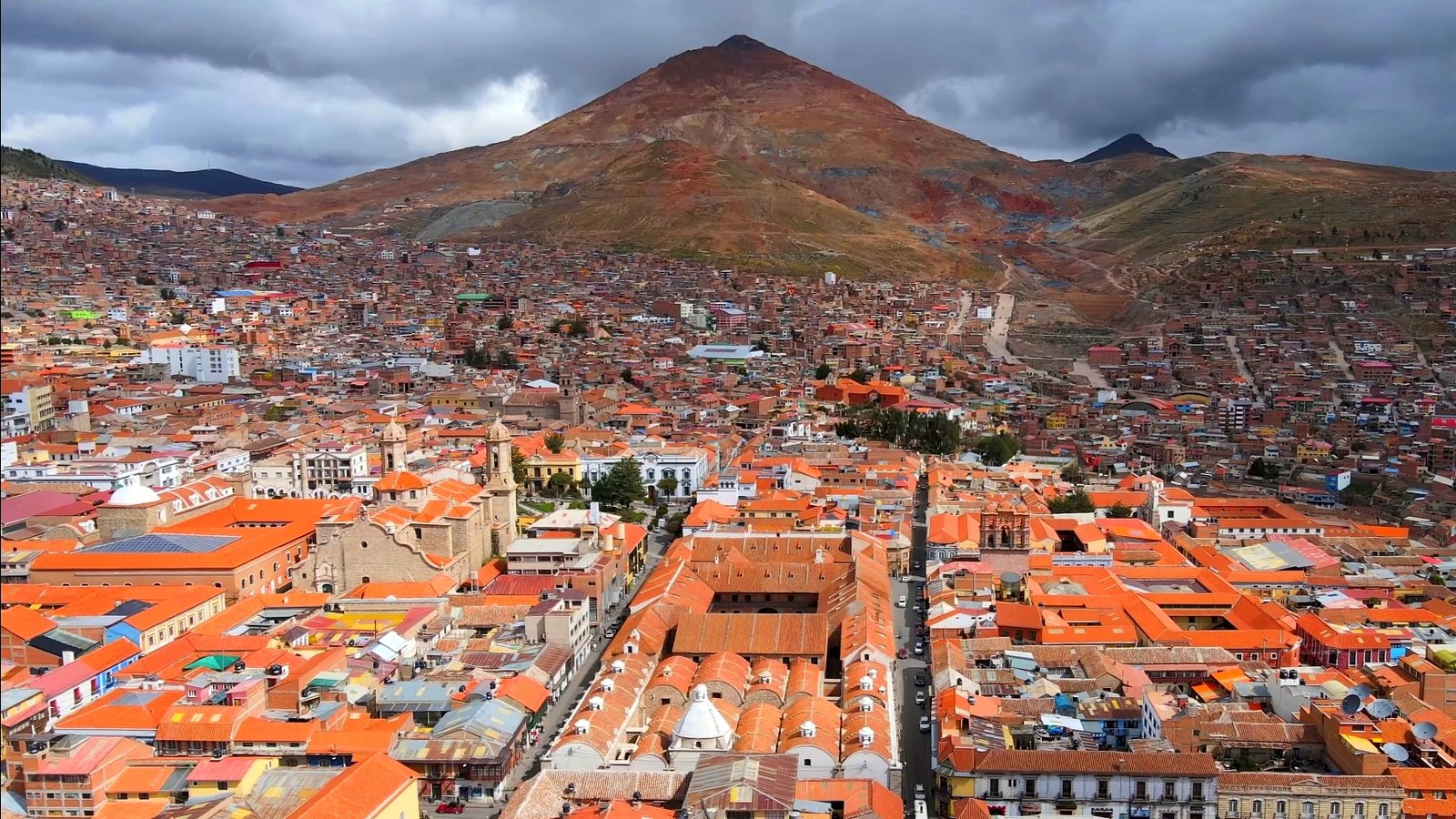
Potosí
Potosí is a city in southern Bolivia, located at approximately 4,090 metres above sea level, making it one of the highest cities in the world. Founded by the Spanish in 1546 following the discovery of vast silver deposits in the nearby Cerro Rico mountain, it became the largest city in the Western Hemisphere during the 17th century and the engine of the Spanish colonial economy. The Historic City of Potosí was inscribed as a UNESCO World Heritage Site in 1987.
At a glance
- Type
- Historic silver-mining city; UNESCO World Heritage Site (1987)
- Period
- Founded 1546 by Spanish colonisers; major silver production 1572–1800; continued mining to present day
- Style
- Spanish colonial baroque; colonial urban planning; industrial mining landscape
- Location
- Potosí Department, southern Bolivia; 4,090 m above sea level
- Coordinates
- 19.6685° S, 65.4305° W
Overview
Potosí rose to global prominence after the discovery of the Cerro Rico silver mountain in 1545, and was formally founded by the Spanish Crown in 1546. By 1650 it had a population estimated at 160,000 — larger than London or Madrid at the time — fuelled by the forced labour of indigenous and enslaved African workers in its mines. The wealth extracted from Cerro Rico financed much of the Spanish Empire and shaped the global economy of the early modern period, a legacy captured in the Spanish phrase vale un Potosí (worth a Potosí), meaning immeasurable wealth.
History
The Cerro Rico deposits were discovered by Huallpa, an indigenous Quechua man, in 1545, and the Spanish immediately established a mining settlement. Viceroy Francisco de Toledo reorganised silver extraction in 1572 by introducing the mercury amalgamation process and the mita system of coerced indigenous labour, transforming Potosí into an industrial operation of extraordinary scale. At its peak in the early 17th century, Potosí produced roughly half the world's silver. As deposits became exhausted and production fell, the city declined through the 18th and 19th centuries; Bolivia's independence in 1825 further restructured the mining economy. Today Potosí remains Bolivia's fourth-largest city, and cooperative miners continue to work the Cerro Rico tunnels.
What you see
The UNESCO-inscribed historic centre preserves one of the finest ensembles of Spanish colonial architecture in the Americas, including the Royal Mint (Casa de la Moneda, built 1753–1773), a monumental baroque complex where coins were struck for the entire Spanish Empire. The Cathedral of Potosí, rebuilt in neoclassical form in the 19th century, faces the Plaza 10 de Noviembre. More than a dozen colonial churches survive, many with hybrid mestizo-baroque facades that blend Spanish and indigenous Andean decorative motifs. Above the city, the conical peak of the Cerro Rico — pockmarked by five centuries of tunnelling — remains the defining visual symbol of Potosí and can be visited on guided mine tours.
Cultural significance
Potosí is one of the most consequential sites of the colonial world: its silver underwrote the global economy of the 16th and 17th centuries and the city became a byword for fabulous wealth. At the same time, the Cerro Rico mines consumed the lives of an estimated eight million indigenous and enslaved workers over three centuries, making Potosí equally a monument to colonial exploitation. Its World Heritage inscription recognises both the extraordinary architectural legacy and the complex, contested history of a city whose rise and fall embody the contradictions of the Spanish imperial project in the Americas.
Practical information
- Address
- Potosí, Potosí Department, Bolivia
- Casa de la Moneda
- Plaza 10 de Noviembre, Potosí — open Tuesday to Sunday; check official website for current hours and admission fees
- Mine tours
- Cooperative mine tours depart from the city centre — book via licensed local operators; physically demanding due to altitude
- Altitude note
- At 4,090 m, visitors should allow 24–48 hours for acclimatisation before strenuous activity
Getting there
Potosí is connected by regular bus services to Sucre (3 hours), Oruro (6 hours), and La Paz (10 hours). The Captain Nicolas Rojas Airport (POI) handles domestic flights from La Paz and Sucre. From Sucre, the road journey through the Bolivian highlands offers dramatic Andean scenery. Potosí is commonly included in overland itineraries connecting the Uyuni Salt Flat region with Sucre and southern Bolivia.
Sources & resources
Find it on the map
See this place and what’s around it →📷 Diventa un fotografo di Cultural Heritage Online
Condividi le tue foto dei luoghi: restano pubblicate con la tua firma come autore. Più vengono viste, più ti fai conoscere — e presto un concorso premierà le foto più apprezzate.
Accedi o registrati gratis per aggiungere una foto