
Pallavicin Palace
A Renaissance palace transformed into a European court under Marshal Gian Luca Pallavicini, where Mozart performed and emperors and princes gathered in the shadow of the Habsburgs.
At a glance
Pallavicin Palace stands as one of Bologna’s most historically significant residences, its monumental staircase and lavishly decorated halls bearing witness to centuries of political and cultural prominence. From its fifteenth-century origins through its neoclassical transformation, the palace embodies the architectural and artistic ambitions of the families who owned it.
History
The building began in fifteenth-century Bologna under Bentivoglio rule, passing from the Sala family (recorded 1493) through the Volta, Marsili, and Isolani counts. In 1680, the Isolani commissioned architect Paolo Canali to restore it “in the ways of senatorial architecture,” creating the monumental staircase and a hall with lantern ceiling—among the city’s highest.
In 1765, Marshal Count Gian Luca Pallavicini (Genoa, 1697–1773), minister to Emperor Charles VI and Empress Maria Theresa of Austria, leased the palace from Senator Ferdinando Bolognetti. The marshal transformed it into a seat of European diplomacy and culture, hosting crowned heads, emperors, and the international aristocracy. His son Giuseppe (1756–1818) later undertook a sweeping neoclassical renovation beginning in 1776, enlisting the era’s foremost artists.
What you see
Paolo Canali’s 1680 restoration introduced the palace’s defining feature: a monumental staircase among the city’s most impressive. Giovanni Antonio Burrini’s 1690 frescoes adorned the halls with Baroque richness.
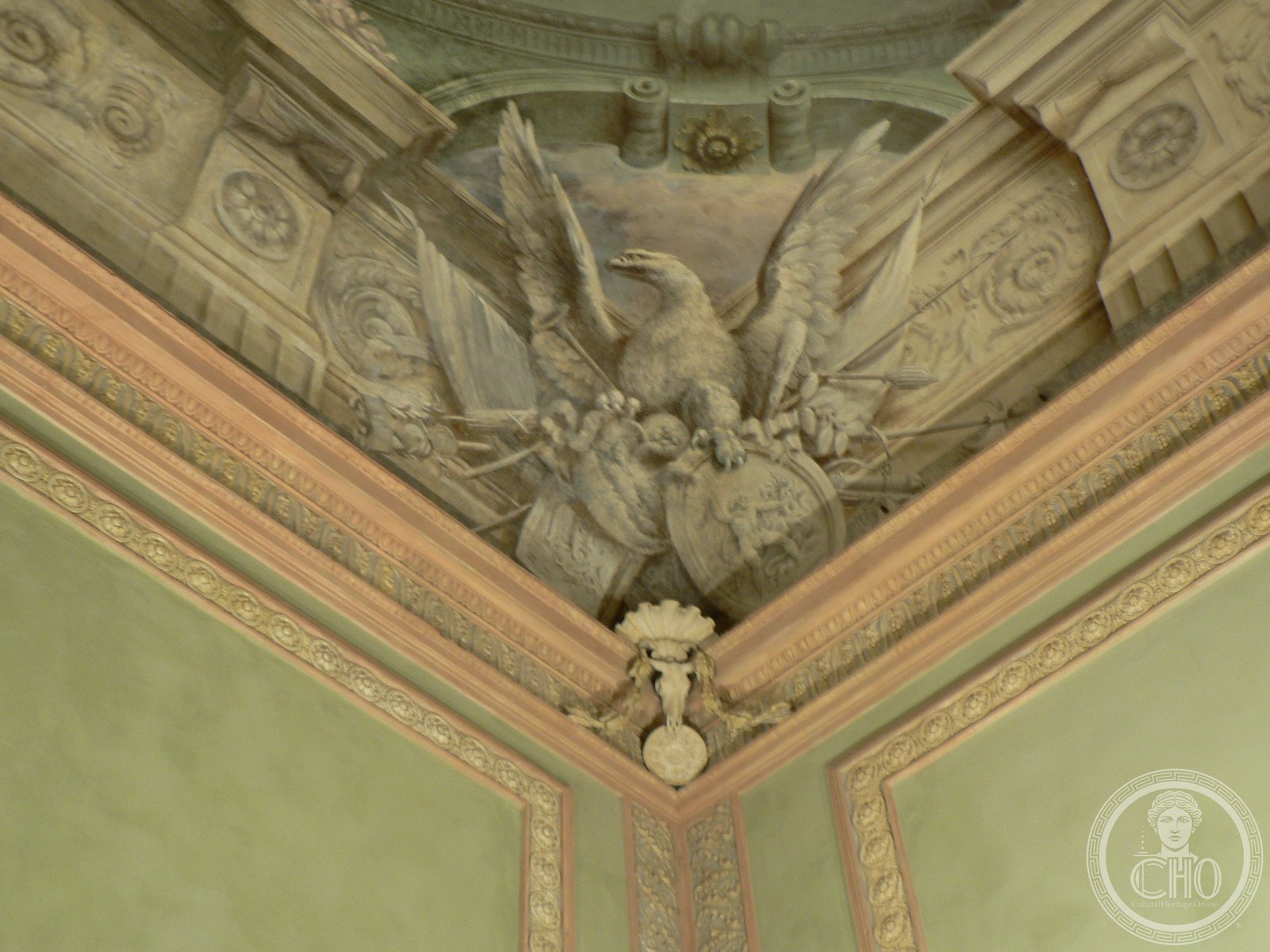
Giuseppe Pallavicini’s late-eighteenth-century campaigns introduced neoclassical refinement. Architect Raimondo Compagnini and sculptor Giacomo Rossi created stucco decorations of unparalleled elegance, with Rossi’s candelabra *à la greque* adorning the great chambers. Painter Filippo Pedrini contributed ceilings set in Vincenzo Martinelli’s landscapes; Serafino Barozzi painted floral garlands echoing ornaments from Catherine the Great’s Oranienbaum.
A fresco by Pietro Fabbri (1791–92) on the noble floor depicts Empress Maria Theresa as Cybele, Mother of All Peoples—unique in the world, painted in the year Marie Antoinette was imprisoned in Paris. The library, with its dome signed and dated 1792 by quadraturist Flaminio Minozzi, represents a rare occurrence in fresco painting.
Cultural significance
Pallavicin Palace was the stage for pivotal moments of late-Enlightenment European culture. On 26 March 1770, the fourteen-year-old Wolfgang Amadeus Mozart performed in Burrini’s hall before seventy Bolognese ladies, cardinals, and international nobility. Count Pallavicini wrote to Minister Firmian of the young musician’s “admirable proofs” of skill. Mozart returned repeatedly during his 1770 visit, composing works including the minuet K 94 and the antiphons *Cibavit eos* and *Quaerite primum regnum Dei* at the palace.
The hall hosted encounters between Mozart and leading musicians including Myslivečck, Vanhalle, Farinelli, musicologist Charles Burney, and the theorist Padre Martini. In 1768, Princess Maria Carolina passed through en route to marry Ferdinand of Bourbon; in 1769, Emperor Joseph II stayed here. Grand Duke Pietro Leopoldo of Tuscany and Austrian Archduke Maximilian also visited. The palace thus became a pivot of Habsburg diplomacy in Italy and a center of European musical life.
Key facts
- Address: Via S. Felice 24, 40122 Bologna
- Coordinates: 44.49650915749623, 11.334559321403503
- Phone: 051 412 0456
- Website: https://www.palazzopallavicini.com/
- Architect (1680 restoration): Paolo Canali
- Fresco artist (1690): Giovanni Antonio Burrini
- Neoclassical architect (1776 onward): Raimondo Compagnini
Practical information
The palace remains a private residence and cultural venue. Visits and events are organized through the official website. Opening hours and admission details are available at https://www.palazzopallavicini.com/ or by contacting the palace directly at 051 412 0456.
Getting there
Pallavicin Palace is located on Via San Felice in central Bologna, within walking distance of the city’s historic core. Public transport and parking information are available through Bologna’s tourism website and local transit authority.
Sources & resources
- Official website: Palazzo Pallavicini
- Elisabetta Landi, “Gianluca e Giuseppe Pallavicini: culture e committenze artistiche e musicali,” in Maria Camilla Pallavicini (ed.), Quaderni Obertenghi, secc. XVI–XIX, n. 4 (Rome: Obertenga Cultural Association, 2014), pp. 403–422
- Cultural Heritage Online
Find it on the map
See this place and what’s around it →Historical events at this place (1)
📷 Diventa un fotografo di Cultural Heritage Online
Condividi le tue foto dei luoghi: restano pubblicate con la tua firma come autore. Più vengono viste, più ti fai conoscere — e presto un concorso premierà le foto più apprezzate.
Accedi o registrati gratis per aggiungere una foto