
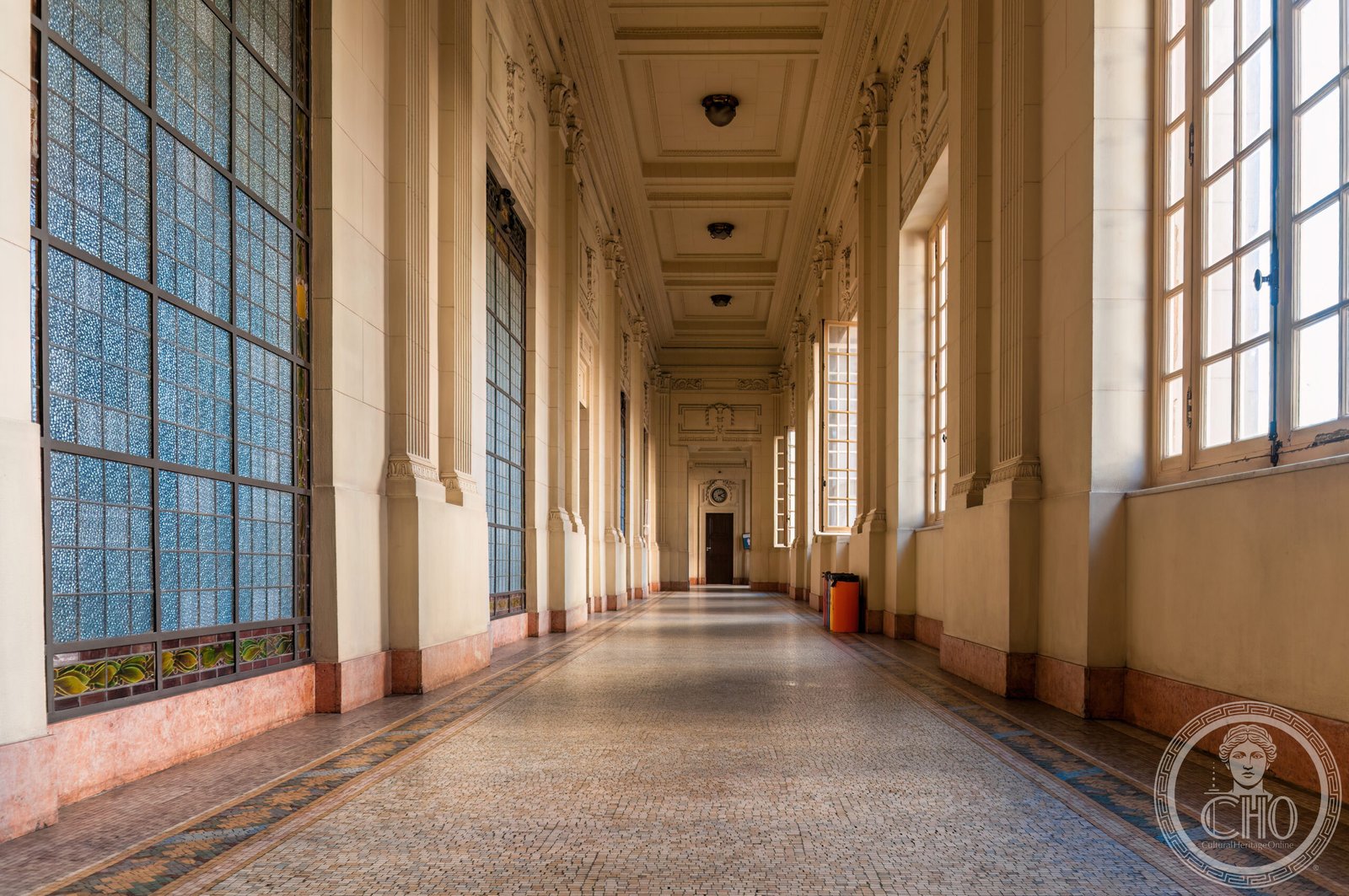
The Palácio Tiradentes is the grandest neoclassical public building in Rio de Janeiro and one of Brazil’s most symbolically loaded political monuments. Completed in 1926 to designs by architects Archimedes Memória and Francisco Cuchet, it was built to house the Brazilian federal legislature on the site of the old House of Correction — a charged location from which republican lawmakers deliberately displaced the colonial penal order. Named for Joaquim José da Silva Xavier, known as Tiradentes — the proto-martyr of Brazilian independence, hanged and quartered in 1792 — the palace bears the weight of Brazil’s long struggle toward self-determination. Today it serves as the seat of the Rio de Janeiro State Legislative Assembly and as a public cultural monument, open for visits and a permanent exhibition on Brazilian political history.
At a glance
- Type
- Legislative palace / public monument
- Period
- 1922–1926
- Style
- Neoclassical
- Location
- Rio de Janeiro, Brazil
- Coordinates
- 22.9028° S, 43.1764° W
- Architect(s)
- Archimedes Memória and Francisco Cuchet
Overview
The Palácio Tiradentes occupies a full city block in the historic centre of Rio de Janeiro, presenting an imposing Corinthian-columned façade to Rua Primeiro de Março. A central clock tower rises above the portico, giving the building its distinctive silhouette. The main chamber interior features a large ornate ceiling dome and a prominent statue of Tiradentes on the main staircase — bronze, larger than life, his gaze directed upward in the posture of martyred idealism. A permanent exhibition on the ground floor traces Brazilian parliamentary and political history from the colonial period to the present.
History
The Brazilian Old Republic commissioned the building in the early 1920s to provide the federal Chamber of Deputies with a suitably impressive home. Construction began in 1922 and was completed in 1926 to coincide with Brazil’s centennial independence celebrations. For its first years the palace functioned as planned; then Getúlio Vargas seized power in 1930 and dissolved the legislature. During the Estado Novo dictatorship (1937–1945) the palace was repurposed for state functions. After the return of democratic government in 1945 it briefly resumed its legislative role, but when the federal capital moved to Brasília in 1960, the palace passed to the Rio de Janeiro state legislature, which occupies it still. The building has survived every upheaval in Brazilian political life with its fabric intact.
Architecture & Design
Memória and Cuchet worked in the tradition of French Beaux-Arts classicism as practised by the Brazilian academic school. The façade is organised as a tripartite composition with a rusticated base, a piano nobile of tall arched windows between Corinthian pilasters, and an attic story capped by a balustrade. The central clock tower reads as a vertical accent completing the symmetry. Inside, the main hall leads through a colonnaded vestibule to the grand staircase with its Tiradentes statue. The hemicycle chamber has curved seating tiers facing a raised dais, with the ceiling dome providing natural light. Details throughout — cornices, capitals, bronze fittings — reflect the ambitions of the Old Republic’s public works programme.
Cultural significance
The Palácio Tiradentes is at once a work of architectural history and a palimpsest of Brazilian political life. Its name encodes the founding myth of Brazilian nationalism — Tiradentes as Christ-like martyr — and the building has witnessed more than a century of democracy, dictatorship, military rule, and re-democratisation. The permanent exhibition inside is one of the best introductions to Brazilian political history available to the public. As a pure work of neoclassical urbanism, the building’s massing, clock tower, and relationship to the surrounding historic fabric make it a landmark of Rio’s historic centre that rewards careful observation.
Visiting today
The Palácio Tiradentes is open to the public on non-session days, typically Monday through Friday. Entry is free. The ground-floor exhibition on Brazilian political history is accessible without an appointment. Group tours of the chamber and state rooms can be arranged by contacting the administrative office of the Rio de Janeiro Legislative Assembly. Photography is permitted in most public areas. The palace is within walking distance of the Imperial Palace and the Cultural Centre of Banco do Brasil.
Getting there
The Palácio Tiradentes is at Rua Primeiro de Março in the historic centre of Rio de Janeiro. The nearest Metro station is Uruguaiana (Line 1), a 5-minute walk. The VLT light rail stops at Rua do Ouvidor, also nearby. From Santos Dumont Airport the journey by taxi or Uber takes approximately 15 minutes. The palace is near Praça XV and the Museu Histórico Nacional, making it easy to combine with a broader tour of the historic centre.
Sources & resources
Find it on the map
See this place and what’s around it →📷 Become a Cultural Heritage Online photographer
Share your photos of places: they stay published under your name as the author. The more they're seen, the more you get noticed — and soon a contest will reward the most appreciated photos.
Log in or sign up free to add a photoIs this page about you?
This page is read by travellers and heritage enthusiasts who find it on Google. Tell us how you are connected to this place and we will take it from there.