
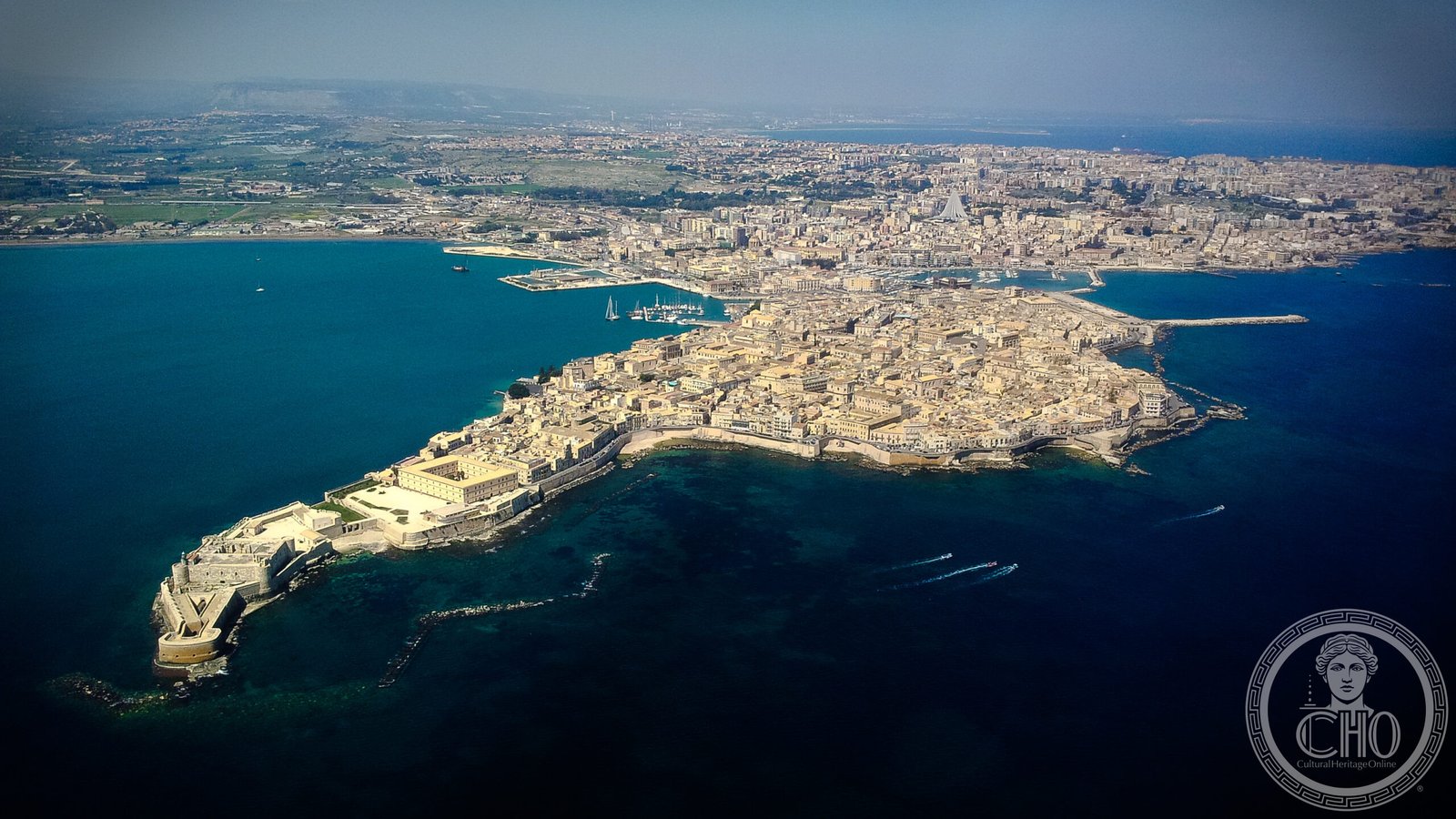
Ortigia
Ortigia (also spelled Ortygia) is a small island forming the ancient historical heart of Syracuse, Sicily. Enclosed by the sea on all sides and linked to the mainland by two short bridges, it concentrates over 2,700 years of continuous urban history within barely half a square kilometre, from Greek colonial foundations to Baroque palaces rebuilt after the 1693 earthquake.
At a glance
- Type
- Historic island district · UNESCO World Heritage Site (2005)
- Period
- Founded by Corinthian colonists c. 734 BC; continuously inhabited to present
- Style
- Greek, Roman, Norman, Baroque; multi-layered urban fabric
- Location
- Ortigia, Syracuse, Sicily, Italy
- Coordinates
- 37.0609° N, 15.2950° E
Overview
Ortigia is the historic nucleus of Syracuse, one of the greatest cities of the ancient Greek world. Separated from the modern city by a narrow channel, the island retains an intact medieval and Baroque street plan overlaid on Greek foundations. It forms part of the UNESCO World Heritage Site “Syracuse and the Rocky Necropolis of Pantalica,” inscribed in 2005. Visitors encounter Greek temples, a Baroque cathedral built inside a Doric colonnade, Norman fortifications, and a natural freshwater spring revered since antiquity — all within easy walking distance.
History
Corinthian settlers founded Syracuse on Ortigia around 734 BC, making it one of the earliest and most powerful Greek colonies in the western Mediterranean. Under the tyrant Dionysius I in the fifth and fourth centuries BC, it rivalled Athens in wealth and influence. Roman occupation began in 212 BC after a prolonged siege; the city later passed to Byzantium, the Arabs, and the Normans. The catastrophic earthquake of 1693 prompted a wholesale Baroque rebuilding of its churches and palaces, giving the island its current architectural character.
What you see
The centrepiece is the Cathedral of Syracuse, whose exterior baroque facade conceals the original fifth-century BC Temple of Athena — its Doric columns still visible inside the walls. Nearby, Piazza del Duomo is regarded as one of the finest Baroque squares in Sicily. The Fonte Aretusa, a freshwater spring on the seafront, was sacred to the nymph Arethusa and described by ancient poets. The island is also home to the Castello Maniace, a thirteenth-century Hohenstaufen fortress at the southern tip, and the Palazzo Bellomo, which houses a regional art gallery.
Cultural significance
Ortigia’s UNESCO inscription recognises its exceptional layering of Greek, Roman, Byzantine, Arab, Norman, and Baroque cultures within an unbroken urban fabric. It is considered one of the best-preserved examples of a Greek colonial city in the western Mediterranean, and its temple-inside-a-cathedral offers a unique demonstration of how successive civilisations adapted rather than erased what came before.
Practical information
- Address
- Ortigia island, Syracuse (Siracusa), Sicily, Italy
- Access
- Open urban district; free to walk. Individual monuments have separate entry fees and hours.
- Cathedral hours
- Generally open daily; check official website for current schedules
Getting there
Ortigia is connected to central Syracuse by the Ponte Umbertino and Ponte Santa Lucia bridges, both walkable. Syracuse railway station (Syracuse FS) is roughly 20 minutes on foot or a short taxi ride from the island. Buses from Catania airport serve Syracuse city centre in approximately 75 minutes. Limited parking is available at the edges of the island; the interior is largely pedestrianised.
Sources & resources
Find it on the map
See this place and what’s around it →Historical events at this place (1)
📷 Diventa un fotografo di Cultural Heritage Online
Condividi le tue foto dei luoghi: restano pubblicate con la tua firma come autore. Più vengono viste, più ti fai conoscere — e presto un concorso premierà le foto più apprezzate.
Accedi o registrati gratis per aggiungere una foto