
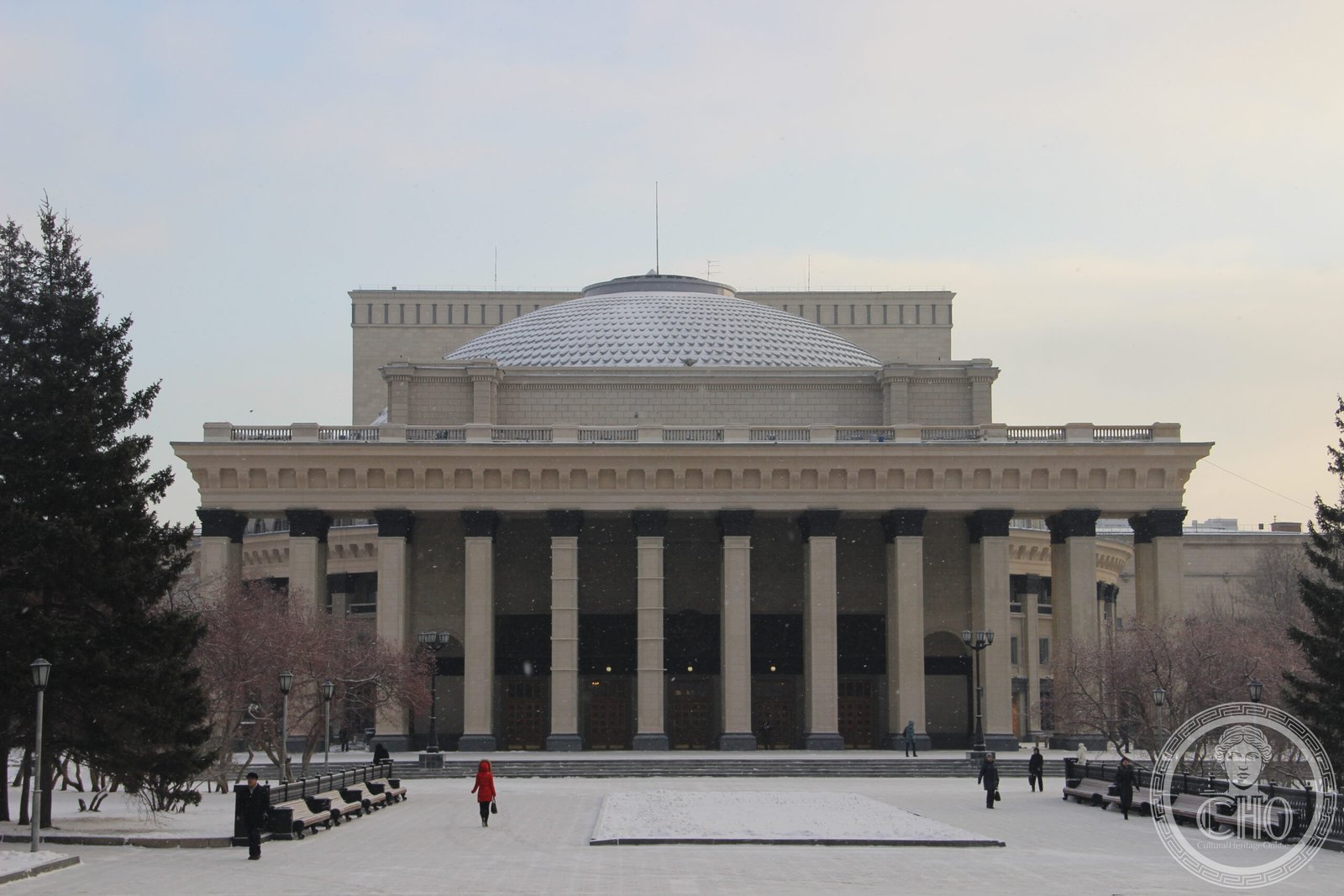
Rising from the Siberian steppe, the Novosibirsk State Academic Opera and Ballet Theatre is the largest opera house in Russia and among the largest in the world. Its colossal dome, spanning 60 metres in diameter and surpassing that of the Pantheon in Rome, crowns a building whose construction spanned the most turbulent decades of Soviet history. Begun in 1931 as a communal gathering space for the booming industrial city, interrupted by World War II when its dome served as a secret research facility, and finally inaugurated as an opera house in 1945 on Stalin’s orders, the theatre stands as a monument to Soviet ambition and Siberian resilience. The building’s hybrid style, blending Constructivist spatial logic with the monumental Stalinist classicism of its exterior, reflects the ideological upheavals of the 1930s. Today it remains the undisputed cultural flagship of Siberia, drawing audiences from across the vast region to performances of opera and ballet that would do credit to any European capital.
At a glance
- Type
- Opera and ballet theatre
- Period
- 1931-1945
- Style
- Stalinist Classicism with Constructivist interior
- Location
- Krasny Prospekt, Novosibirsk, Russia
- Coordinates
- 54.8417 N, 83.0927 E
- Architect(s)
- Thomas Faidysh, Mikhail Kurillo, Alexander Grinberg
Overview
The Novosibirsk Opera and Ballet Theatre dominates the city centre from its position on Theatre Square, a vast civic space designed on a scale matching the ambitions of Soviet urban planning. Seating 1,774 spectators, the theatre operates a full season of opera and ballet, hosting world-class productions and nurturing a company whose dancers and singers regularly perform internationally. Its sheer scale and architectural authority make it a destination in itself, drawing visitors who come as much to witness the building as to attend a performance.
History
Construction began in 1931 on what was initially conceived as a gigantic House of Science and Culture for the workers of Novosibirsk, then rapidly industrialising as part of Stalin’s first Five-Year Plan. Financial constraints and shifting political priorities led to repeated design revisions, with the building transformed into an opera house mid-construction. Work halted entirely with the German invasion of 1941, and the dome was enclosed and used as a classified research and storage facility during the war years. Stalin himself ordered the project completed as a cultural symbol of Soviet reach into Asia, and the theatre opened on 12 May 1945, just four days after the German surrender.
Architecture and Design
The theatre’s most striking feature is its reinforced concrete dome, 60 metres in diameter, making it larger than the Pantheon in Rome and one of the great engineering achievements of Soviet construction. The exterior presents a Stalinist classical facade of monumental columns, rusticated base, and symmetrical massing that deliberately projects state power. The interior retains traces of its Constructivist origins in the rational planning of its foyers, circulation corridors, and auditorium seating, creating an unusual and historically significant layering of two opposed Soviet architectural ideologies within a single structure.
Cultural significance
The theatre represents the Soviet state’s determination to bring high culture to the furthest reaches of its territory, asserting that Siberia’s industrial workers deserved access to opera and ballet equal to that of Moscow or Leningrad. As the largest opera house in Russia, it carries the same symbolic weight for Siberia that La Scala carries for Milan or Covent Garden for London. Its company has produced internationally recognised artists, and its archive documents a continuous performance tradition maintained through wars, economic collapse, and political upheaval.
Visiting today
The theatre operates a full season from September through June with performances most evenings. Tickets are available online and at the box office on Theatre Square. The building exterior and grand foyers may be visited independently of performances. Guided architectural tours of the building, including the backstage areas and the historic dome structure, are available by advance booking through the theatre’s administration office.
Getting there
Theatre Square (Teatralnaya Ploshchad) is in central Novosibirsk, served by the Ploshchad Lenina metro station on both lines of the Novosibirsk Metro. The square is a 10-minute walk from the main railway station. Novosibirsk Tolmachevo International Airport is approximately 20 kilometres from the city centre, connected by taxi and shuttle bus.
Sources and resources
Find it on the map
See this place and what’s around it →📷 Become a Cultural Heritage Online photographer
Share your photos of places: they stay published under your name as the author. The more they're seen, the more you get noticed — and soon a contest will reward the most appreciated photos.
Log in or sign up free to add a photoDo you manage this place?
This page is read by travellers and heritage enthusiasts who find it on Google. Keep it accurate — and make it work for you. Free for non-profit heritage institutions.