
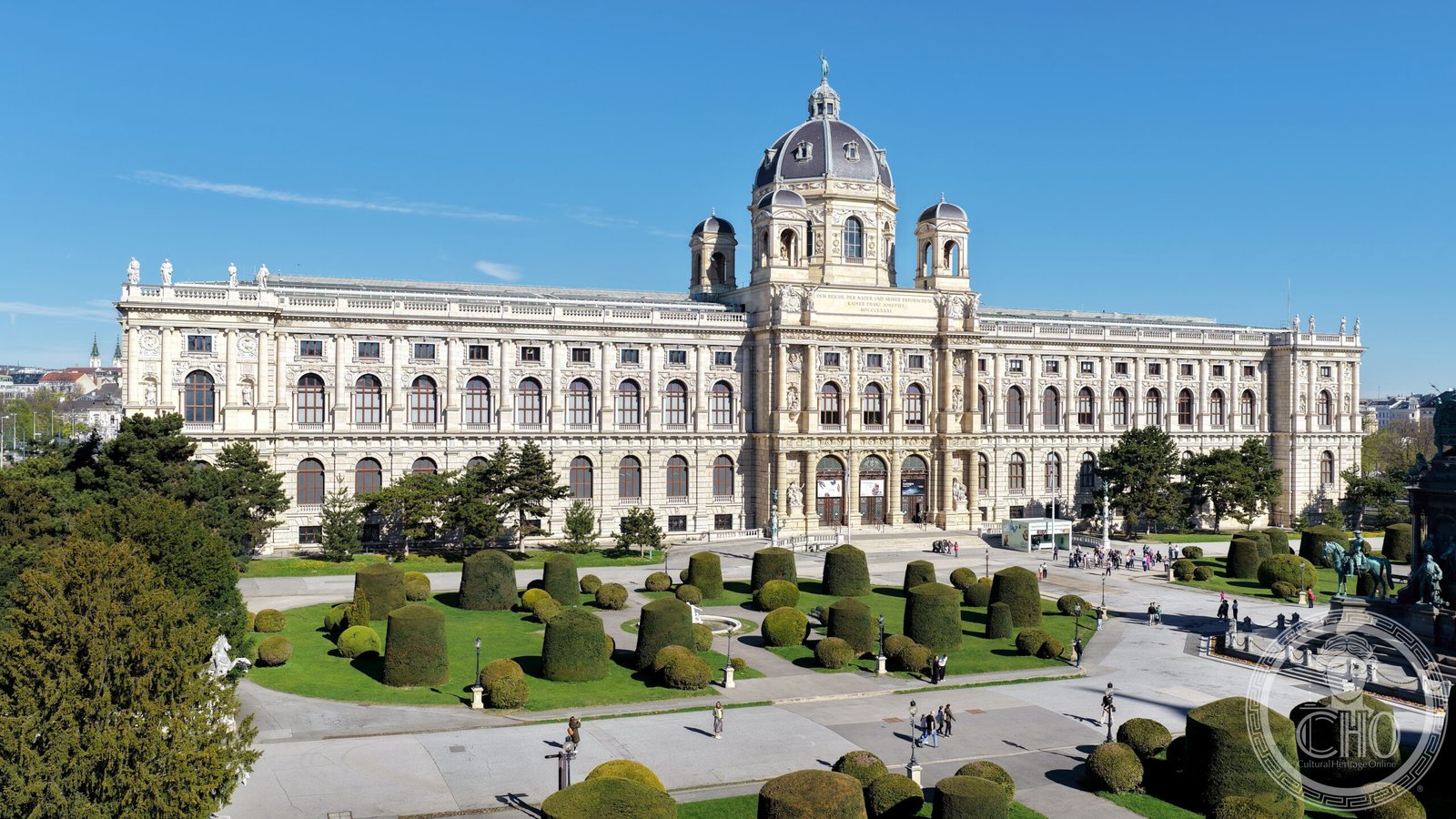
Natural History Museum Vienna (NHM)
The Natural History Museum Vienna is one of the world’s great natural history institutions, housing more than 30 million objects across 39 exhibition halls. Opened by Emperor Franz Joseph I in 1889 in a monumental historicist building designed by Gottfried Semper and Carl Hasenauer, it holds the Venus of Willendorf — one of prehistory’s most iconic objects — alongside outstanding collections in mineralogy, meteorites, and zoology.
At a glance
- Type
- National natural history museum
- Period
- Built 1872–1889; opened 10 August 1889
- Style
- Renaissance Revival and Historicism
- Location
- Burgring 7, 1010 Vienna, Austria
- Coordinates
- 48.2052° N, 16.3577° E
- Architects
- Gottfried Semper (1803–1879) and Carl Hasenauer (1833–1894)
- Collection
- 30 million objects; over 100,000 on display across 8,700 m²
Overview
The Natural History Museum Vienna (Naturhistorisches Museum Wien, NHM) is Austria’s foremost repository for the natural and earth sciences, amassing collections built across more than 250 years of imperial and scientific endeavour. Its 39 exhibition halls cover geology and mineralogy, prehistoric life, human evolution, zoology, botany, and anthropology. The museum sits on the Ringstrasse opposite the Kunsthistorisches Museum, forming the twin anchor of Vienna’s monumental museum district.
History
The collections that today fill the NHM were largely assembled by the Habsburg imperial court from the 17th century onward. Franz Joseph I commissioned the purpose-built museum in 1872 from Gottfried Semper, who died before its completion; Carl Hasenauer oversaw the final construction. The museum opened on 10 August 1889, with 175,000 visitors attending in its first months of operation. Over the following century, the collections grew through field expeditions, scientific exchange, and donations to become among the most comprehensive natural history holdings in Europe.
What you see
The building itself rewards close attention: the facade carries allegorical figures and portrait busts of renowned naturalists, and the central dome — 65 metres high and crowned with a bronze Helios — provides orientation within the vast symmetrical floor plan. Inside, the Hall of Meteorites displays one of the world’s finest collections of extraterrestrial rock, while the mineralogy galleries present gemstones and crystals of extraordinary size and colour. The Venus of Willendorf — a limestone figurine carved approximately 30,000 years ago, discovered in Lower Austria in 1908 — is displayed in its own case and remains one of the most studied objects in prehistoric art.
Cultural significance
The NHM represents the Habsburg ambition to systematise and display the entire natural world within a single imperial institution, a model that influenced natural history museum design across Europe. Its mineralogy collection is considered among the finest on the continent, and the Venus of Willendorf has become a globally recognised symbol of prehistoric human creativity. The museum continues active research across its departments, making it a working scientific institution as well as a public heritage site.
Practical information
- Address
- Burgring 7, 1010 Vienna, Austria
- Hours
- Check official website for current hours: nhm-wien.ac.at
- Admission
- Paid entry; reduced rates for children and students; check website for current prices
Getting there
Take the Vienna U-Bahn U2 or U3 to Volkstheater station, or U2 to MuseumsQuartier station. The museum is also a short walk from the Burgring tram stop (lines 1 and 2). It faces the Kunsthistorisches Museum across Maria-Theresien-Platz, a central landmark visible from the Ringstrasse.
Sources & resources
Find it on the map
See this place and what’s around it →📷 Diventa un fotografo di Cultural Heritage Online
Condividi le tue foto dei luoghi: restano pubblicate con la tua firma come autore. Più vengono viste, più ti fai conoscere — e presto un concorso premierà le foto più apprezzate.
Accedi o registrati gratis per aggiungere una foto