

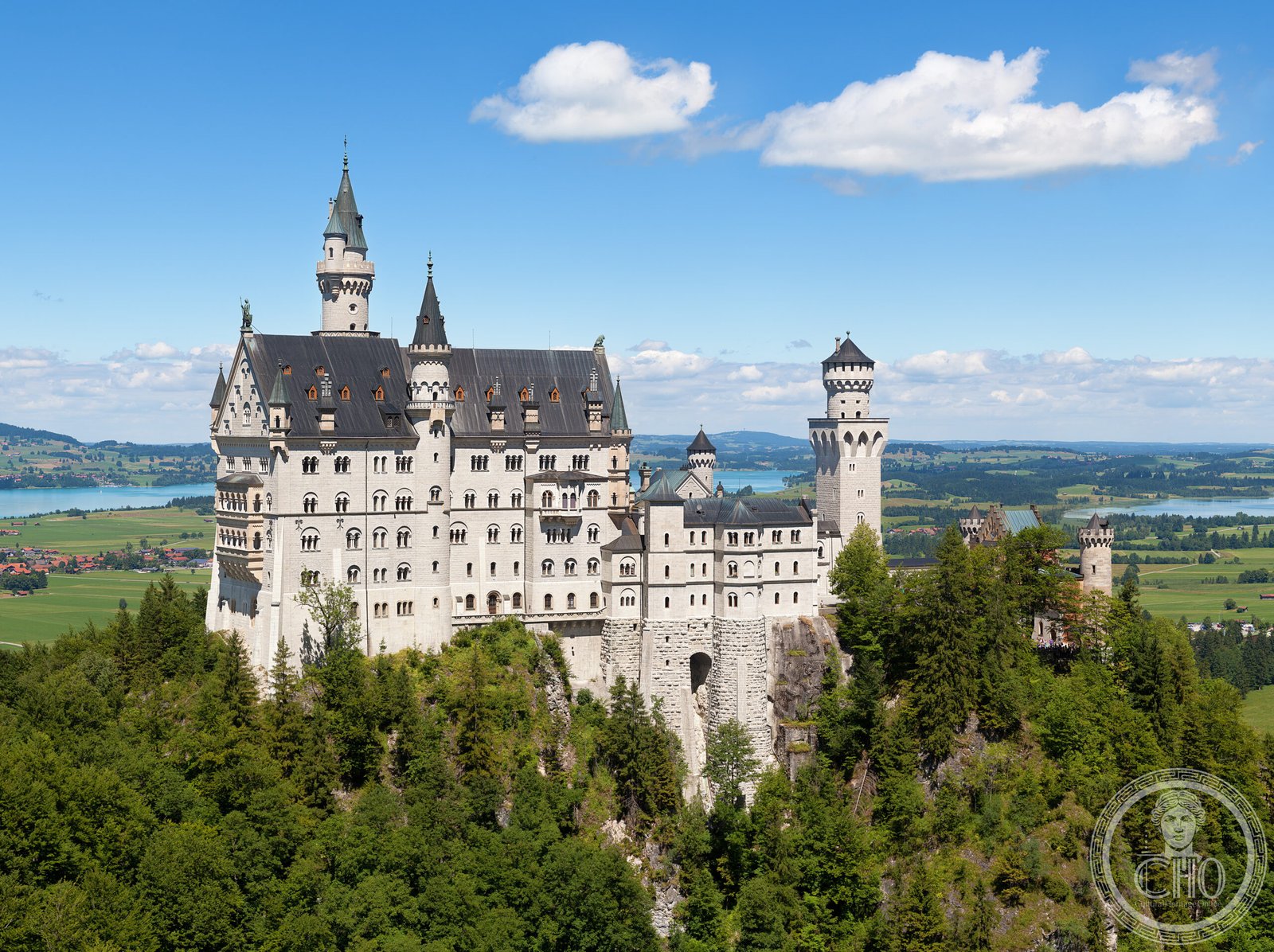
King Ludwig II’s 19th-century palace, built as a personal retreat and Wagner tribute, stands in the Bavarian Alps opposite Hohenschwangau castle.
At a glance
Neuschwanstein Castle rises in south-western Bavaria near Füssen, in the town of Schwangau. Its name derives from the Schwangau territory—the County of the Swan—and translates as “New Swan Stone.” The castle commands views across the Alpine landscape from its dramatic hilltop position.
History
King Ludwig II commissioned the castle as a personal refuge and tribute to the composer Richard Wagner, whom he held in highest regard. Ludwig financed construction entirely from his own funds, refusing access to the State treasury. The king valued isolation from the world, and this palace became his sanctuary. Following his death in 1886, the castle was immediately opened to the public, becoming one of Bavaria’s most visited monuments.
What you see
The castle exemplifies 19th-century Romantic architecture, with whitewashed walls, ornate towers, and dramatic positioning on a rugged outcrop. Its theatrical design reflects Ludwig’s artistic vision and Wagner-inspired aesthetic—a structure more fantastical than strictly defensive in purpose.
Cultural significance
Neuschwanstein became a defining model for fairy-tale castle imagery. Walt Disney drew direct inspiration from it when designing the castles featured in Snow White and the Seven Dwarfs, Cinderella, Sleeping Beauty, and Rapunzel. The castle has also appeared in numerous films, including Chitty Chitty Bang Bang (as the Palace of Vulgaria) and The Great Escape. Its visual influence extends to anime, television, and video games worldwide.
Key facts
- Address: Neuschwanstein 20, 87645 Schwangau
- Coordinates: 47.5580146, 10.7498178
- Phone: +49 8362 930830
- Website: www.neuschwanstein.de
Practical information
The castle is open to the public year-round. From April to 15 October, hours are 09:00–18:00. From 16 October to March, hours are 10:00–16:00. The castle is closed on 1 January, 24 December, 25 December, and 31 December. Guided tours and audio guides are available. Contact the castle directly for current admission prices and group booking information.
Getting there
Schwangau lies near Füssen in southern Bavaria, approximately two hours south-west of Munich. Train and coach services connect Füssen to major German cities. From Füssen, local buses and taxis serve Schwangau. The castle is also accessible via marked hiking trails from the village.
See the place
Sources & resources
Find it on the map
See this place and what’s around it →Historical events at this place (1)
📷 Become a Cultural Heritage Online photographer
Share your photos of places: they stay published under your name as the author. The more they're seen, the more you get noticed — and soon a contest will reward the most appreciated photos.
Log in or sign up free to add a photoIs this page about you?
This page is read by travellers and heritage enthusiasts who find it on Google. Tell us how you are connected to this place and we will take it from there.