
National Archaeological Museum of Athens
The National Archaeological Museum of Athens is widely regarded as one of the greatest museums in the world, housing the richest collection of Greek antiquity artifacts anywhere on earth. Founded in 1829 by Ioannis Kapodistrias on Aigina, it moved to its current neoclassical building on Patission Street — designed by Ludwig Lange and completed in 1889 with contributions from Panagis Kalkos, Armodios Vlachos, and Ernst Ziller. Its holdings span prehistory to late antiquity and include the Mask of Agamemnon, the Artemision Bronze, Cycladic marble figurines, Minoan frescoes from Santorini, and the Antikythera mechanism.
At a glance
- Type
- National archaeological museum
- Period
- Founded 1829; current building 1866–1889; major refurbishment 2002–2004
- Style
- Neoclassical
- Location
- Patission Street (28 Oktovriou 44), Exarcheia, Athens, Greece
- Coordinates
- 37.9892° N, 23.7332° E
- Architects
- Ludwig Lange (original design); Panagis Kalkos, Armodios Vlachos, Ernst Ziller (modifications)
Overview
The National Archaeological Museum of Athens houses some of the most important artifacts from archaeological locations across Greece, ranging from prehistory to late antiquity. It is considered one of the greatest museums in the world and contains the richest collection of Greek antiquity artifacts worldwide. The museum’s neoclassical building occupies a prominent block in the Exarcheia district, with its main entrance facing Patission Street adjacent to the historic campus of the National Technical University of Athens.
History
The museum was established in 1829 by Greece’s first governor, Ioannis Kapodistrias, initially operating on the island of Aigina before being relocated to Athens as the new nation’s capital took shape. Construction on the permanent Patission Street building began in 1866 and was completed in 1889, with the neoclassical design conceived by German architect Ludwig Lange and subsequently modified by Greek and Austrian architects. A two-storey east wing was added between 1932 and 1939 to accommodate expanding collections. The museum underwent a major eighteen-month refurbishment concluded in July 2004, timed with the Athens Olympic Games, which included climate-control upgrades, collection reorganisation, and repair of earthquake damage.
What you see
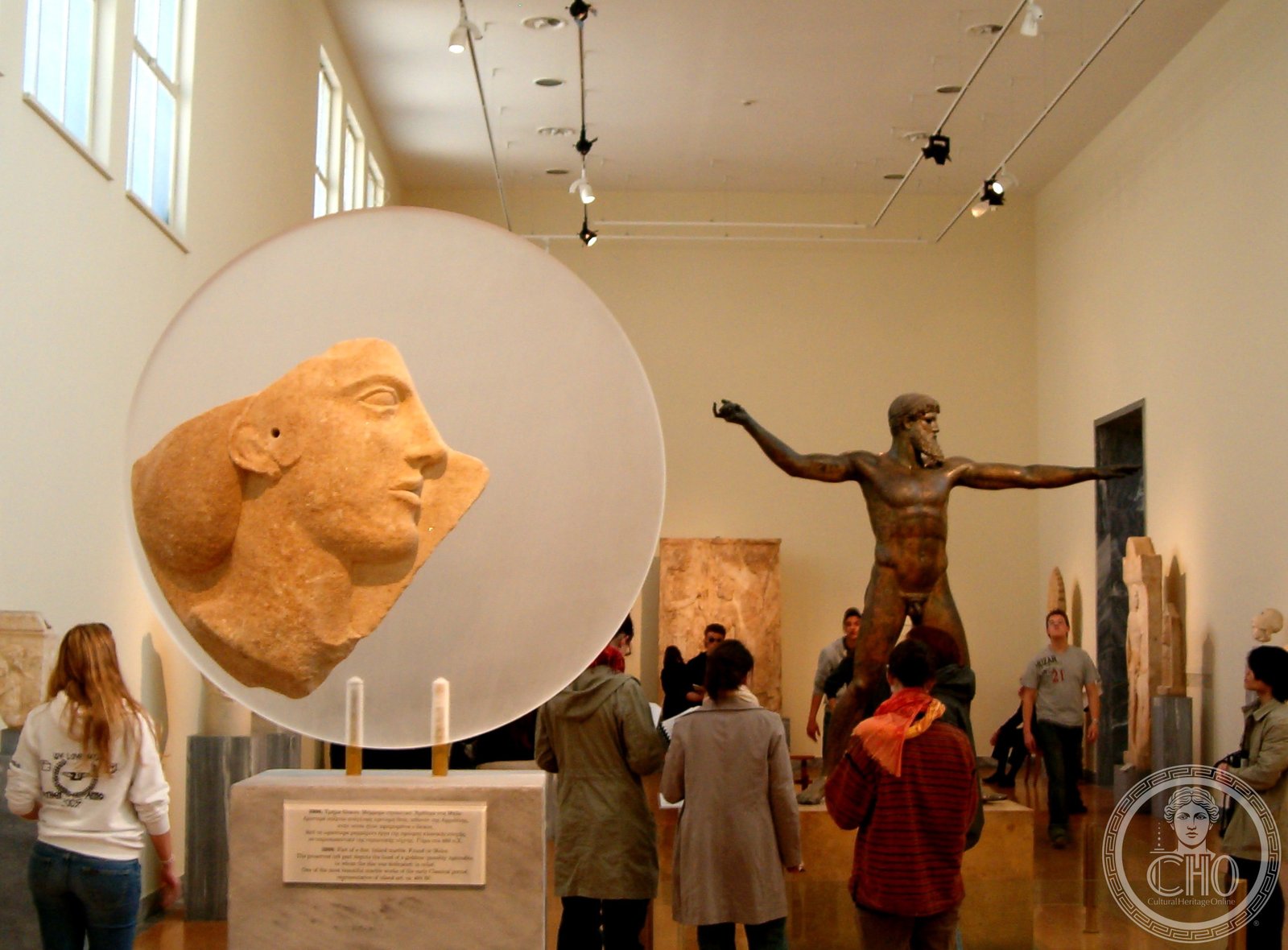
The prehistoric collections are a highlight of any visit: Neolithic ceramics, Cycladic marble figurines, Mycenaean grave goods including the golden “Mask of Agamemnon” (c. 1550–1500 BCE) from the Shaft Graves of Mycenae, and breathtaking Minoan frescoes excavated at Akrotiri on Santorini. The sculpture galleries display masterworks in bronze and marble, centred on the monumental Artemision Bronze (a full-scale Zeus or Poseidon, c. 460 BCE) and works attributed to Myron and Scopas. Additional wings house more than 6,000 Egyptian antiquities, the Stathatos collection of ancient jewellery and metalwork, and the Antikythera mechanism — an ancient analogue computer recovered from a 1st-century BCE shipwreck.
Cultural significance
The National Archaeological Museum is the custodian of Greece’s collective ancient memory, bringing together finds from across the Aegean world that would otherwise be dispersed across dozens of regional sites. Its role in defining the visual and scholarly language of Greek antiquity has been decisive: the Mask of Agamemnon and the Artemision Bronze are among the most reproduced images in the study of ancient civilisation. A major recent debate centres on the Antikythera mechanism, whose complexity continues to reshape understanding of ancient Greek technological achievement.
Practical information
Address: 28 Oktovriou (Patission) 44, 106 82 Athens. The museum is open Tuesday–Sunday; closed Mondays. Check the official website for current hours and ticket prices, as they vary by season. Admission is free on the first Sunday of each month from November to March. The building is fully wheelchair accessible with accommodations for hearing-impaired visitors.
Getting there
The museum is a five-minute walk from Victoria metro station on Line 1 (Green Line). Several bus lines stop on Patission Street directly in front of the entrance. From central Syntagma Square the museum is reachable in about 20 minutes on foot or 10 minutes by metro and a short walk.
Sources & resources
- National Archaeological Museum, Athens — Wikipedia
- Cultural Heritage Online — Greek antiquities guides
Find it on the map
See this place and what’s around it →📷 Diventa un fotografo di Cultural Heritage Online
Condividi le tue foto dei luoghi: restano pubblicate con la tua firma come autore. Più vengono viste, più ti fai conoscere — e presto un concorso premierà le foto più apprezzate.
Accedi o registrati gratis per aggiungere una foto