
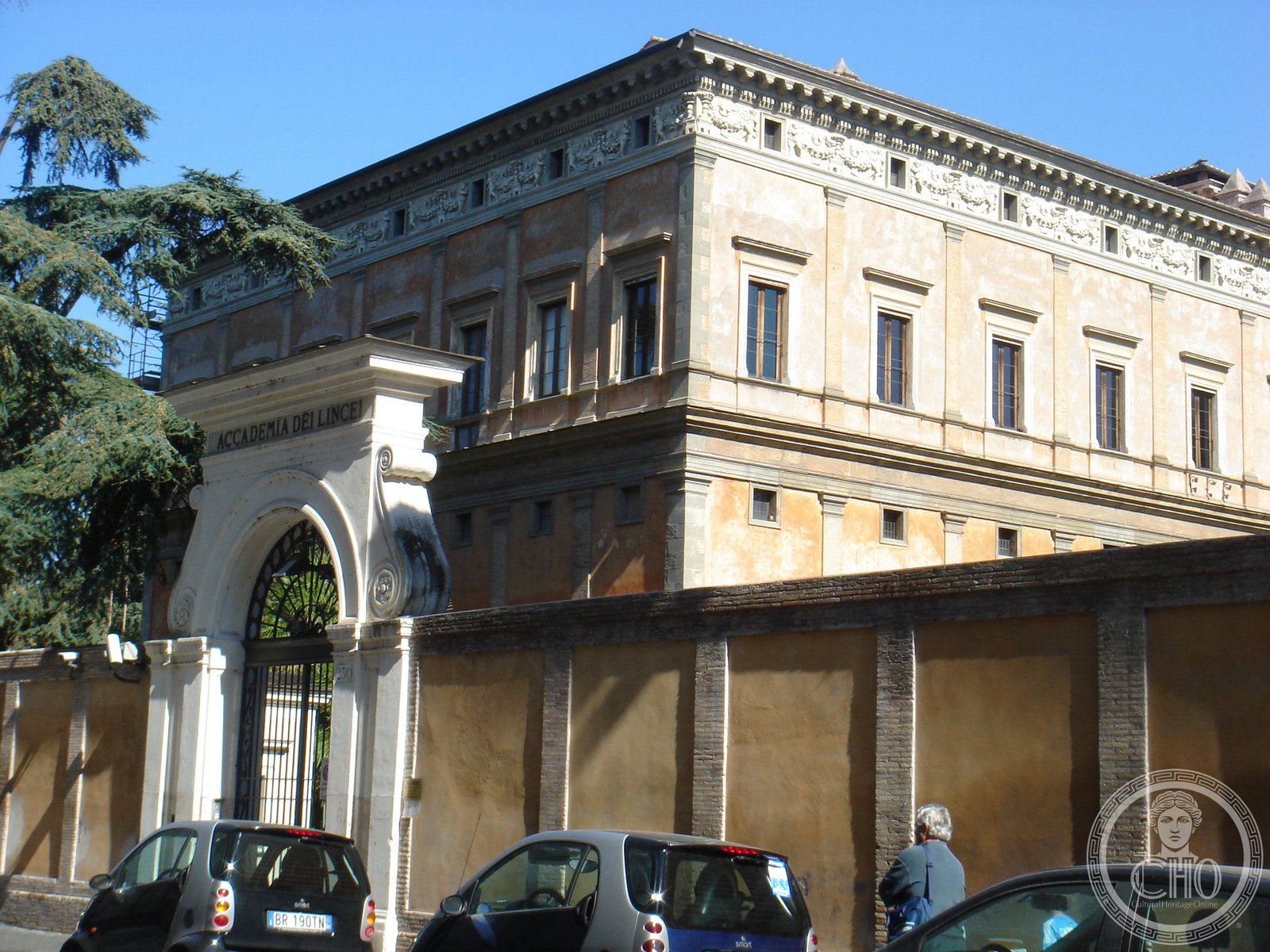
National Academy of Lincei
The Accademia Nazionale dei Lincei (National Academy of Lincei) is Italy’s foremost scientific and humanistic academy, founded in Rome in 1603 by Federico Cesi, a young nobleman who gathered a small circle of natural philosophers committed to direct observation of nature over scholastic authority. Galileo Galilei became its most famous member in 1611, and the academy published his Sidereus Nuncius and other landmark works under its emblem of the lynx — whose sharp sight was taken as a symbol of the acute observation required of the new empirical science. Today the academy, housed in the 16th-century Palazzo Corsini in Trastevere, functions as Italy’s national advisory body on science and learning, a European and global correspondent of the world’s great learned societies.
At a glance
- Type
- National scientific and humanistic academy
- Period
- Founded 1603 by Federico Cesi; current seat Palazzo Corsini 18th century
- Style
- Baroque (Palazzo Corsini); gardens in English landscape style
- Location
- Via della Lungara 10, Trastevere, Rome
- Coordinates
- 41.8933° N, 12.4670° E
Overview
The Accademia dei Lincei is widely regarded as the world’s oldest continuously operating scientific academy — or among the oldest, depending on whether continuity is measured through the gaps imposed by the Inquisition’s suppression of Galileo’s circle in the 1630s and subsequent centuries of discontinuous activity, before the academy was refounded definitively in 1847 under papal patronage and again, as a national institution, after Italian unification in 1870. The debate over the claim to antiquity is itself a measure of the academy’s exceptional prestige.
The name Lincei — from the Latin lynx — encodes the founding aspiration: members must see sharply and without illusion, as the lynx was believed to do. This empiricist commitment, radical in 1603 when Aristotelian scholasticism still dominated European universities, aligned the academy with the new natural philosophy that would produce the Scientific Revolution. Galileo’s membership and the academy’s support for his telescopic astronomy gave Lincei its defining historical moment.
Today the academy has two classes — Sciences and Humanities — each with national members, foreign correspondents, and honorary members drawn from the global scholarly elite. It advises the Italian President and Parliament on scientific matters, awards prizes, publishes research, and maintains extensive library and archival collections including manuscripts, early printed books, and scientific instruments.
History
Federico Cesi (1585–1630) founded the academy at the age of eighteen, recruiting the mathematician Francesco Stelluti, the Dutch physician Johannes van Heeck, and the Umbrian naturalist Anastasio de Filiis as his first associates. The group met in Cesi’s palace near the Campo de’ Fiori and studied botany, mineralogy, optics, and astronomy through direct experiment — an approach that put them in implicit tension with Church authority over natural knowledge. Galileo, invited into membership in 1611 following his telescopic discoveries, became the central figure of the academy’s early fame.
Cesi’s death in 1630 and Galileo’s condemnation by the Inquisition in 1633 effectively ended the first phase of Lincei’s life. The academy lay dormant for over two centuries, its name preserved in scholarly memory as a symbol of scientific courage. A refoundation attempt under papal patronage in the 1840s gave it institutional continuity; the establishment of the Kingdom of Italy in 1870 transformed it into a state institution under the President of the Republic, its current constitutional position.
The Palazzo Corsini was assigned to the academy in the 20th century, providing a magnificent monumental seat commensurate with its national prestige. The palazzo also houses part of the Galleria Nazionale d’Arte Antica, making the complex a point of intersection between scientific heritage and fine art collections.
What you see
Palazzo Corsini is a large Baroque palace built in the 1730s to a design by Ferdinando Fuga for Cardinal Neri Corsini, nephew of Pope Clement XII. Its principal façade faces Via della Lungara with a monumental composition of pilasters and balustrades; the hillside behind the palace has been transformed into the Villa Corsini garden, a rare English-landscape park in central Rome that rises toward the Janiculum and provides sweeping views over Trastevere. The garden’s trees, grottoes, and winding paths constitute one of the quieter green spaces in the city.
The academy’s interior spaces include a ceremonial hall used for public lectures and prize ceremonies, a library of exceptional rare books and manuscripts, and archive rooms containing documents relating to Galileo, Cesi, and the early history of Italian science. The Galleria Nazionale section of the palazzo displays paintings from the 15th to 18th centuries including works by Caravaggio, Guido Reni, Fra Angelico, and Rubens.
The museum is rarely crowded — far less so than the major Vatican or Borghese collections — and offers the unusual experience of a great Italian Baroque interior with serious art holdings seen in relative quiet. The adjacent garden is freely accessible during park hours.
Cultural significance
The Accademia dei Lincei’s founding marks a pivotal moment in European intellectual history: the institution of empirical observation as the basis of legitimate knowledge, and the protection of that project within a private scholarly association independent of both university faculties and the Church. Its association with Galileo gives it a symbolic weight in the history of science that few institutions anywhere in the world can match.
For contemporary Italy, the academy functions as a national standard of intellectual excellence, its membership a recognition of scholarly achievement in both sciences and humanities. Its public activities — lectures, publications, prize ceremonies — extend its role beyond the ceremonial to active participation in national scientific policy and education debates.
Practical information
- Address
- Via della Lungara 10, 00165 Roma RM (Palazzo Corsini)
- Gallery hours
- The Galleria Nazionale d’Arte Antica at Palazzo Corsini: Tuesday–Sunday; check official MiC website for current hours and admission prices
- Garden
- Villa Corsini garden: open during park hours, freely accessible
- Academy events
- Public lectures and ceremonies; see lincei.it for calendar
Getting there
Palazzo Corsini is located in Trastevere, on Via della Lungara between the Tiber and the Janiculum Hill. The nearest tram stop is on Viale Trastevere (lines 3 and 8), approximately 10 minutes on foot through the Trastevere neighbourhood. Bus lines serve Lungotevere della Farnesina nearby. From Piazza San Pietro (Vatican), the palazzo is a 10-minute walk across the Tiber via Ponte Sisto or Ponte Garibaldi. No metro station is nearby; Trastevere is best reached by tram, bus, or on foot from the centre.
Sources & resources
- Accademia dei Lincei — Wikipedia
- Official website — Accademia Nazionale dei Lincei
- Cultural Heritage Online — Rome guides
Find it on the map
See this place and what’s around it →Historical events at this place (1)
📷 Diventa un fotografo di Cultural Heritage Online
Condividi le tue foto dei luoghi: restano pubblicate con la tua firma come autore. Più vengono viste, più ti fai conoscere — e presto un concorso premierà le foto più apprezzate.
Accedi o registrati gratis per aggiungere una foto