
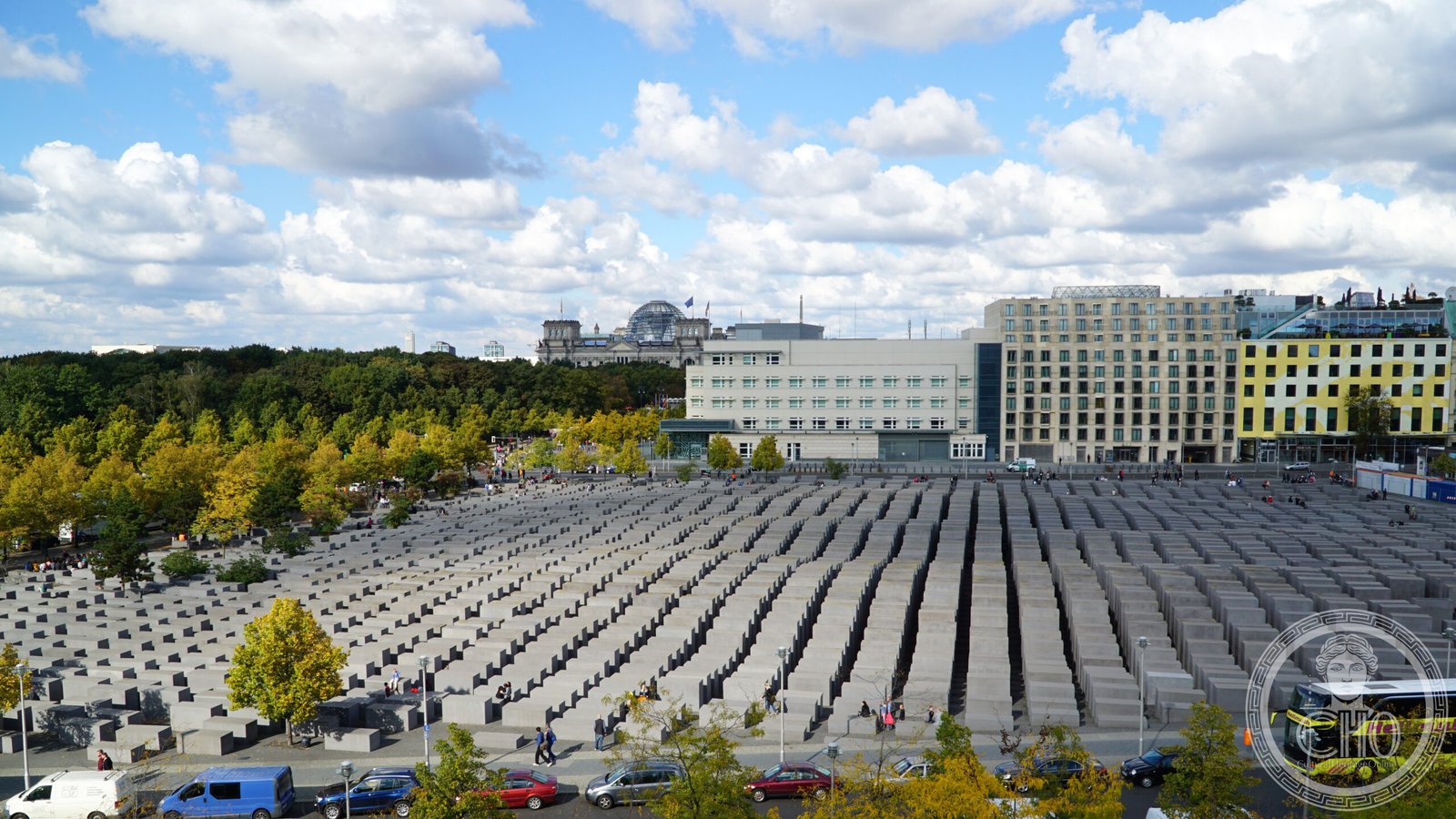
Memorial to the Murdered Jews of Europe
The Memorial to the Murdered Jews of Europe (Denkmal für die ermordeten Juden Europas), also known as the Holocaust Memorial, is a national monument in central Berlin dedicated to the approximately six million Jewish victims of the Nazi genocide. Designed by architect Peter Eisenman and opened on 10 May 2005, the memorial occupies a 4.7-acre field south of the Brandenburg Gate, comprising 2,711 concrete stelae of varying heights arranged in a grid over undulating ground — a landscape that disorients and isolates the visitor as a meditation on the loss of human presence.
At a glance
- Type
- National Holocaust memorial and documentation centre
- Period
- Opened 10 May 2005; planning and debate from 1988
- Style
- Minimalist / deconstructivist (Peter Eisenman)
- Location
- Cora-Berliner-Straße 1, Mitte, Berlin, Germany · 52.5139° N, 13.3765° E
Overview
The memorial’s 2,711 grey concrete blocks range in height from 0.2 metres at the edges to 4.8 metres at the interior, creating a disorienting field in which visitors lose sight of one another and of the surrounding city. Beneath the field, the underground Place of Information (Ort der Information) documents individual fates through family histories, testimony photographs, and the names of known Jewish victims from across Europe. The memorial sits just 200 metres from the former site of Hitler’s Führerbunker, a geographical positioning charged with historical meaning.
History
The idea for a central Berlin Holocaust memorial was first proposed by journalist Lea Rosh and historian Eberhard Jäckel in 1988. After years of public debate, a design competition was held, and Peter Eisenman’s concept — initially developed with sculptor Richard Serra, who later withdrew — was selected. The German Bundestag passed the resolution to build it in 1999. Construction began in 2003 and the memorial opened on 10 May 2005, exactly 60 years after the end of World War II in Europe. The underground information centre opened simultaneously.
What you see
Above ground, the 2,711 stelae — cast in grey concrete without inscription — create shifting alleys of shadow and light. The grid follows the street grid of Berlin but the ground level undulates, so the blocks appear to rise and sink as one walks through. Underground, four rooms form the Place of Information: the Room of Dimensions presents numerical facts about the genocide; the Room of Families shows reconstructed family histories of 15 Jewish families; the Room of Names reads aloud the names and ages of identified victims; and the Room of Sites maps the places of mass murder across Europe.
Cultural significance
As Germany’s central national memorial for the Shoah, the site occupies a unique position in European public memory: it is built in the capital of the perpetrator nation, not a site of victimhood, making it a deliberate act of national acknowledgment. The Eisenman design is widely studied in memorial studies for its refusal of narrative or iconography, placing the burden of meaning on the visitor’s embodied experience rather than on text or symbol.
Practical information
- Address
- Cora-Berliner-Straße 1, 10117 Berlin, Germany
- Field
- Open 24 hours, free access
- Information Centre
- Tue–Sun 10:00–20:00 (Apr–Sep), 10:00–19:00 (Oct–Mar); closed Mon
- Admission
- Free (field and information centre)
Getting there
U-Bahn U55 and S-Bahn S1, S2, S25 stop at Brandenburger Tor / Unter den Linden, a two-minute walk. Bus M85 stops on Ebertstraße directly beside the memorial. The site is a short walk south of the Brandenburg Gate and west of Potsdamer Platz.
Sources & resources
Find it on the map
See this place and what’s around it →📷 Diventa un fotografo di Cultural Heritage Online
Condividi le tue foto dei luoghi: restano pubblicate con la tua firma come autore. Più vengono viste, più ti fai conoscere — e presto un concorso premierà le foto più apprezzate.
Accedi o registrati gratis per aggiungere una foto