
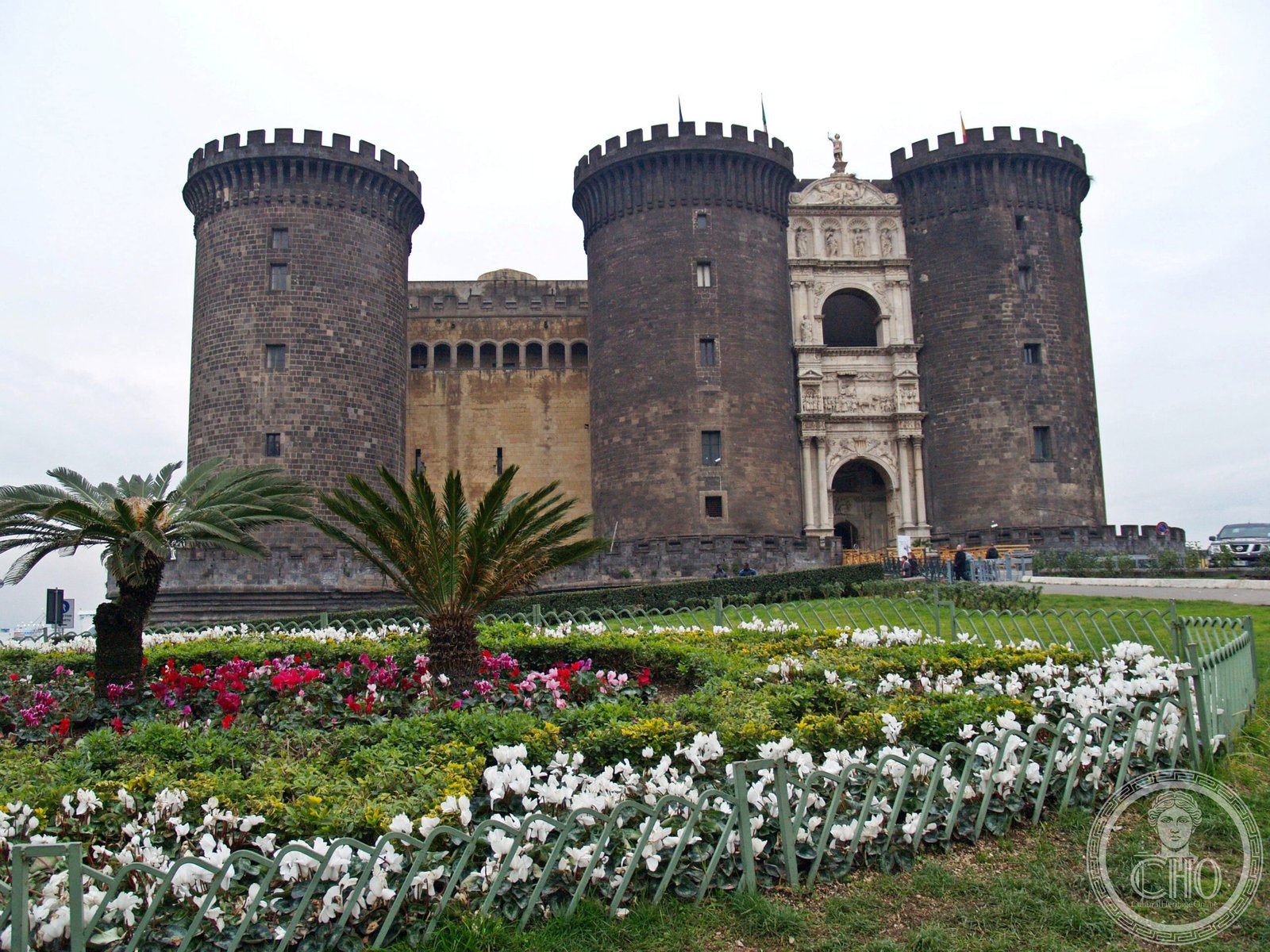
Maschio Angioino (Castel Nuovo)
Maschio Angioino, officially Castel Nuovo, is a medieval castle standing at Piazza Municipio in central Naples, one of the most recognisable monuments of the city and of southern Italian history. First erected in 1279 by Charles I of Anjou, it served as the principal royal seat of the Kingdom of Naples across Angevin, Aragonese, and Spanish rule for more than five centuries. The castle’s defining feature is its Arco di Trionfo, a white marble Renaissance triumphal arch inserted between two of its cylindrical towers by Alfonso V of Aragon after 1443, widely considered one of the masterpieces of 15th-century Italian sculpture.
At a glance
- Type
- Medieval royal castle · civic museum
- Period
- Founded 1279; current form largely 15th century
- Style
- Gothic-Angevin structure with Renaissance Triumphal Arch (1443–1467)
- Location
- Piazza Municipio, Naples, Campania, Italy
- Coordinates
- 40.8385° N, 14.2527° E
Overview
Castel Nuovo, often called Maschio Angioino, is a medieval castle located in front of Piazza Municipio and the city hall in central Naples, Campania, Italy. Its scenic location and imposing size make the castle, first erected in 1279, one of the main architectural landmarks of the city. It was a royal seat for kings of Naples, Aragon, and Spain until 1815, and today houses the Museo Civico with collections of medieval and Renaissance art and sculpture.
History
Charles I of Anjou commissioned the castle in 1279, choosing a commanding position between the harbour and the medieval city that gave the structure its popular name — Maschio Angioino, the “Angevin Keep.” The Aragonese rulers who took Naples in 1443 undertook a comprehensive transformation: Alfonso V commissioned the triumphal arch celebrating his entry into the city, which rises between two cylindrical towers and is decorated with figural reliefs by sculptors including Francesco Laurana and Pietro da Milano. Subsequent centuries under Spanish viceroys brought further alterations, and the castle served administrative as well as ceremonial functions through the Bourbon Kingdom of the Two Sicilies.
What you see
The exterior presents five massive cylindrical towers in grey volcanic stone (piperno), with the white marble Triumphal Arch of Alfonso V as the principal entrance — a jarring and intentional contrast between the dark military mass and the gleaming humanist monument. The interior houses the Sala dei Baroni, a late-Gothic hall of vast dimensions with a stellar vault, where a 1486 rebellion of barons against Ferrante I of Aragon was crushed. The Museo Civico displays frescoes salvaged from the original Angevin chapel, bronzes, and Renaissance paintings.
Cultural significance
Castel Nuovo represents the point of convergence of two of the defining powers of medieval and Renaissance Italy — the Angevin French dynasty that brought Gothic culture to the south, and the Aragonese dynasty that made Naples one of the principal courts of the Italian Renaissance. The Triumphal Arch is a monument not only to political power but to the new humanist vocabulary of image-making that would define European royal self-representation for the following two centuries.
Practical information
- Address
- Piazza Municipio, 80133 Napoli NA, Italy
- Hours
- Typically Monday–Saturday 09:00–19:00; check official website for current hours and admission prices
- Museum
- Museo Civico di Castel Nuovo — included with castle admission
Getting there
Castel Nuovo is centrally located in Naples at Piazza Municipio, served by the Toledo or Municipio stations of Naples Metro Line 1. Numerous bus lines stop at Piazza Municipio and the adjacent Molo Beverello ferry terminal. The castle is approximately 15 minutes on foot from Naples Centrale railway station via Via Agostino Depretis.
Sources & resources
- Wikipedia: Castel Nuovo
- Cultural Heritage Online — curated guides to Naples and southern Italy’s architectural heritage
Find it on the map
See this place and what’s around it →📷 Diventa un fotografo di Cultural Heritage Online
Condividi le tue foto dei luoghi: restano pubblicate con la tua firma come autore. Più vengono viste, più ti fai conoscere — e presto un concorso premierà le foto più apprezzate.
Accedi o registrati gratis per aggiungere una foto