
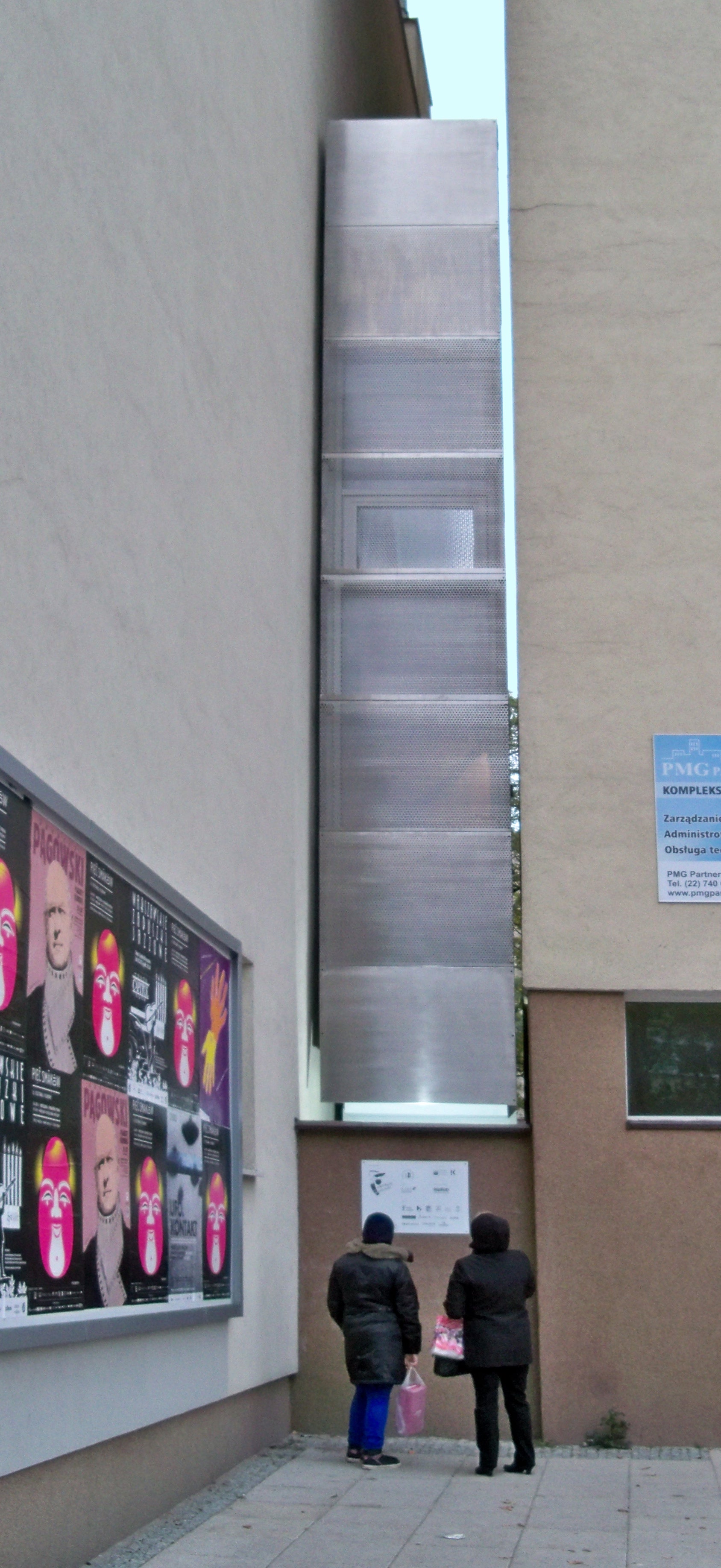
Keret House
Keret House is an art installation and habitable structure in Warsaw, Poland, designed by architect Jakub Szczęsny of the firm Centrala and completed in 2012. Wedged into a narrow gap between two existing buildings at 22 Żelazna Street and 74 Chłodna Street, it measures just 92 centimetres at its thinnest point and 152 centimetres at its widest, and has been described as the narrowest house in the world. Named after Israeli writer and filmmaker Etgar Keret — who was the building’s first tenant — the structure serves as a residence for international writers and artists on short-term residencies, as well as a commentary on urban space and the history of Warsaw’s Jewish community.
At a glance
- Type
- Art installation and habitable structure
- Period
- Completed 2012
- Style
- Contemporary / conceptual architecture
- Location
- Warsaw, Poland · 52.2378° N, 20.9868° E
Overview
Keret House occupies one of the most unusual footprints in world architecture: a tapering wedge of space between two Warsaw apartment buildings, with a floor plan that never exceeds 1.52 metres in width. Designed by Jakub Szczęsny and realised through the firm Centrala, the project was conceived as both a functional dwelling and a work of public art, exploring themes of urban density, memory and displacement. The structure is managed by the Institute for Polish Culture at the University of Warsaw and offers rotating residencies to international writers, with Israeli author Etgar Keret — in whose family’s story the Warsaw Jewish ghetto figures prominently — as its symbolic patron and first resident.
History
The project was initiated by architect Jakub Szczęsny, who identified the narrow gap between two buildings at the boundary of the former Warsaw Jewish Ghetto as a site with exceptional conceptual potential. Construction was completed in 2012 using lightweight prefabricated elements inserted between the party walls of the adjacent buildings without structural modification. The decision to name the house after Etgar Keret was deliberate: Keret’s parents survived the Holocaust and the Warsaw Ghetto, and the location — straddling the boundary of the ghetto’s pre-war and wartime extent — gave the project a memorial dimension beyond its architectural novelty. The house received widespread international press coverage upon opening and has since become one of Warsaw’s best-known contemporary cultural landmarks.
What you see
Seen from the street, Keret House is nearly invisible — a white sliver barely wider than a door frame, visible only as a thin vertical plane between the two flanking buildings. The interior, accessible via a retractable ladder, comprises two levels: a sleeping area and a writing/living space, each barely wide enough for a single person to move sideways. The structure is clad in translucent white polycarbonate panels, which glow at night when lit from within, transforming the gap between the buildings into an unexpected lantern in the city fabric. The surrounding street corner retains its original post-war apartment buildings, providing essential context for understanding the scale of the intervention.
Cultural significance
Keret House has attracted global attention as an extreme statement on the boundaries of habitable space and as a meditation on the layered history of Warsaw’s Jewish quarter. It demonstrates how architecture can operate simultaneously as formal experiment, social commentary and memorial gesture. The building’s location at the edge of the former ghetto, its association with Etgar Keret and its use as an artists’ residency give it a cultural weight that far exceeds its physical dimensions.
Practical information
- Address
- Between ul. Żelazna 22 and ul. Chłodna 74, Warsaw, Poland
- Visits
- The exterior is viewable from the street at any time; interior access is restricted to residency programme participants. Check the Institute for Polish Culture website for event visits.
Getting there
The house is located in central Warsaw near the intersection of Żelazna and Chłodna Streets in the Wola district. The nearest metro station is Rondo ONZ on Metro Line 2. Numerous bus lines serve the area, and the site is a short walk from the Museum of the History of Polish Jews (POLIN), making a combined visit natural. The Keret House is approximately 1 km west of the Old Town.
Sources & resources
Find it on the map
See this place and what’s around it →📷 Diventa un fotografo di Cultural Heritage Online
Condividi le tue foto dei luoghi: restano pubblicate con la tua firma come autore. Più vengono viste, più ti fai conoscere — e presto un concorso premierà le foto più apprezzate.
Accedi o registrati gratis per aggiungere una foto