
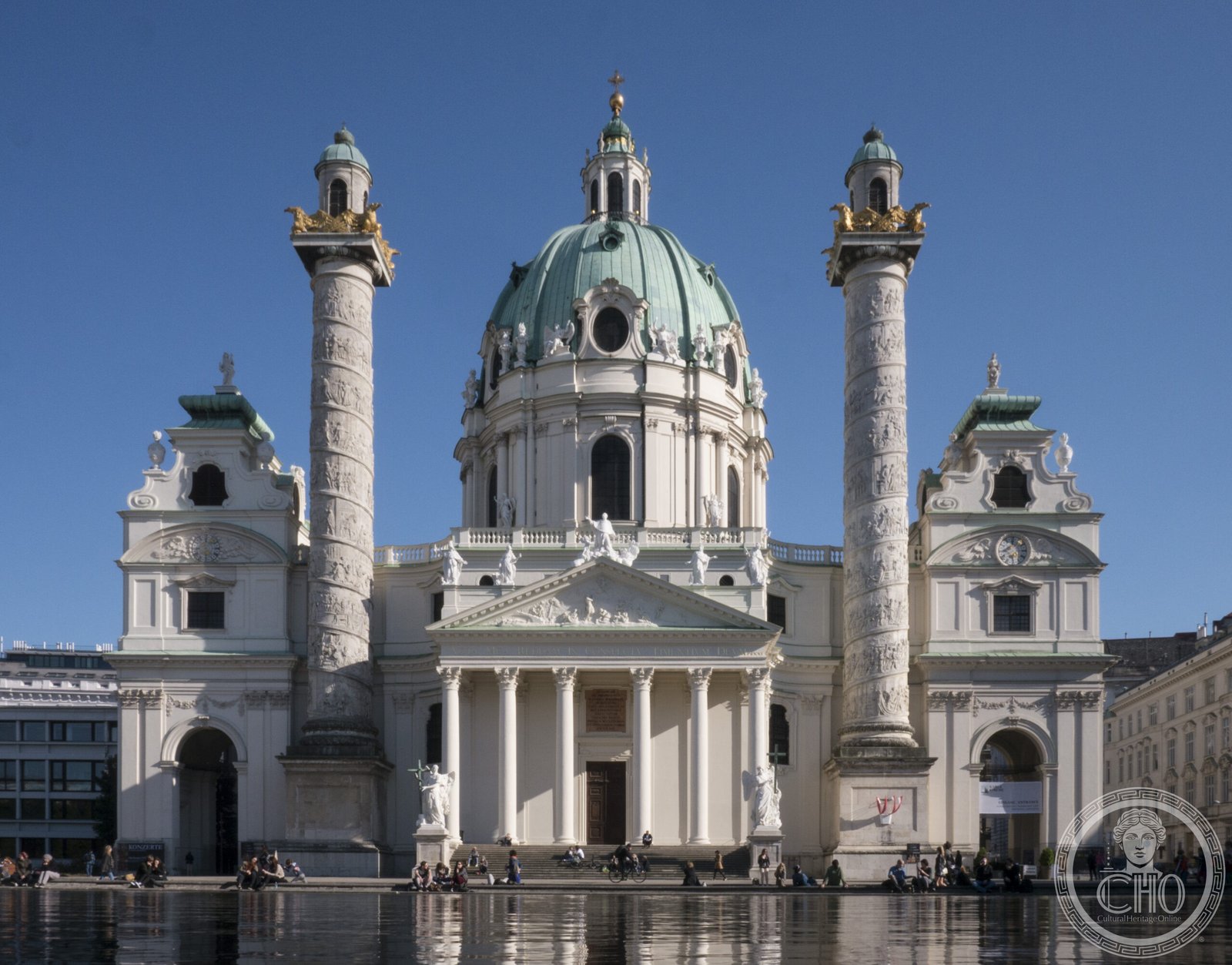
Karlskirche — Church of Saint Charles Borromeo
The Karlskirche is one of the finest Baroque churches in Central Europe, located on the Karlsplatz in Vienna, Austria. Built between 1716 and 1737 to a design by Johann Bernhard Fischer von Erlach and completed by his son Joseph Emanuel, it was commissioned by Emperor Charles VI as a votive church following the end of the 1713 plague in Vienna. Its celebrated façade combines a classical portico, two triumphal columns modelled on Trajan’s Column in Rome, and a towering elliptical copper dome, creating a synthesis of ancient Roman and Baroque idioms unique in European sacred architecture.
At a glance
- Type
- Votive church · Roman Catholic · dedicated to Saint Charles Borromeo
- Period
- 1716–1737
- Style
- Austrian High Baroque
- Location
- Karlsplatz, Vienna, Austria
- Coordinates
- 48.1982° N, 16.3696° E
Overview
The Karlskirche stands on the southern edge of the Karlsplatz, one of Vienna’s most important public squares, facing the historic city centre across a reflecting pool added in the 20th century. It is dedicated to Saint Charles Borromeo, a leading figure of the Counter-Reformation and the patron saint of Emperor Charles VI, who both shared the name and saw in Borromeo a model of imperial piety and authority. The church is located on the border between the districts of Wieden and the Innere Stadt.
The building is considered the masterpiece of Johann Bernhard Fischer von Erlach, the leading Austrian Baroque architect of his generation. His design consciously drew on multiple historical references — the Roman Pantheon, Trajan’s Column, the Temple of Solomon as described in the Bible — to project an image of the Habsburg emperor as successor to the ancient Roman and biblical monarchs.
Today the Karlskirche functions as an active parish church and a major cultural attraction. Visitors can ascend inside the dome via a contemporary panoramic lift to view the frescoes by Johann Michael Rottmayr at close range.
History
Emperor Charles VI vowed to build a church dedicated to Saint Charles Borromeo if Vienna was spared from the great plague epidemic of 1713, which killed some 8,000 people in the city. When the epidemic ended, he held an architectural competition; Fischer von Erlach’s design was selected and construction began in 1716. The elder Fischer von Erlach died in 1723 and the project was completed by his son Joseph Emanuel in 1737.
The choice of Saint Charles Borromeo was layered with dynastic significance: Borromeo had been canonised in 1610 and was associated with the Catholic reform movement that the Habsburgs championed. The two flanking columns, each approximately 33 metres high and decorated with spiralling relief narratives of Borromeo’s life, explicitly echo the Column of Trajan in Rome, presenting Charles VI as heir to Roman imperial tradition.
The church has served continuously as a place of worship since its consecration. In the 20th century it became closely associated with the Wiener Symphoniker, which holds seasonal concerts within the church, and the addition of the reflecting pool in front during the 1970s–80s redesign of Karlsplatz enhanced its visual setting.
What you see
The façade presents an extraordinary theatrical composition: a wide convex portico with a classical pediment at the centre, flanked by two cylindrical towers capped with lanterns, and two triumphal columns rising on either side. The columns are sheathed in continuous spiral relief carvings depicting scenes from Borromeo’s life, topped by copper lanterns. Above the entrance body rises the main elliptical drum and copper dome, crowned by a lantern, reaching approximately 72 metres.
Inside, the nave is an oval space flooded with light from the dome’s windows. The ceiling fresco by Johann Michael Rottmayr (completed 1730) depicts the apotheosis of Saint Charles Borromeo and fills the entire interior of the dome with swirling figures in rich colour. Side chapels contain altarpieces by leading Baroque painters of the Vienna school.
A panoramic glass lift installed inside the dome allows visitors to ascend and view the Rottmayr frescoes from close range — a unique experience that brings the monumental paintings within arm’s reach — before emerging onto a platform with views over Vienna’s roofscape.
Cultural significance
The Karlskirche is listed as a UNESCO tentative site within the Historic Centre of Vienna, itself a World Heritage Site since 2001. It represents the apex of Austrian Baroque sacred architecture and is one of the most programmatically complex buildings of the European 18th century, encoding dynastic, religious, and political symbolism into every element of its design.
The church has exerted wide influence on Central European Baroque architecture and continues to function as both an active house of worship and a major venue for classical music, including orchestral concerts and the Vienna Philharmonic Ball preparations. It remains one of the most photographed monuments in Vienna.
Practical information
- Address
- Karlsplatz, 1040 Wien, Austria
- Hours
- Monday–Saturday 09:00–18:00; Sunday 12:00–19:00 (check official website for current times)
- Admission
- Paid entry includes panoramic lift and fresco platform; reductions available
- Website
- karlskirche.at
Getting there
The Karlskirche is directly accessible from Karlsplatz station, served by U-Bahn lines U1, U2, and U4 — one of the most central transport hubs in Vienna. Tram lines 1, 2, 62, and 71 also stop at Karlsplatz. The church is a short walk from the Naschmarkt and the Musikverein concert hall, and is approximately 15 minutes on foot from the Stephansdom in the historic centre. Cycling via the Ringstraße cycle path is also convenient.
Sources & resources
Find it on the map
See this place and what’s around it →📷 Diventa un fotografo di Cultural Heritage Online
Condividi le tue foto dei luoghi: restano pubblicate con la tua firma come autore. Più vengono viste, più ti fai conoscere — e presto un concorso premierà le foto più apprezzate.
Accedi o registrati gratis per aggiungere una foto