
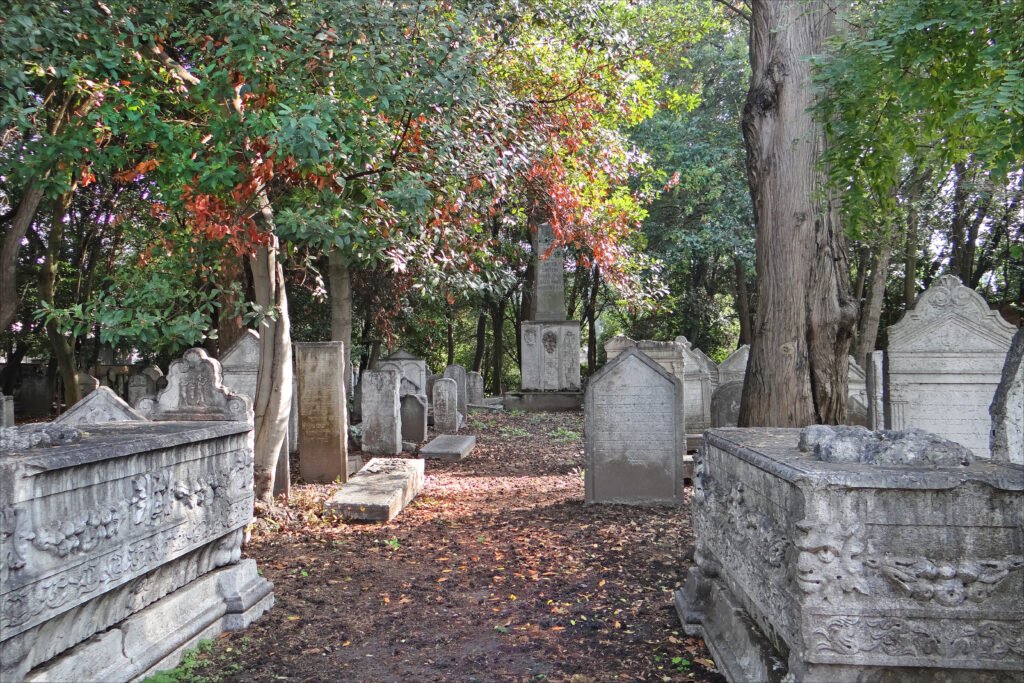
Jewish Cemetery of Venice
The Jewish Cemetery of Venice (Jüdischer Friedhof, also known as Universitas Judeorum) is one of the oldest surviving Jewish cemeteries in Europe, founded between 1386 and 1389 on the island of the Lido di Venezia. Used as the primary burial ground for Venice’s Jewish community until the end of the 18th century, its ancient tombstones — engraved in Hebrew, Ladino, and Portuguese — document centuries of Sephardic, Ashkenazi, and Italian Jewish life in the Serenissima. Known in Jewish tradition as Bet Ha-Chajim, the “House of Life,” the site reflects the profound role of memory and continuity in Jewish thought.
At a glance
- Type
- Historic Jewish cemetery
- Period
- Founded 1386–1389; in continuous use until the late 18th century
- Style
- Vernacular funerary; tombstones in Romanesque, Baroque, and classicising forms
- Location
- Riviera S. Nicolò 23, 30126 Lido di Venezia, Venice, Italy
- Coordinates
- 45.4246° N, 12.3783° E
Overview
The Jewish Cemetery of Venice occupies a secluded plot on the Lido, separated from the bustle of the lagoon city by water and centuries of memory. It is among the oldest extant Jewish burial grounds in Europe, predating many of the continent’s other surviving sites. The cemetery’s Hebrew name, Bet Ha-Chajim — “House of Life” — reflects the Jewish tradition that views burial not as an end but as a passage, and that treats the cemetery as an eternal school for the living.
History
The cemetery was established between 1386 and 1389, when Venice’s Jewish community — then restricted in residence and occupation — was granted burial rights on the Lido. For approximately four centuries it served as the sole Jewish burial ground in the Venetian Republic, receiving merchants, physicians, scholars, and ordinary families from the Ghetto. By the late 18th century, following the Napoleonic reorganisation of the region, new Jewish cemeteries were established and this ancient ground gradually fell out of active use. The site weathered neglect, wartime damage, and the upheavals of the 20th century; restoration efforts in recent decades have stabilised many of the most fragile stones.
What you see
Visitors enter through a simple gate into a densely planted enclosure where hundreds of tombstones lean at varying angles, many deeply weathered by the lagoon’s salt air. Epitaphs are carved in Hebrew, Ladino, Portuguese, and Italian, reflecting the diverse origins of Venice’s Jewish community — Sephardic exiles from Spain and Portugal, Levantine traders, and Ashkenazi arrivals from central Europe. The oldest markers are plain rectangular slabs; later Baroque stones feature elaborate relief carvings of heraldic symbols, floral borders, and narrative scenes. Some inscriptions record remarkable lives: physicians who served the Doge’s court, poets, and rabbinical scholars.
Cultural significance
As one of the oldest surviving Jewish cemeteries in Europe, the site is a primary document of Venetian Jewish history and a recognised heritage asset within the broader context of the Venice UNESCO World Heritage site. It testifies to the complex, often fraught but remarkably enduring relationship between Venice’s Jewish community and the Republic of the Serenissima, and stands as a place of memory for descendants of Venetian Jews scattered across the world.
Practical information
Address: Riviera S. Nicolò 23, 30126 Lido di Venezia, Venice. The cemetery is managed by the Jewish Community of Venice (Comunità Ebraica di Venezia). Visits are typically guided; check with the community for current opening hours and tour schedules. Access is by ACTV water bus (vaporetto) to the Lido, then on foot or by bicycle.
Getting there
Take ACTV Line 1 or Line 2 from Piazza San Marco or the Ferrovia (Santa Lucia station) to Lido S.M.E. The cemetery is approximately 1 km north along Riviera S. Nicolò; bicycles are available for hire at the Lido landing stage. No direct car access from central Venice; a car ferry operates from Tronchetto if arriving by road.
Sources & resources
- Comunità Ebraica di Venezia — official information on guided visits
- culturalheritageonline.com — more heritage places in Venice and the Veneto
Find it on the map
See this place and what’s around it →📷 Diventa un fotografo di Cultural Heritage Online
Condividi le tue foto dei luoghi: restano pubblicate con la tua firma come autore. Più vengono viste, più ti fai conoscere — e presto un concorso premierà le foto più apprezzate.
Accedi o registrati gratis per aggiungere una foto