
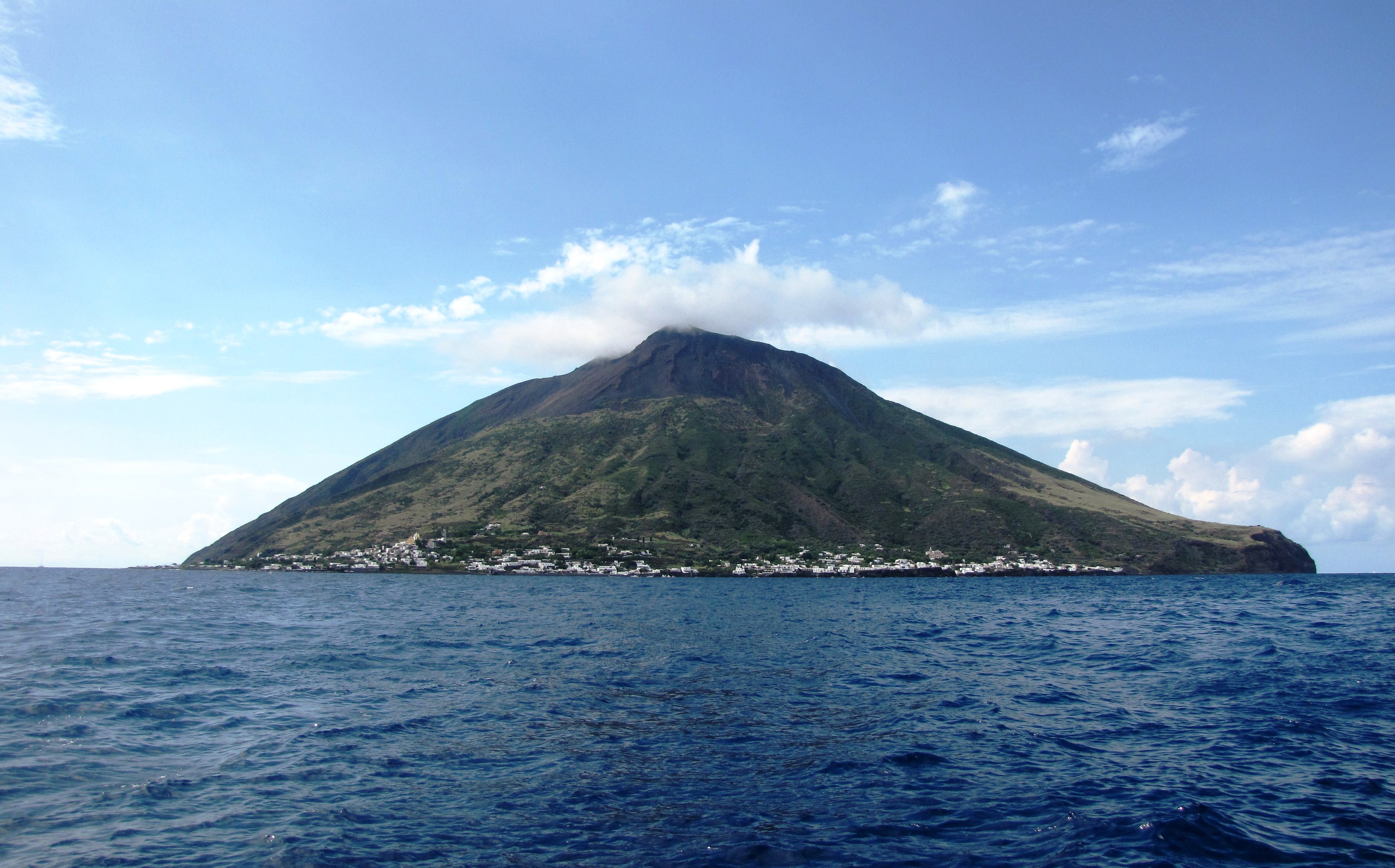
Island of Stromboli
Stromboli is an active volcanic island in the Tyrrhenian Sea, part of the Aeolian archipelago off the north coast of Sicily. One of only four active volcanoes in Italy, it has been in nearly continuous eruption for 2,000–5,000 years and belongs to a UNESCO World Heritage Site inscribed in 2000 for its outstanding record of volcanic island-building. The island is famously nicknamed the “Lighthouse of the Mediterranean” for its persistent nocturnal eruptions visible from the sea.
At a glance
- Type
- Active volcanic island
- Period
- Continuous eruption for 2,000–5,000 years; settled in antiquity
- Style
- Natural landscape; Strombolian volcanic type
- Location
- Tyrrhenian Sea, Aeolian archipelago, Province of Messina, Sicily, Italy
- Coordinates
- 38.7925° N, 15.2149° E
- Area
- 12.6 km²
- Population
- Approximately 500 residents (2016)
- UNESCO status
- Part of the Aeolian Islands UNESCO World Heritage Site (2000)
Overview
Stromboli rises 926 metres above sea level and extends more than 2,700 metres above the sea floor, forming a near-perfect volcanic cone at the northeastern extremity of the Aeolian chain. The island covers 12.6 square kilometres and is divided into three small villages — San Bartolo, San Vincenzo and Ginostra — which today host a community of around 500 permanent residents. The surrounding waters are deep, crystal-clear and protected as part of the Aeolian Islands marine environment, making Stromboli one of the most dramatic and visually recognisable islands in the Mediterranean.
History
The island was settled in antiquity and was known to Greek and Roman navigators as a reliable waypoint in the Tyrrhenian Sea, its eruptions serving as a natural beacon. Early twentieth-century population reached several thousand, but emigration reduced the permanent community to a few hundred by the mid-1950s. The island rose to international cultural prominence in 1950 when Roberto Rossellini filmed Stromboli here starring Ingrid Bergman, drawing global attention to the volcanic landscape. The Aeolian Islands, including Stromboli, were inscribed on the UNESCO World Heritage List in 2000 for their outstanding record of volcanic geology and ongoing natural phenomena.
What you see
Stromboli is defined by its summit craters, which produce periodic explosive bursts of incandescent lava fragments every few minutes — the eruption type that volcanologists worldwide now call “Strombolian.” The northwestern slope is dramatically scarred by the Sciara del Fuoco (stream of fire), a large horseshoe-shaped depression formed by repeated volcanic collapses over the past 13,000 years, down which lava flows directly into the sea. Off the northeastern shore lies Strombolicchio, a stark volcanic plug that represents the eroded remnant of an earlier, much older volcano. The island’s fertile volcanic soils support Mediterranean maquis, vineyards producing the local Malvasia delle Lipari wine, and terraced gardens clinging to the steep slopes.
Cultural significance
Stromboli occupies a unique place in Western cultural imagination: Jules Verne located the exit of his protagonists’ subterranean journey here in Journey to the Centre of the Earth, and the island is widely cited as an influence on J.R.R. Tolkien’s conception of Mount Doom. As part of the Aeolian Islands UNESCO World Heritage Site, Stromboli is recognised globally as a living laboratory for understanding volcanic island formation and one of the most accessible active volcanoes on Earth for scientific study and heritage tourism.
Practical information
- Access
- Accessible only by sea; regular hydrofoil and ferry services connect Stromboli to Milazzo, Lipari, and other Aeolian islands
- Summit hike
- Guided treks to the summit craters are permitted after 16:00 and require a licensed guide by law; check local guide associations for current schedules
- Viewpoint
- The Sciara del Fuoco can be viewed from authorised sea-level vantage points at night without summit access
- Hours
- Check official website for current access regulations and eruption status
Getting there
From Milazzo (Sicily) or Reggio Calabria, hydrofoils operated by Liberty Lines and ferries operated by Siremar connect Stromboli in approximately 1 hour 45 minutes to 3 hours depending on the service. From Naples (Molo Beverello), seasonal direct hydrofoil connections run in summer. There are no cars on the island; walking and three-wheeled Ape vehicles are the only land transport.
Sources & resources
Find it on the map
See this place and what’s around it →📷 Diventa un fotografo di Cultural Heritage Online
Condividi le tue foto dei luoghi: restano pubblicate con la tua firma come autore. Più vengono viste, più ti fai conoscere — e presto un concorso premierà le foto più apprezzate.
Accedi o registrati gratis per aggiungere una foto