
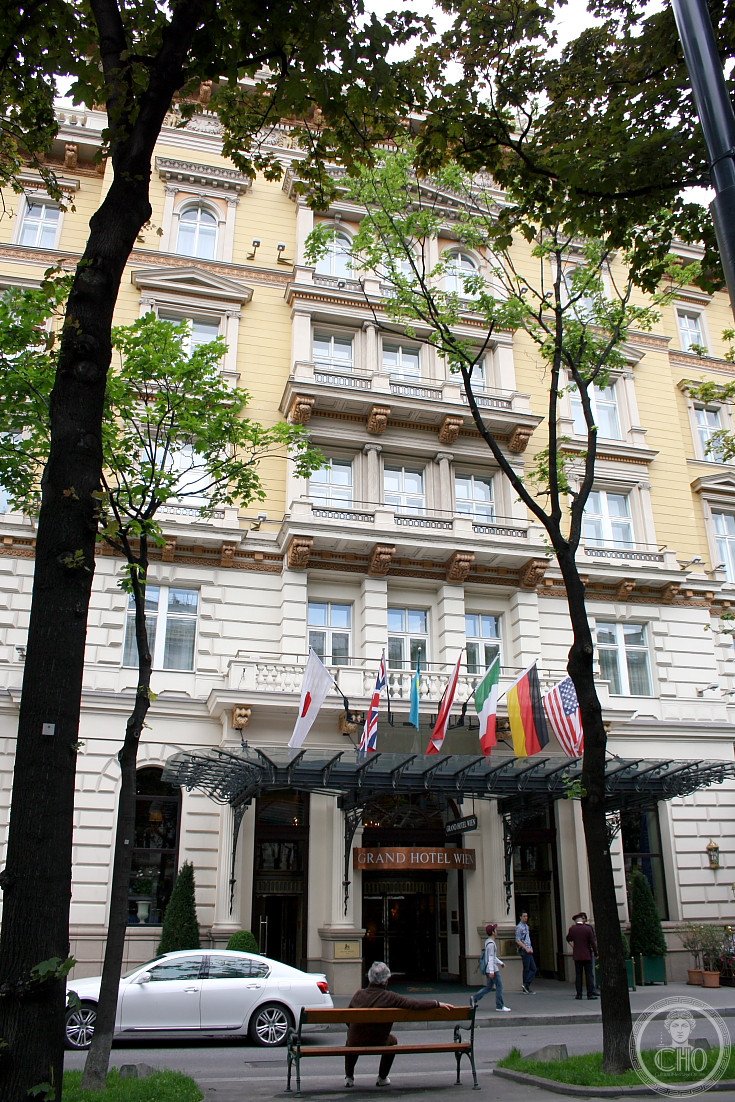
Vienna's first grand hotel, opened on the Ringstrasse in 1870 in a building by architect Carl Tietz and famous for amenities that astonished the imperial capital.
At a glance
The Grand Hotel Wien stands at Kärntner Ring 9, on Vienna's monumental Ringstrasse boulevard, and opened on 10 May 1870 as the first grand hotel in the city. It was created from a building designed by the Viennese architect Carl Tietz, originally raised as a residential house in the 1860s and converted to hotel use. From the outset it offered amenities considered sensational for the period — some 300 rooms, 200 bathrooms, steam-powered elevators and its own telegraph office — and it quickly became a meeting point for the aristocracy and high society of the late Habsburg capital.
Key facts
- Opened 10 May 1870 as the first grand hotel in Vienna (official hotel history; Wien Geschichte Wiki)
- Designed by Viennese architect Carl Tietz (1831–1874)
- Original residential building constructed 1861–1865, converted to a hotel by 1866
- Debuted with about 300 rooms, 200 bathrooms, steam elevators and a telegraph office
- In 1894 composer Johann Strauss celebrated his 50-year stage jubilee at the hotel
- Reached its largest expansion by 1911 with the neighbouring properties at Kärntner Ring 11 and 13
- Occupied by Soviet troops after 1945 and closed for roughly a decade
History
The Grand Hotel Wien owes its existence to the building of Vienna's Ringstrasse, the grand circular boulevard laid out from the late 1850s on the line of the demolished city walls. According to the Wien Geschichte Wiki, the original wing at Kärntner Ring 9 (corner of Akademiestraße) was erected between 1861 and 1865 by the architect Carl Tietz as a residential house, and was already remodelled into a hotel by 1866. A separate new wing at Kärntner Ring 11–13, also by Tietz, followed in 1869. On 10 May 1870 the establishment opened as the first grand hotel in the city, a status confirmed both by the hotel's own published history and by the city's heritage wiki.
The hotel was a sensation of its day. Its official history records that it debuted with roughly 300 rooms, 200 bathrooms, steam elevators and a telegraph office — extraordinary technical comforts for 1870 — and it rapidly became the social centre of imperial Vienna, frequently fully booked. In 1894 the composer Johann Strauss celebrated his fiftieth stage jubilee there. By 1911 the hotel had reached its greatest extent, absorbing the adjoining houses at Kärntner Ring 11 and 13; the Wien Geschichte Wiki notes that the original 1869 new wing was demolished in 1911 and replaced in 1911–1913 by a building designed by the architects Baschkis and Bahr. After 1945 the hotel was requisitioned by Soviet occupying forces and closed for about a decade. In later decades the complex served institutional uses before being comprehensively renovated; the hotel's own account dates its reopening as a five-star hotel to 1994, after the building had been acquired and restored.
What you see
From the Kärntner Ring the building presents a monumental historicist façade typical of the Ringstrasse era, several storeys high and treated with the ordered, ornamented stonework that defined Vienna's grand boulevard architecture of the 1860s–1910s. The structure combines Carl Tietz's original 1860s wing with the larger 1911–1913 replacement block by the architects Baschkis and Bahr, so the elevation reflects two phases of Ringstrasse historicism. The corner site, where Kärntner Ring meets Akademiestraße, gives the hotel a prominent presence facing the boulevard.
Practical information
- Address: Kärntner Ring 9, 1010 Vienna (Innere Stadt, 1st district)
- Operating five-star hotel — public areas accessible to guests and diners
- Directly on the Ringstrasse boulevard, a short walk from the State Opera
- Confirm any visits or dining via the hotel's official site
Getting there
The hotel sits on the Ringstrasse near the State Opera; the nearest U-Bahn is Karlsplatz (U1/U2/U4), and Ringstrasse trams 1, 2, 71 and D stop close by.
Nearby
- Vienna Secession building (Olbrich, 1897–98) — approx. 800 m west
- Karlsplatz Stadtbahn Pavilions (Otto Wagner, 1898–99) — approx. 700 m southwest
- Otto Wagner's Majolikahaus / Wienzeile houses — approx. 1.5 km southwest
Sources
- Our History — Grand Hotel Wien (https://en.grandhotelwien.com/about-us/history/)
- Grand Hotel — Wien Geschichte Wiki (https://www.geschichtewiki.wien.gv.at/Grand_Hotel)
- File:Wien Grand Hotel 1.JPG — Wikimedia Commons (https://commons.wikimedia.org/wiki/File:Wien_Grand_Hotel_1.JPG)
- OpenStreetMap Nominatim geocode — Grand Hotel Wien, Kärntner Ring 9
Find it on the map
See this place and what’s around it →📷 Become a Cultural Heritage Online photographer
Share your photos of places: they stay published under your name as the author. The more they're seen, the more you get noticed — and soon a contest will reward the most appreciated photos.
Log in or sign up free to add a photoIs this page about you?
This page is read by travellers and heritage enthusiasts who find it on Google. Tell us how you are connected to this place and we will take it from there.