
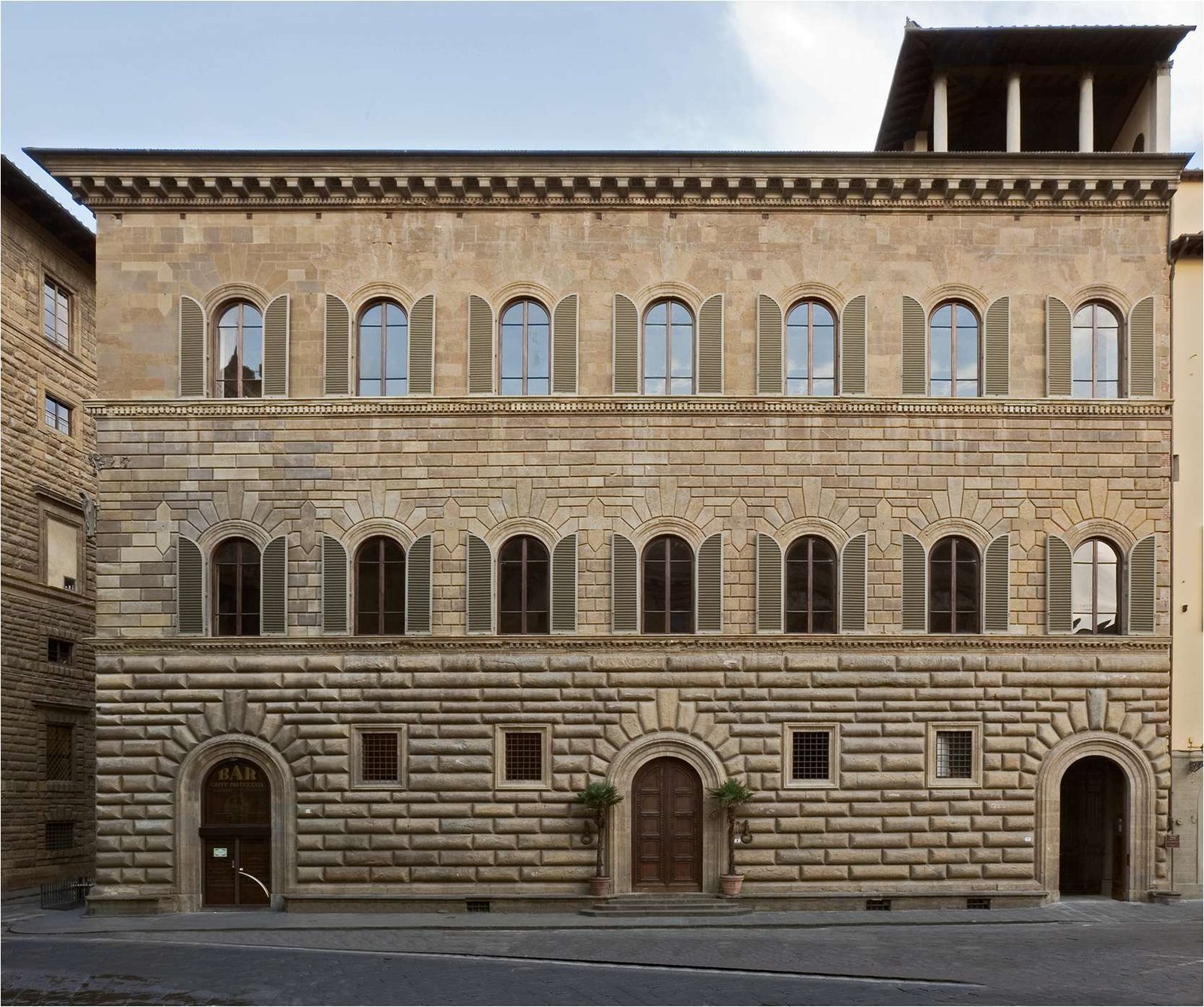
Gondi Palace
Gondi Palace (Palazzo Gondi) is a Renaissance palace in the historic centre of Florence, built for the Gondi family — originally Florentine merchants who became prominent in France under Catherine de Medici — and designed by Giuliano da Sangallo in the late fifteenth century. Its rusticated stone facade and refined courtyard place it among the significant secular buildings of High Renaissance Florence.
At a glance
- Type
- Renaissance private palace
- Period
- Begun c. 1490; completed early 16th century
- Style
- Florentine Renaissance
- Location
- Piazza San Firenze, Florence, Tuscany
- Coordinates
- 43.7696° N, 11.2572° E
Overview
Gondi Palace stands near Piazza della Signoria in the historic centre of Florence, commissioned by Giuliano Gondi and attributed to the architect Giuliano da Sangallo, who produced one of the more restrained and elegant palace designs of the period. The Gondi family were Florentine bankers and merchants who rose to European prominence partly through their close relationship with the Medici and their later connections to the French court. The palace remains in private ownership and is still associated with the Gondi family.
History
Construction of the palace began around 1490 under the patronage of Giuliano Gondi, a wealthy Florentine merchant who had spent years at the French court and wished to establish a suitably imposing residence on his return. Giuliano da Sangallo, who had also worked for Lorenzo de Medici, was chosen as architect, bringing to the commission a deep familiarity with classical principles as interpreted in Florence. The palace was not completed until the early sixteenth century, by which time the Gondi had consolidated their position as one of the leading Florentine families with international reach. The family later rose to considerable nobility under the patronage of Catherine de Medici.
What you see
The facade of Gondi Palace is built in pietra forte, the grey-yellow sandstone characteristic of Florentine palace architecture, with graduated rustication — rougher stonework on the lower floors giving way to smoother courses above — creating a subtle sense of weight and refinement. The ground-floor loggia opens onto the courtyard, which follows the colonnaded model developed by Brunelleschi and refined by Michelozzo, with round arches on slender columns. Decorative details including carved medallions and refined cornices reflect the sophisticated taste of both patron and architect. The palace interior retains historical furnishings and artworks belonging to the family.
Cultural significance
Gondi Palace represents an important chapter in the story of Florentine Renaissance domestic architecture, demonstrating how the city’s banking and merchant class translated wealth into built form following classical models. Its continued private ownership by descendants of the original family gives it an unusual degree of historical continuity rarely found in Italy’s great urban palaces. The palace also anchors the narrative connecting Florentine financial power with the European cultural transformations of the fifteenth and sixteenth centuries.
Practical information
- Address
- Piazza San Firenze 1, 50122 Florence, Italy
- Visiting
- Privately owned; exterior viewable from the piazza. Check official sources for any organised visits or events.
- Hours
- Check official website for current information
Getting there
Florence is served by Florence Airport (FLR) and Santa Maria Novella railway station, the main intercity rail hub. From Santa Maria Novella, Piazza San Firenze is reachable in approximately 15 minutes on foot through the historic centre. Local ATAF buses also connect the station to the Piazza della Signoria area. The palace is within the historic centre ZTL restricted traffic zone, so visitors arriving by car should park outside the perimeter.
Sources & resources
Find it on the map
See this place and what’s around it →📷 Diventa un fotografo di Cultural Heritage Online
Condividi le tue foto dei luoghi: restano pubblicate con la tua firma come autore. Più vengono viste, più ti fai conoscere — e presto un concorso premierà le foto più apprezzate.
Accedi o registrati gratis per aggiungere una foto