
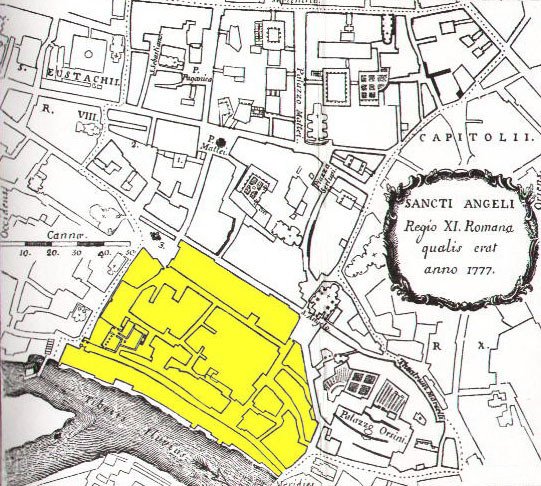
Ghetto Ebraico di Roma — Jewish Ghetto of Rome
The Jewish Ghetto of Rome is one of the oldest continuous Jewish residential districts in the world, established by papal decree in 1555 under Pope Paul IV and dissolved only after Italian unification in 1870. Located in the Rione Sant’Angelo alongside the Theatre of Marcellus and the Portico d’Ottavia, the ghetto preserves layers of Roman, medieval, Renaissance, and modern Jewish heritage within a compact area of the historic centre. Today the neighbourhood is a living community and cultural destination, anchored by the monumental Great Synagogue of Rome built in 1904.
At a glance
- Type
- Historic Jewish ghetto and urban heritage district
- Period
- Established 1555 by Pope Paul IV; enclosed until 1870; community present since antiquity
- Style
- Layered urban fabric: Roman, medieval, papal Baroque, 19th-century residential
- Location
- Rione Sant’Angelo, Rome, Italy — bounded by Via del Portico d’Ottavia, Lungotevere dei Cenci, Via del Progresso, and Via di Santa Maria del Pianto
- Coordinates
- 41.8931° N, 12.4765° E
Overview
The Roman Jewish community is one of the oldest in the world, with documented presence in Rome dating to at least the 2nd century BC. The area along the left bank of the Tiber, close to the ancient Theatre of Marcellus, became the neighbourhood into which Jews were confined by Pope Paul IV’s bull Cum nimis absurdum (1555). The ghetto was small — at its most crowded, several thousand people lived in just a few city blocks — and remained enclosed by walls and gates until they were demolished after 1870. Today the neighbourhood functions as both a living community and an important stop on Rome’s cultural heritage circuit, with the Great Synagogue as its most prominent landmark.
History
Rome’s Jewish population had been present and largely tolerated through much of the medieval period, but Pope Paul IV’s 1555 decree imposed severe restrictions, enclosing Jews behind walls, requiring distinctive dress, and forbidding property ownership and most professions. The ghetto was briefly opened during Napoleon’s occupation (1808–1815) and the Roman Republics of 1798–99 and 1849, before being definitively abolished when Italian troops entered Rome in 1870 and the city became the capital of a unified Italy. During the Second World War, the neighbourhood suffered grievously: on 16 October 1943, the SS conducted a roundup of over 1,000 Roman Jews, the vast majority of whom were deported to Auschwitz and killed. A memorial plaque at the corner of Via del Portico d’Ottavia commemorates the victims.
What you see
The Great Synagogue of Rome (Tempio Maggiore, 1904) dominates the district with its distinctive square aluminium dome and Assyro-Babylonian interior; the building also houses the Jewish Museum of Rome (Museo Ebraico di Roma), which displays Torah scrolls, ceremonial objects, and documents tracing two millennia of Jewish life in the city. The nearby Portico d’Ottavia, a monumental Roman gate commissioned by Emperor Augustus in 27 BC, forms a dramatic backdrop to the neighbourhood and is itself partly incorporated into the mediaeval church of Sant’Angelo in Pescheria. The streets of the ghetto retain their characteristic narrow pattern, with restaurant terraces spilling onto Via del Portico d’Ottavia and Via della Reginella.
Cultural significance
The Ghetto of Rome represents the longest continuous Jewish urban presence in Western Europe, a living thread connecting the ancient Roman Republic to the present day. It is also a site of memory for the Shoah in Italy: the October 1943 deportation remains a defining trauma, commemorated annually and documented in the Jewish Museum. The neighbourhood illustrates with particular clarity how urban heritage carries both the beauty of layered history and the weight of collective suffering — making it one of the most ethically complex and culturally rich heritage sites in Italy.
Practical information
- Address
- Via del Portico d’Ottavia, 00186 Rome — central ghetto street
- Jewish Museum of Rome
- Lungotevere Cenci (inside the Great Synagogue complex) — open Sunday to Friday; closed Saturdays and Jewish holidays; check museoebraicoroma.it for current hours
- Great Synagogue
- Visits via the Jewish Museum ticket; guided tours available
Getting there
The ghetto is walkable from Largo di Torre Argentina (10 minutes) and the Colosseum/Roman Forum (20 minutes on foot). By metro, take Line B to Circo Massimo and walk north along the Tiber (15 minutes), or Line A to Spagna and walk south-east (25 minutes). Buses 23, 280, and 780 stop on Lungotevere dei Cenci. The area is best explored on foot; the narrow streets and river embankment offer an atmospheric setting in the early morning before tourist crowds arrive.
Sources & resources
- Ghetto of Rome — Wikipedia
- Jewish Museum of Rome — Official Website
- Cultural Heritage Online — culturalheritageonline.com
Find it on the map
See this place and what’s around it →Historical events at this place (2)
📷 Diventa un fotografo di Cultural Heritage Online
Condividi le tue foto dei luoghi: restano pubblicate con la tua firma come autore. Più vengono viste, più ti fai conoscere — e presto un concorso premierà le foto più apprezzate.
Accedi o registrati gratis per aggiungere una foto