
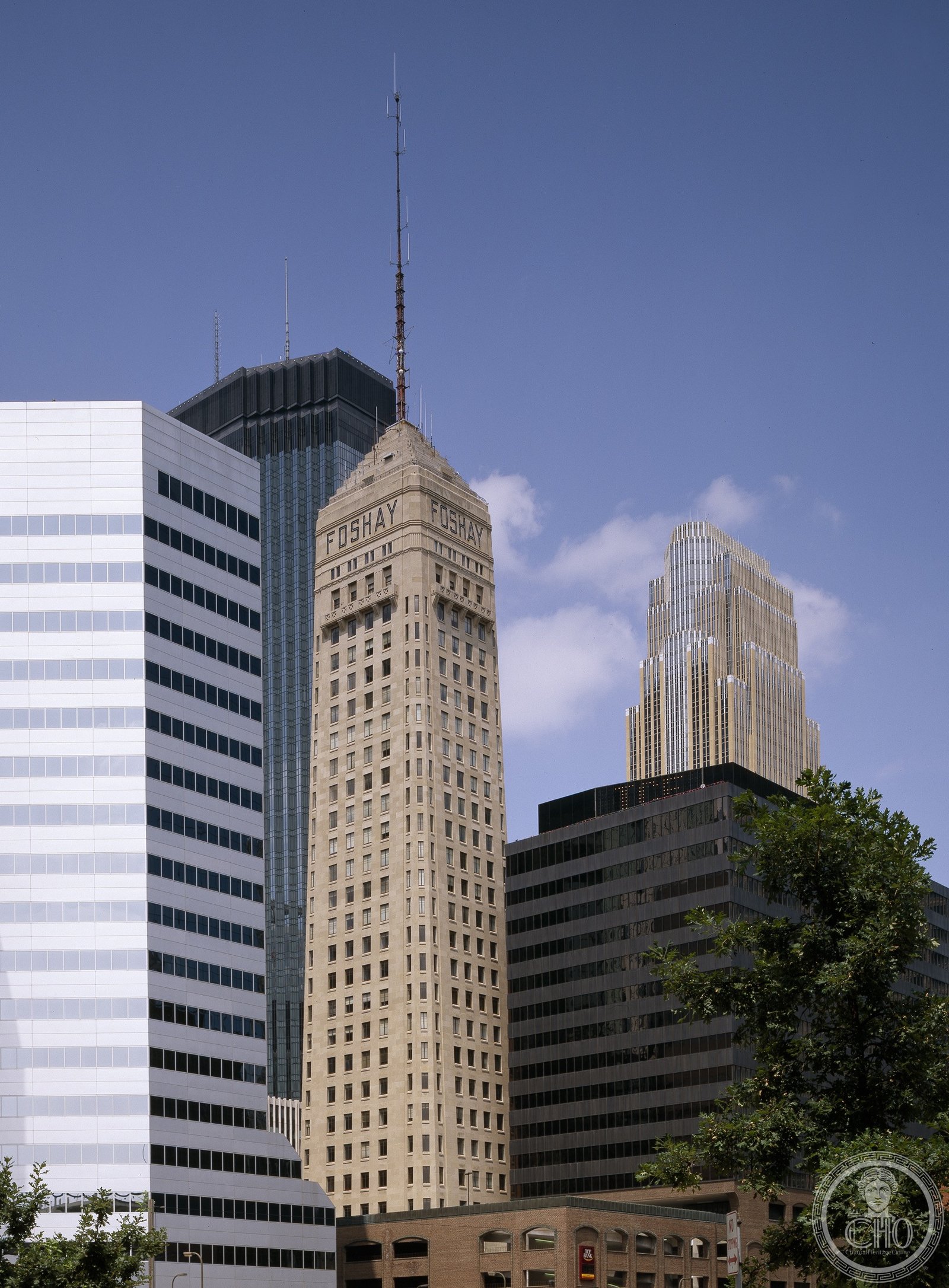
A 32-story Art Deco obelisk built to echo the Washington Monument — and to immortalize the man who commissioned it. Wilbur Foshay’s celebrated 1929 opening came just months before the stock market crash that unraveled his fraudulent securities empire.
At a glance
Rising 447 feet above Marquette Avenue, the Foshay Tower was Minneapolis’s first skyscraper and remained the tallest building in the city for four decades. Its unmistakable silhouette — a stepped Art Deco shaft crowned by a tapered obelisk — was deliberately modeled after the Washington Monument in Washington, D.C. The tower opened in August 1929 to a three-day celebration that included John Philip Sousa conducting his specially commissioned “Foshay Tower — Washington Memorial March.” Within months of the stock market crash, federal investigators began unraveling the fraudulent securities that had funded the tower.
Key facts
- Address: 821 Marquette Avenue South, Minneapolis, MN 55402
- Height: 447 ft (136 m), 32 stories
- Completed: 1929
- Architects: Magney & Tusler (Léon Arnal, associated architect)
- Style: Art Deco
- National Historic Landmark: December 8, 1978
- Current use: W Minneapolis — The Foshay Hotel (upper floors), offices and observation deck
History
Wilbur B. Foshay was a utilities magnate who controlled an empire of water and power companies across the American West and Midwest. By the late 1920s he had accumulated enough capital — much of it through fraudulent securities — to erect a monument to himself on the Minneapolis skyline. He chose the obelisk of the Washington Monument as his model and hired the Minneapolis firm of Magney & Tusler to execute the design in Art Deco terracotta and limestone. The tower was formally dedicated in August 1929. Sousa, flown in for the occasion and reportedly paid $20,000, conducted the march that bore the tower’s name.
The celebration lasted three days. Following the stock market crash in October 1929, his utilities empire unraveled and Foshay was subsequently arrested and convicted of using the mails to defraud investors. He served more than three years in Leavenworth Federal Penitentiary before receiving a pardon from President Harry S. Truman in 1947. His tower, meanwhile, passed to creditors and cycled through various commercial tenants over the following decades.
The tower was designated a National Historic Landmark in 1978. After sitting largely vacant in the early 2000s, it was converted into the W Minneapolis hotel, which opened in 2008. An observation deck on the 30th floor was restored and reopened to the public, offering panoramic views of downtown Minneapolis and the surrounding prairie cityscape.
What you see
The tower’s most striking feature is its profile. Rather than the setback wedding-cake silhouette typical of Art Deco skyscrapers built under New York’s 1916 zoning law, the Foshay rises as a single tapering mass — a direct quotation of the obelisk form, squared off and sheathed in cream-colored terracotta with horizontal banding. The name “FOSHAY” is spelled out in large letters near the top of each face, a touch of personal branding so bold it has survived every ownership change.
At street level, the lobby retains much of its original character: marble floors, bronze fittings, and carved ornamental details consistent with the high-water mark of American Art Deco commercial decoration. The transition from the broad base to the tapered crown happens through a series of setbacks in the upper third of the building, giving the tower an elegance that belies the grandiosity of its conception.
Practical information
- Observation deck: 30th floor; open to the public (fee applies); check W Minneapolis hotel for current hours
- Hotel access: The lobby and ground-floor bar are accessible without a room reservation
- Best time: Clear days offer views to the Minnesota River and, on exceptional days, west to the Twin Cities suburbs
- Photography: Best exterior shots from Marquette Avenue looking south-west at dusk
Getting there
The Foshay Tower is in the heart of downtown Minneapolis, one block from Nicollet Mall. The Blue and Green light-rail lines stop at Nicollet Mall Station (two-minute walk). By car, the nearest parking structures are on Marquette Avenue and 8th Street. Minneapolis–Saint Paul International Airport (MSP) is about 11 miles south via Interstate 35W or light rail.
Nearby
- Minneapolis City Hall — Romanesque Revival landmark two blocks north on 3rd Avenue South
- IDS Center (1972) — Philip Johnson’s glassy tower that superseded the Foshay as the city’s tallest
- Hennepin Avenue — historic theatre corridor four blocks north-west, with surviving 1920s–30s cinema facades
Sources
- Wikipedia, “Foshay Tower” — architecture, NHL designation, Foshay biography
- National Park Service, NHL nomination form (1978) — significance statement
- Minneapolis Star Tribune historical archive — 1929 dedication coverage
- W Minneapolis — The Foshay hotel website — current public access details
Find it on the map
See this place and what’s around it →📷 Become a Cultural Heritage Online photographer
Share your photos of places: they stay published under your name as the author. The more they're seen, the more you get noticed — and soon a contest will reward the most appreciated photos.
Log in or sign up free to add a photoDo you manage this place?
This page is read by travellers and heritage enthusiasts who find it on Google. Keep it accurate — and make it work for you. Free for non-profit heritage institutions.