
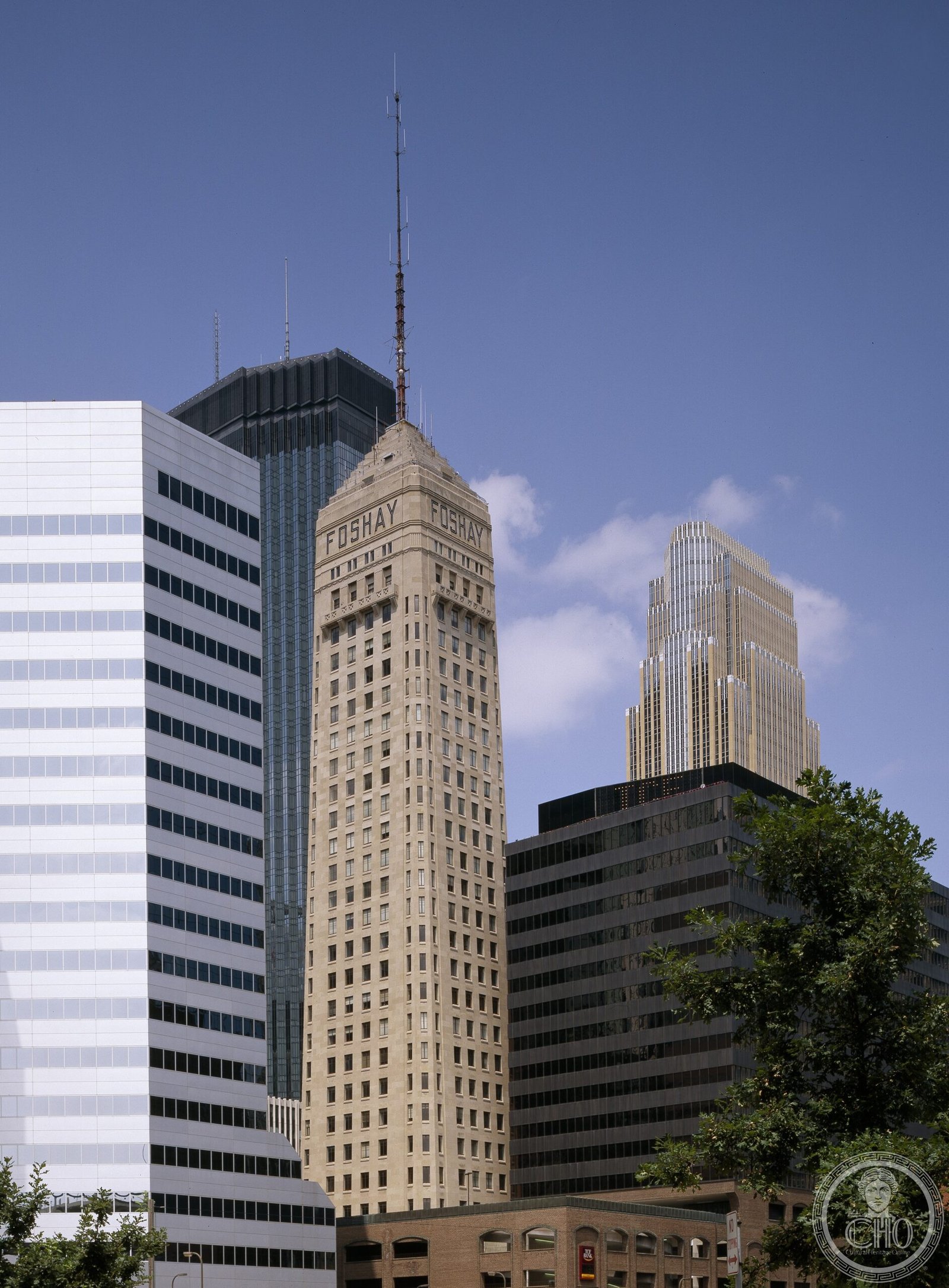
Wilbur Foshay raised 32 stories of Indiana limestone above Marquette Avenue in 1929 — shaped like the Washington Monument and dedicated with John Philip Sousa — then lost his entire empire to a federal mail fraud conviction within months of the opening.
At a glance
The Foshay Tower stands 447 feet (136 metres) at 32 stories, and was Minneapolis’s tallest building from 1929 until the IDS Center surpassed it in 1972. Utilities magnate Wilbur B. Foshay commissioned the tower from architects Magney & Tusler, explicitly modelling the tapered obelisk profile on the Washington Monument. The building opened August 30, 1929, with a three-day celebration attended by approximately 25,000 guests; John Philip Sousa composed the “Foshay Tower Washington Memorial March” for the occasion — a fee Foshay reportedly never paid. Listed on the National Register of Historic Places in 1978, the tower now operates as the W Minneapolis – The Foshay hotel.
Key facts
- Address: 821 Marquette Avenue South, Minneapolis, Minnesota 55402
- Completed: 1929 (dedicated August 30, 1929)
- Height: 447 feet (136 m), 32 stories
- Architects: Magney & Tusler
- Style: Art Deco (obelisk profile based on Washington Monument)
- Status: National Register of Historic Places (1978); W Minneapolis – The Foshay hotel
- Distinction: Tallest building in Minneapolis 1929–1972
History
Wilbur B. Foshay built a utilities empire in the 1920s that extended across several states, and at the height of his fortune conceived this tower as both his business headquarters and personal monument to himself and to George Washington. The dedication in August 1929 was one of the most elaborate building openings in American history: bands played, distinguished guests arrived from Washington and New York, and Foshay distributed souvenir gold-plated miniature replicas of the tower to dignitaries.
Two months after the opening, the stock market crashed. By 1932, Foshay’s empire had collapsed and he was convicted of mail fraud and sentenced to fifteen years at Leavenworth federal penitentiary. He was pardoned by President Roosevelt in 1937. The building passed through various hands and sat nearly empty for years; a renovation in the 1980s stabilized its future. Starwood Hotels acquired the property in the 2000s and converted it to a W Hotel, carefully restoring the Art Deco lobby, bronze fixtures, and original letter signage on the crown.
Sousa’s march, reportedly written under contract but never paid for, became part of the Foshay Tower’s legend — a fitting postscript to the story of a man who spent money he did not have on monuments to ambitions he could not sustain.
What you see
The exterior presents a monochrome limestone shaft rising in subtle setbacks, ornamented with restrained Art Deco detail — geometric cornices, stylized capitals, and the large rooftop letters spelling “FOSHAY” in a sans-serif typeface still visible across much of the downtown skyline. The obelisk profile gives the tower a distinctly un-skyscraper quality at street level, where the building’s base is relatively compact for its height.
The lobby features original Art Deco bronze metalwork, marble wainscoting, coffered ceilings, and the original terrazzo floors — all preserved through the W Hotel renovation. An observation deck on the 30th floor offers views over the Minneapolis grid, the Mississippi River valley to the east, and on clear days, the lakes that stud the southern reaches of the city.
Practical information
- Observation deck accessible through W Hotel lobby (fee applies; current hours at the hotel)
- Hotel lobby open during standard hours
- Restaurant and bar on premises preserve significant original Deco detailing
- Best exterior photography from Nicollet Mall (one block west) or from the IDS Center skyway
- The tower sits within easy walking distance of the downtown skyway system
Getting there
The Foshay Tower is in downtown Minneapolis’s central business district, on Marquette Avenue between 8th and 9th Streets South. The Nicollet Mall Metro Transit stops along Nicollet Mall (one block west) serve multiple routes. Minneapolis–Saint Paul International Airport (MSP) is approximately 12 miles south; the Metro Blue Line light rail connects MSP to downtown in roughly 25 minutes, stopping at Nicollet Mall Station a block from the tower.
Nearby
- IDS Center (1972) — the 57-story Philip Johnson tower that replaced the Foshay as Minneapolis’s tallest, with its celebrated Crystal Court atrium and skyway connections, at 80 South 8th Street, two blocks north.
- Nicollet Mall — the pedestrianized shopping and transit corridor one block west, lined with architecture spanning a century of Minneapolis commercial building.
- Minneapolis Central Library (2006) — César Pelli’s glass-and-granite civic building four blocks east, offering an architectural counterpoint in contemporary civic design.
Sources
- National Register of Historic Places: Foshay Tower nomination, 1978
- Millett, Larry. AIA Guide to the Twin Cities. Minnesota Historical Society Press, 2007
- Kane, Patricia E. Art Deco in Minneapolis. Minneapolis Institute of Art, 1983
- Wikimedia Commons: Foshay Tower Highsmith.jpg (Public domain, Carol M. Highsmith / Library of Congress)
Find it on the map
See this place and what’s around it →📷 Become a Cultural Heritage Online photographer
Share your photos of places: they stay published under your name as the author. The more they're seen, the more you get noticed — and soon a contest will reward the most appreciated photos.
Log in or sign up free to add a photoDo you manage this place?
This page is read by travellers and heritage enthusiasts who find it on Google. Keep it accurate — and make it work for you. Free for non-profit heritage institutions.