
Former Ford Factory — Memories at Old Ford Factory
Memories at Old Ford Factory is Singapore’s national WWII museum housed in the former Ford Motor Company assembly plant on Upper Bukit Timah Road, built in 1941 as the first car factory in Southeast Asia. The building became the site of the largest British capitulation in history on 15 February 1942, when Lieutenant-General Arthur Percival surrendered Singapore to General Tomoyuki Yamashita in the factory boardroom. Managed by the National Archives of Singapore, the museum preserves the surrender room as a memorial space and mounts extensive archival exhibitions on the Japanese Occupation of 1942–1945.
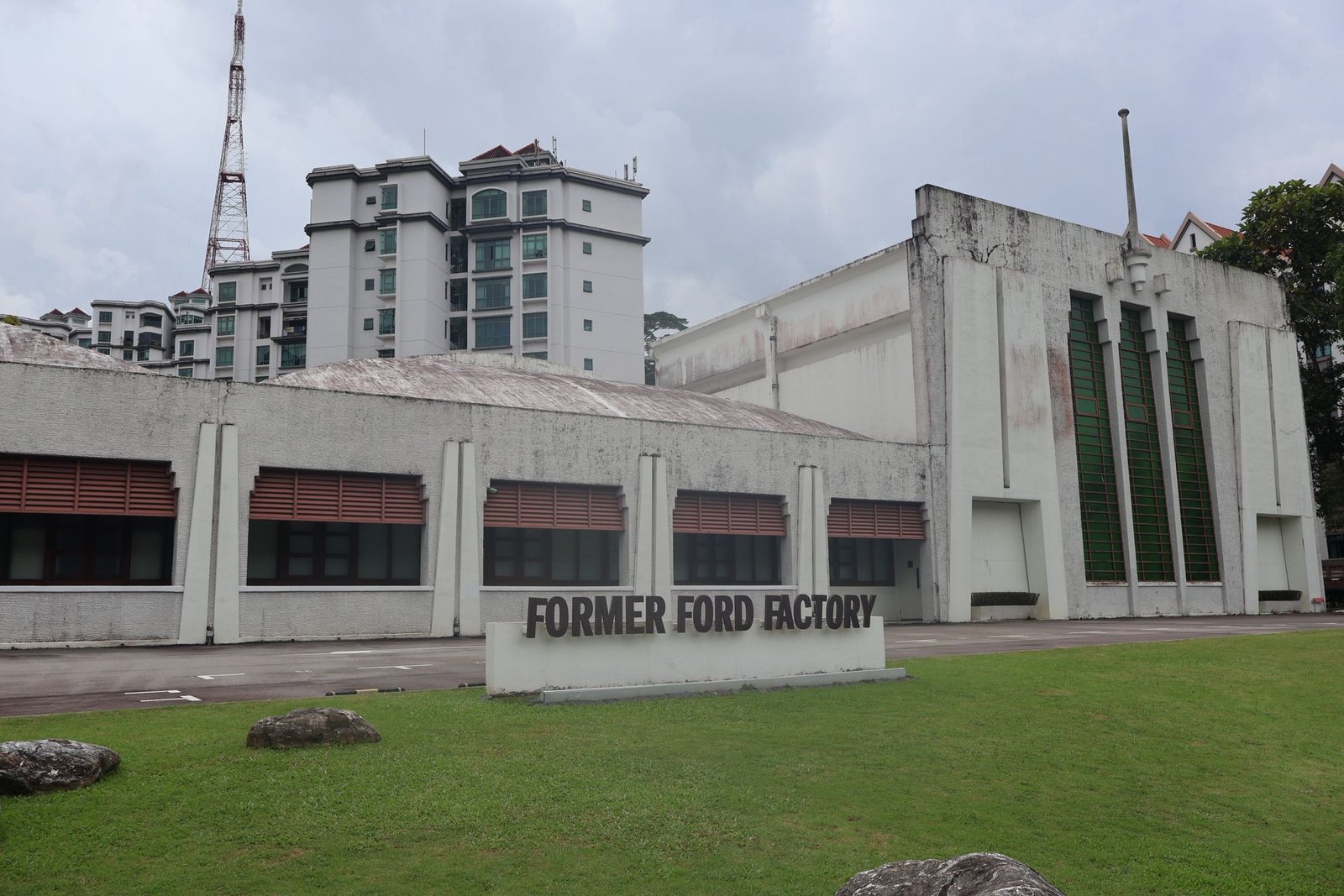
At a glance
- Type
- National WWII memorial museum and archival exhibition space
- Period
- Factory built 1941; site of British surrender 15 February 1942; converted to museum 2006
- Style
- Art Déco industrial architecture; two-storey reinforced concrete with distinctive tower
- Status
- National Monument of Singapore
- Location
- 351 Upper Bukit Timah Road, Singapore 588192 · 1.3526° N, 103.7689° E
Key facts
The Old Ford Factory is one of Singapore’s most historically charged sites, combining industrial heritage with the pivotal moment that ended British colonial rule on the island. The Art Déco building — with its distinctive tower, steel-frame windows and two-storey reinforced-concrete frame — was constructed by Ford Motor Company and opened just months before the Japanese invasion began. The museum, formally titled “Memories at Old Ford Factory” and operated by the National Archives of Singapore (NAS), tells the story of the Occupation through declassified documents, personal testimonies, photographs, and artefacts donated by survivors and their families. A permanent gallery recreates conditions of daily life under occupation and documents the Sook Ching massacres and forced labour on the Death Railway.
History
Ford Motor Company chose Singapore for its first Southeast Asian assembly plant in 1941, completing the factory just as war clouds gathered. Within months of its opening, Japanese forces swept down the Malay Peninsula, and on 15 February 1942 General Percival met General Yamashita in the factory’s board room to sign the instrument of surrender — a moment that shocked the British Empire and irrevocably altered Singapore’s colonial identity. During the three-and-a-half years of Japanese administration the factory continued operating, now producing military vehicles. After liberation in 1945 Ford briefly resumed production; the factory subsequently housed various industrial tenants before the National Archives of Singapore acquired and converted it into a heritage museum, which opened in 2006. The building was gazetted as a National Monument in 2006 under the Preservation of Monuments Act.
What you see
The centrepiece is the preserved surrender room — the original boardroom table and chairs where the 1942 capitulation was signed — displayed with contemporary photographs and a scale model of the scene. Surrounding galleries present a chronological narrative of the Malayan Campaign, the Battle of Singapore, and the years of Occupation, drawing heavily on the National Archives’ collections of official documents, diaries, and filmed testimony. The factory’s industrial fabric — steel-frame windows, exposed concrete, and the period tower — has been conserved, giving the building an authenticity that purpose-built museums cannot replicate.
Practical information
- Address
- 351 Upper Bukit Timah Road, Singapore 588192
- Phone
- +65 6462 6724
- Hours
- Check National Archives of Singapore website for current opening hours
- Admission
- Paid entry; concessions available; check official website for current pricing
- Coordinates
- 1.3526° N, 103.7689° E
Getting there
By MRT, take the Downtown Line to Hillview station (DT3) and walk approximately 10 minutes along Upper Bukit Timah Road. Bus services 67, 75, 170, 173, 184 and 961 stop near the museum. By car, the museum is on Upper Bukit Timah Road; limited parking is available on site.
Sources
Find it on the map
See this place and what’s around it →📷 Diventa un fotografo di Cultural Heritage Online
Condividi le tue foto dei luoghi: restano pubblicate con la tua firma come autore. Più vengono viste, più ti fai conoscere — e presto un concorso premierà le foto più apprezzate.
Accedi o registrati gratis per aggiungere una foto