
Forlì
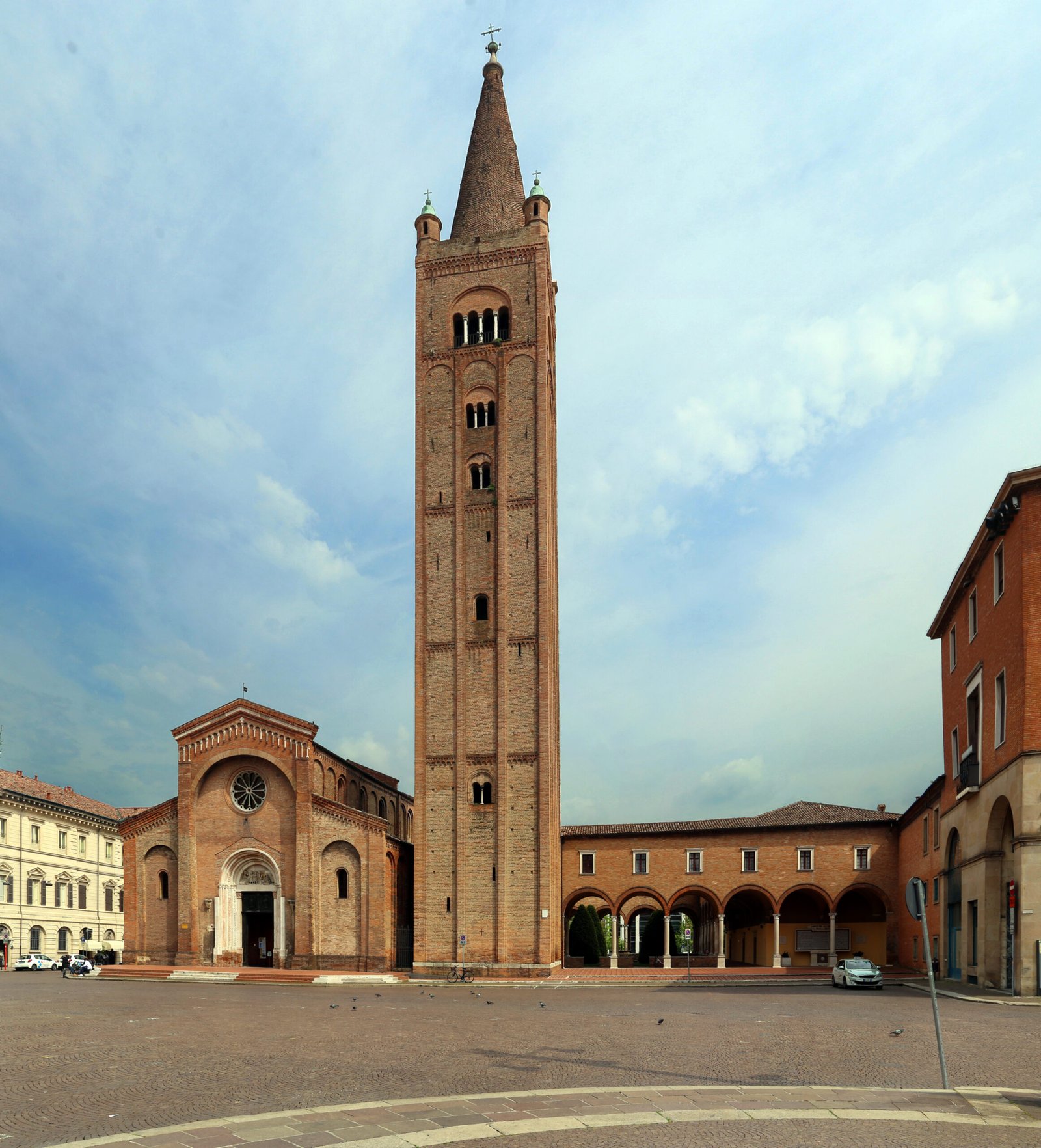
Two ages of building meet in Forlì. A medieval brick bell tower marks one end of the city; at the other, a wide stripped avenue of the 1930s runs dead straight toward a war memorial.
At a glance
Forlì sits on the Via Aemilia in eastern Emilia-Romagna, the chief town of the Forlì-Cesena province and home to about 116,000 people. Its centre keeps two clear layers. The older one gathers around Piazza Aurelio Saffi and the Abbey of San Mercuriale, finished in 1180. The newer one, built under the Fascist regime in the 1920s and 1930s, gave the city one of Italy’s densest concentrations of Rationalist architecture — a planned avenue, public buildings and monuments laid out as a national showcase. You come to read both at once: Romanesque brick and stripped 20th-century geometry within a short walk of each other.
Key facts
- Region: Emilia-Romagna · Province: Forlì-Cesena
- Roman origin: the Roman Forum Livii, traditionally dated to around 188 BC, on the Via Aemilia
- Signature monument: the bell tower of San Mercuriale, 75 m of brick, completed 1180
- 20th-century layer: a major ensemble of 1920s–1930s Rationalist architecture, much of it along Viale della Libertà
- Tied to: Caterina Sforza, lady of Forlì in the late 15th century; the regime nicknamed it the “città del Duce” for its nearness to Mussolini’s birthplace at Predappio
History
The city began as the Roman Forum Livii, a settlement on the Via Aemilia that some historians trace to around 188 BC and the consul Gaius Livius Salinator. The medieval comune that grew on the site fell, like much of Romagna, to a succession of signorial families. Its most remembered ruler is Caterina Sforza, lady of Forlì in the late 15th century, whose defence of the city against invasion turned her into one of the period’s legendary figures.
Forlì’s second defining chapter came in the 20th century. Predappio, Benito Mussolini’s birthplace, lies just south, and during the regime Forlì was developed as a deliberate showcase of Fascist-era planning and architecture. From 1926 the city laid out a broad new axis, Viale della Libertà, linking a rebuilt railway station to the centre.
Building continued through the 1930s. The avenue, the public offices and the monumental district that rose along it left Forlì with a concentration of Rationalist work unusual for a town of its size, and that 20th-century inheritance now sits beside the Romanesque core as a documented part of the city’s fabric.
What you see
- Abbey of San Mercuriale — completed in 1180 in Lombard-Romanesque style, its brick campanile rising 75 m, among the tallest in Italy; the rose window over the main portal, showing the Adoration of the Magi, is attributed to the so-called Master of the Months.
- Piazza Aurelio Saffi — the wide central square at the heart of the old town, named for the 19th-century politician whose statue stands on it, with San Mercuriale on one flank.
- Viale della Libertà — designed in 1926 and inaugurated in 1927, a straight avenue roughly 40 m wide, exceptional for a city of Forlì’s size, running from the station to the centre and lined with 1930s buildings.
- Former Aeronautical College — a monumental Rationalist complex from 1937, attributed to the architect Cesare Valle, built along the avenue and now used by the university.
- Palazzo delle Poste — the main post office of 1932–1935, attributed to the architect Cesare Bazzani, one of the city’s set-piece works of the period.
Practical information
- Time needed: half a day for the centre and the avenue; longer to take in the museums.
- Getting around: the historic core around Piazza Saffi is compact and walkable, and the 20th-century avenue runs in a single straight line toward the station.
- When to go: spring and autumn are most comfortable; the Po-valley summer is humid.
Getting there
Forlì sits on the Bologna–Rimini railway line; trains from Bologna take roughly 40 minutes. The Viale della Libertà leads straight from the station to the centre, so the simplest first walk in the city also reads its 20th-century plan. Bologna airport (BLQ) is about an hour away by road or rail.
Nearby
- Predappio, Mussolini’s birthplace and itself a planned town of the period, lies a short way south.
- Ravenna and its early-Christian mosaics are roughly an hour to the east; Cesena and its Renaissance Malatestiana library are close to the south-east.
Sources
- Wikipedia, Forlì; Abbey of San Mercuriale; Viale della Libertà (Forlì).
- Wikimedia Commons, file Forlì, san mercuriale, esterno 02,0.jpg.
Find it on the map
See this place and what’s around it →Historical events at this place (3)
📷 Diventa un fotografo di Cultural Heritage Online
Condividi le tue foto dei luoghi: restano pubblicate con la tua firma come autore. Più vengono viste, più ti fai conoscere — e presto un concorso premierà le foto più apprezzate.
Accedi o registrati gratis per aggiungere una foto