
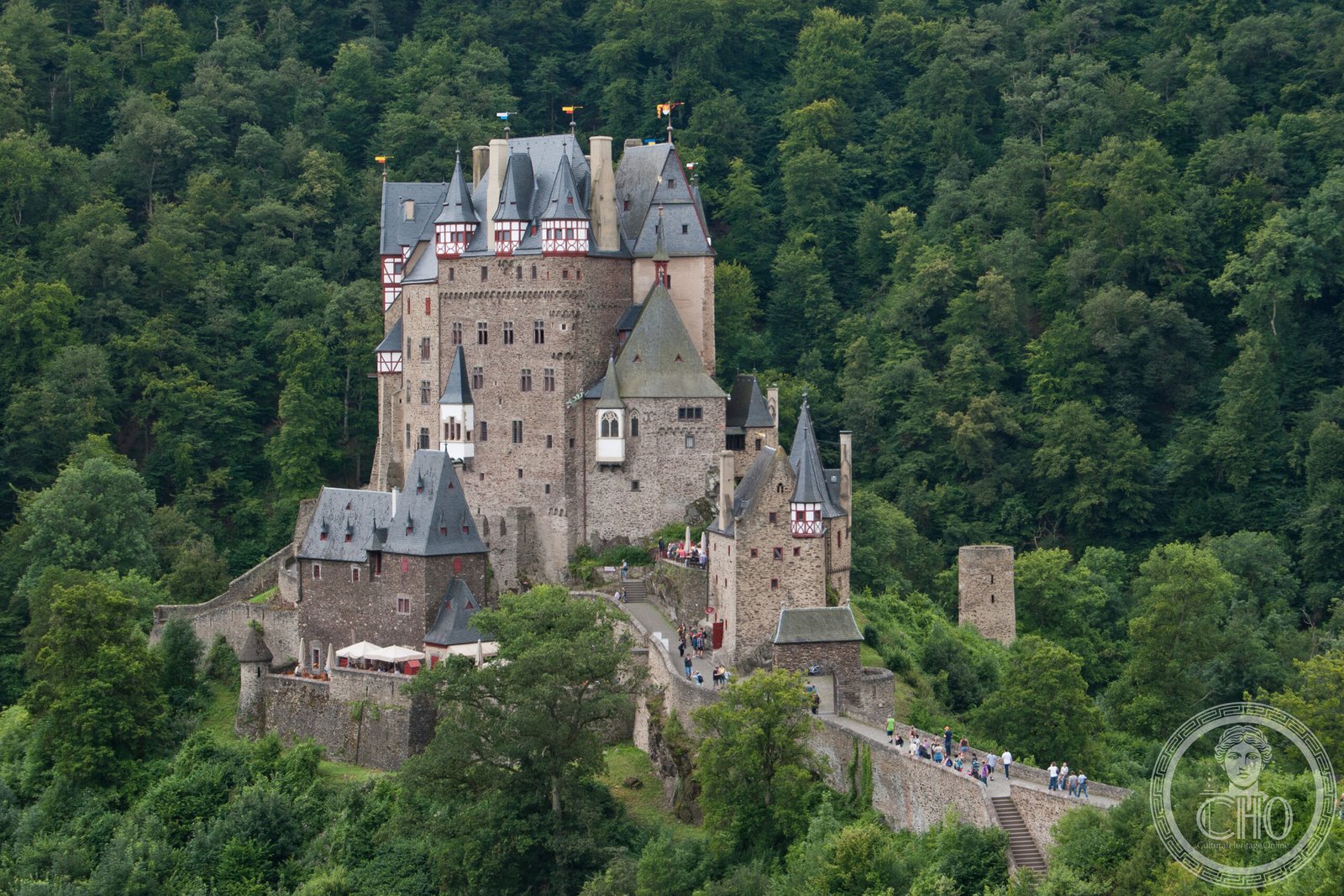
Eltz Castle
Eltz Castle is a medieval fortress perched on a rocky promontory above the Eltz stream in the Eifel hills of Rhineland-Palatinate, Germany, about 25 km northeast of Trier. Owned continuously by the Eltz family since the 12th century — never captured or destroyed in warfare — the castle survives as a rare example of an inhabited, multi-towered Ganerbenburg, a type of jointly-held family castle. Its eight residential towers, timber-framed upper stories, and remarkably intact interiors with original furnishings from the 15th and 16th centuries make it one of Germany’s most photogenic and historically authentic medieval monuments.
At a glance
- Type
- Ganerbenburg (joint-family) castle
- Period
- First documented 1157; major building campaigns 12th–15th century
- Style
- Romanesque through Late-Gothic; timber-framed upper towers
- Location
- Burg Eltz, 56294 Wierschem, Rhineland-Palatinate, Germany
- Coordinates
- 50.2052° N, 7.3344° E
Overview
Eltz Castle has been in the possession of the Eltz family for over 850 years, passing through more than 33 generations without ever being seized by a hostile force. The castle complex rises eight stories in places, with multiple towers huddled together on the narrow rock, giving it a distinctly vertical, almost organic silhouette against the surrounding forest. Today it is one of the most visited castles in Germany and is managed by a foundation of the Eltz family as a privately-owned heritage site open to the public.
History
The castle is first mentioned in documents dated to 1157, when Rudolf I of Eltz appears as a vassal of the Archbishop of Trier. By the 13th century three branches of the Eltz family — Eltz-Kempenich, Rübenach, and Rodendorf — held the castle jointly as a Ganerbenburg, each branch maintaining its own residential tower and household. The castle successfully resisted a siege by the Archbishop of Trier in the Eltz Feud of 1331–1337, after which it was documented in a detailed enumeration that survives as a primary source. Unlike many Rhineland castles, Eltz was never slighted and escaped the destruction of the Thirty Years War and the French revolutionary campaigns.
What you see
Guided tours take visitors through the Rübenach and Rodendorf residential apartments, which retain much of their original 15th and 16th-century furnishing: carved beds, tapestries, faience stoves, and painted wooden ceilings. The treasury room houses a collection of medieval silver and gold artefacts, weapons, and armour assembled by the family over the centuries. The exterior presents a compact mass of eight towers — the tallest rising about 35 metres — with half-timbered galleries and oriels projecting over the river gorge.
Cultural significance
Eltz Castle appeared on the reverse of the 500-Deutsche-Mark banknote between 1965 and 1992, cementing its status as an emblem of German medieval heritage. Its unbroken private ownership and extraordinary state of preservation have made it a reference point for castle restoration standards and a model of heritage management combining family stewardship with public access.
Practical information
- Address
- Burg Eltz, 56294 Wierschem, Germany
- Opening hours
- Generally open April–October, 09:30–17:30; closed November–March. Check official website for exceptions and group bookings.
- Admission
- Fee applies; guided tours included in admission price
Getting there
The castle is accessible on foot (approximately 1.5 km forest walk) from the car parks at Münstermaifeld or Hatzenport, or from the Mosel valley via a shuttle bus in high season. The nearest train station is Moselkern on the Koblenz–Trier line (Moselstrecke), from which a marked trail leads uphill to the castle in about 45 minutes. Koblenz is approximately 30 km north, Trier about 60 km south.
Sources & resources
Find it on the map
See this place and what’s around it →📷 Diventa un fotografo di Cultural Heritage Online
Condividi le tue foto dei luoghi: restano pubblicate con la tua firma come autore. Più vengono viste, più ti fai conoscere — e presto un concorso premierà le foto più apprezzate.
Accedi o registrati gratis per aggiungere una foto