
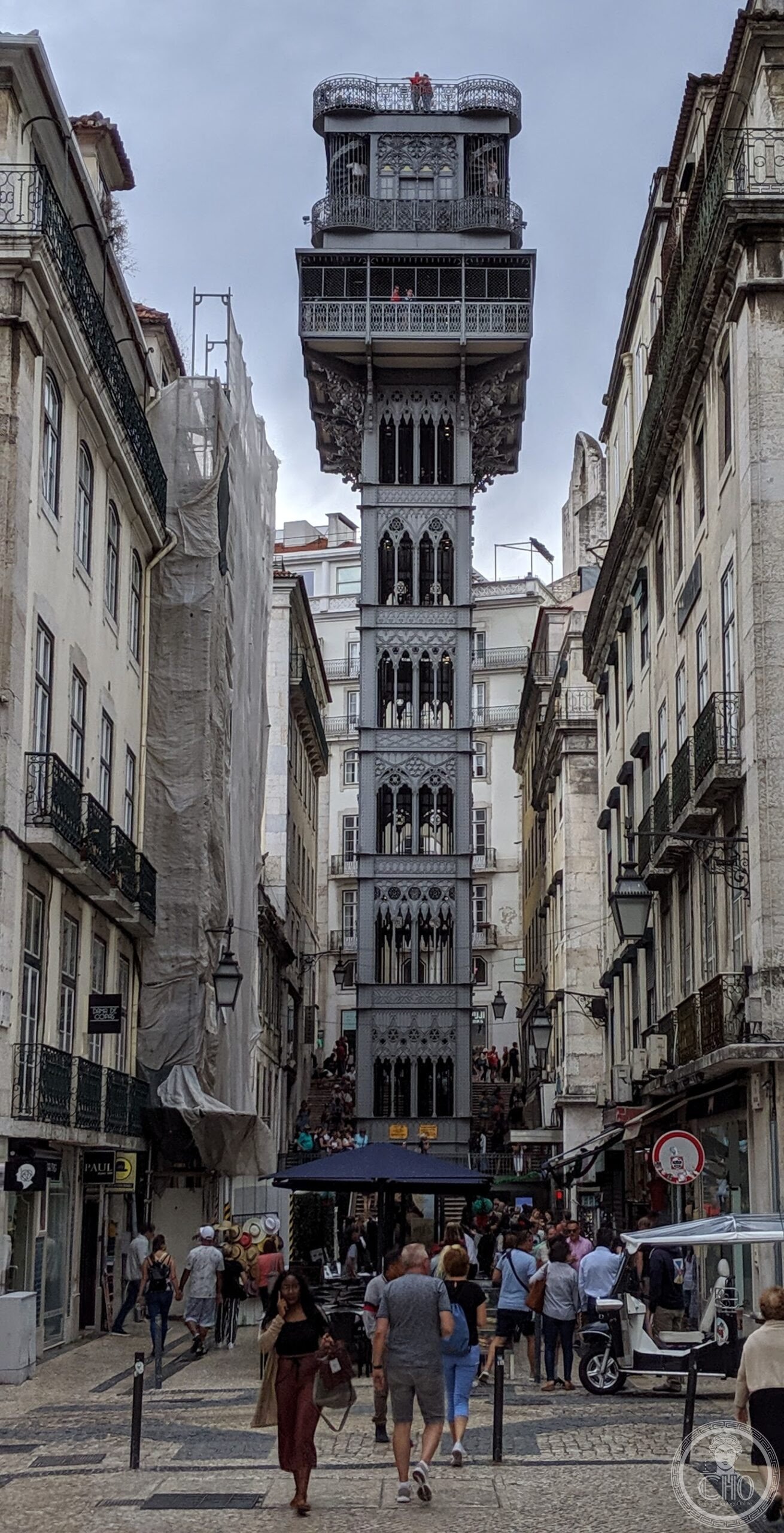
Elevador de Santa Justa
The Elevador de Santa Justa is a wrought-iron vertical lift in central Lisbon, built in 1902 by engineer Raul Mesnier de Ponsard to connect the lower Baixa district with the higher Chiado neighbourhood. One of only three remaining lifts in Lisbon and the only one that is entirely vertical rather than funicular, it has become one of the most recognisable landmarks of the Portuguese capital and a symbol of the city’s ingenious 19th-century solutions to its dramatic topography.
At a glance
- Type
- Vertical iron elevator / public transport landmark
- Period
- Constructed 1900–1902; inaugurated 10 July 1902
- Style
- Neo-Gothic wrought iron; often attributed (incorrectly) to Gustave Eiffel
- Location
- Rua de Santa Justa / Rua do Ouro, Baixa, Lisbon · 38.7121° N, 9.1416° W
Overview
The Elevador de Santa Justa rises 45 metres through the heart of Lisbon’s flat commercial district, the Baixa, linking it via a covered walkway to the terrace of the ruined Carmo Convent above. Designed by Raul Mesnier de Ponsard, a Portuguese engineer of French descent, the elevator was the technological solution to a long-standing problem of urban connectivity between two dramatically different levels of the city. It remains in daily use as part of the Carris public transport network and carries both commuters and the many thousands of tourists who visit each year.
History
The project was first proposed in the 1880s as Lisbon developed its network of funicular tramways (elevadores) to manage the city’s steep hills. Raul Mesnier de Ponsard won the commission and designed the entirely vertical lift structure — unlike the city’s other elevators at Glória, Bica, and Lavra, which are inclined funiculars. The tower was built between 1900 and 1902 and inaugurated on 10 July 1902; it was originally steam-powered and converted to electric operation in 1907. The popular attribution to Gustave Eiffel is a persistent legend: Eiffel had no documented involvement in the project.
What you see
The tower is constructed of riveted wrought iron in an ornate Neo-Gothic style, with filigree ironwork, arched windows, and a decorated upper belvedere. Two wood-panelled cabins, each accommodating around 25 passengers, travel vertically inside the shaft. At the top, a walkway crosses above the street to the terrace of the ruined Carmo Convent, from which there are outstanding views over the Baixa grid, the Tagus, and the hills of Alfama and Mouraria. The tower top also houses a small café.
Cultural significance
The Elevador de Santa Justa is classified as a National Monument of Portugal and is one of Lisbon’s most photographed structures. It represents the extraordinary period of late-19th-century urban engineering that gave Lisbon its distinctive character of iron funiculars and elevated walkways threading through the hillside neighbourhoods. Along with the tram 28E, it has become an enduring emblem of Lisbon’s identity.
Practical information
Address: Rua de Santa Justa, 1150-060 Lisbon, Portugal.
Hours: Daily 07:30–21:00 (extended hours in summer). Check Carris website for current schedule.
Admission: A Carris travel ticket or single-journey fare is required; the rooftop belvedere has a separate access fee.
Getting there
The elevator is located in the Baixa, one of Lisbon’s most central and walkable districts. The nearest metro stations are Rossio and Baixa-Chiado on the Green Line, both within 300 metres. Numerous bus and tram routes serve the Baixa. From Rossio Square the elevator is a five-minute walk south along Rua do Ouro.
Sources & resources
Find it on the map
See this place and what’s around it →📷 Diventa un fotografo di Cultural Heritage Online
Condividi le tue foto dei luoghi: restano pubblicate con la tua firma come autore. Più vengono viste, più ti fai conoscere — e presto un concorso premierà le foto più apprezzate.
Accedi o registrati gratis per aggiungere una foto