
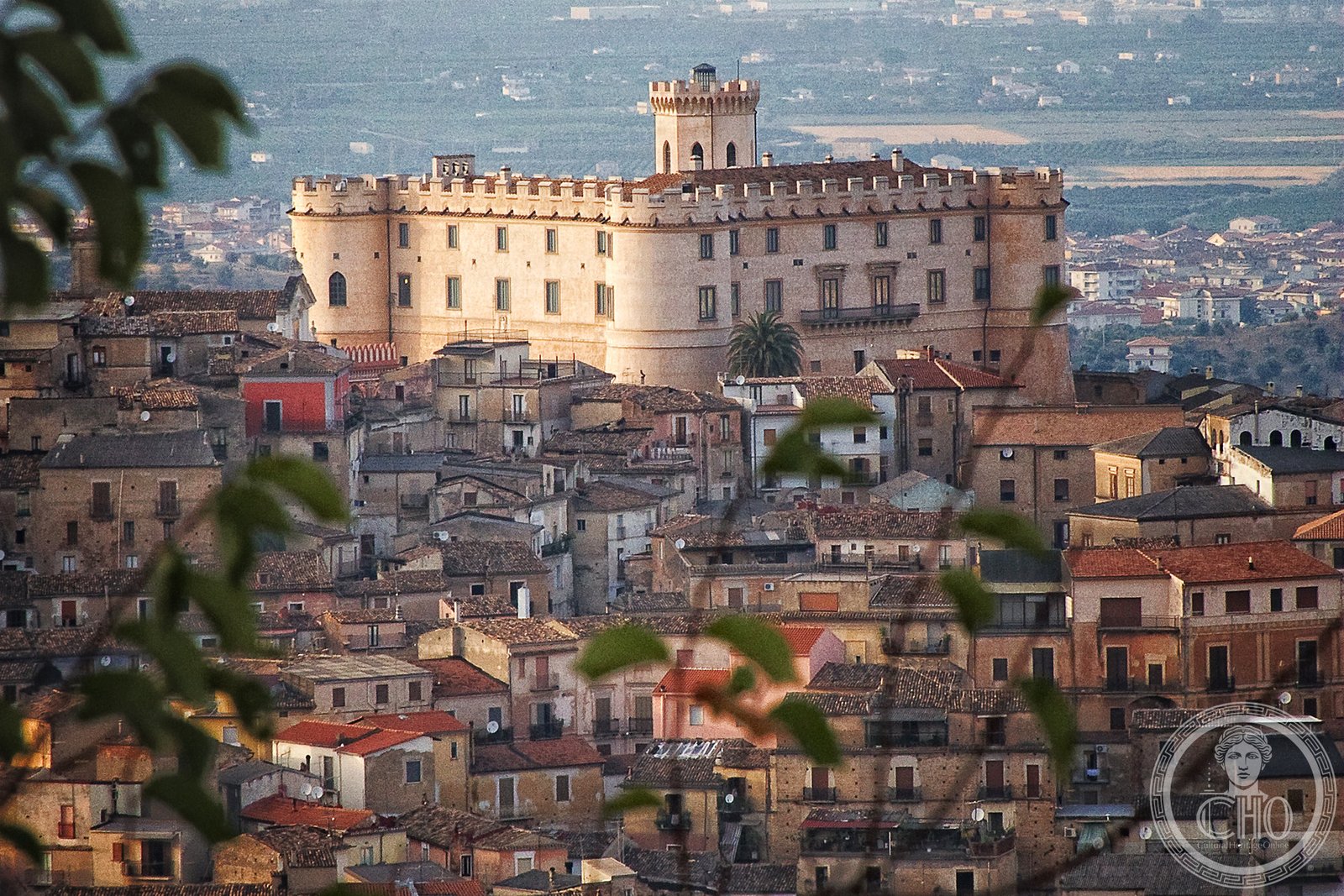
Castello Ducale di Corigliano
The Castello Ducale (Ducal Castle) of Corigliano is a monumental fortified complex dominating the historic centre of Corigliano-Rossano in the Calabrian plain along the Ionian coast of southern Italy. Founded in the Norman period and transformed into a ducal residence during the 15th and 16th centuries, it stands as one of the most imposing castles in Calabria, its massive cylindrical towers visible across the Piana di Sibari.
At a glance
- Type
- Medieval fortified castle / ducal residence
- Period
- Norman origins (11th–12th century); major rebuilding 15th–16th century
- Style
- Norman-Swabian military architecture; Aragonese Renaissance refinements
- Location
- Corigliano-Rossano, Cosenza Province, Calabria, Italy (39.5967° N, 16.5176° E)
Overview
Corigliano-Rossano, formed in 2018 by the merger of the ancient towns of Corigliano Calabro and Rossano, is the third-largest city in Calabria and a significant centre of Byzantine and Norman heritage. The Castello Ducale crowns a hill spur above the old town of Corigliano, commanding views over the orange and bergamot groves of the Piana di Sibari and the Ionian Sea. It served as the seat of the Duchy of Corigliano, one of the major feudal jurisdictions of the Kingdom of Naples, held successively by the Sanseverino, Saluzzo, and Compagna families.
History
A fortification is documented at Corigliano from the Norman conquest of Calabria in the 11th century, when Roger I established control over the Greek-speaking Byzantine communities of the Ionian coast. The castle was substantially rebuilt under the Swabian emperors and again under Aragonese rule in the late 15th century, when the addition of large cylindrical towers adapted its defences to artillery warfare. The Duchy of Corigliano was one of the wealthiest in the Regno, sustained by the fertile plain’s agricultural wealth — particularly the cultivation of liquorice root, still a Calabrian speciality. After the abolition of feudalism in 1806 under French Napoleonic rule, the castle passed through private ownership before being acquired by the municipality.
What you see
The castle presents four massive cylindrical towers at the corners of an irregular quadrangular plan, connected by high curtain walls with a pronounced batter at the base — a typical Aragonese artillery adaptation. The main facade retains a Renaissance portal with the arms of the Duchy of Corigliano. Inside, the ducal apartments preserve frescoed ceilings and decorative details of the 16th century, while the courtyard reveals the stratified construction history of the complex from Norman rubble masonry to Aragonese ashlar. The panoramic view from the castle walls over the Piana di Sibari, ancient Sybaris, and the Ionian horizon is among the most impressive in Calabria.
Cultural significance
The Castello Ducale is listed as a national monument (Monumento Nazionale) and represents the most significant surviving feudal architectural complex in the area of ancient Sybaris, the legendary Greek colony destroyed in 510 BCE whose plain the castle overlooks. It is a key reference point for understanding the Norman-Byzantine cultural synthesis that characterises Calabria’s heritage.
Practical information
- Address
- Piazza Castello, 87064 Corigliano-Rossano CS, Italy
- Hours
- Check the municipality of Corigliano-Rossano website for current visiting hours
- Admission
- Paid entry for guided tours; check local tourist office for current tariffs
Getting there
Corigliano-Rossano is served by the Corigliano-Rossano railway station on the Ionian coastal line (Taranto–Reggio Calabria); from the station, the old town and castle are a short taxi or bus ride uphill. By car from the A2 Autostrada del Mediterraneo, take the Sibari exit and follow the SS106 Ionica east for approximately 15 kilometres. The nearest airport is Lamezia Terme (SUF), approximately 120 kilometres south via the A2.
Sources & resources
Find it on the map
See this place and what’s around it →📷 Diventa un fotografo di Cultural Heritage Online
Condividi le tue foto dei luoghi: restano pubblicate con la tua firma come autore. Più vengono viste, più ti fai conoscere — e presto un concorso premierà le foto più apprezzate.
Accedi o registrati gratis per aggiungere una foto